Name/Title
In Memory of Old Emory University [Book]Description
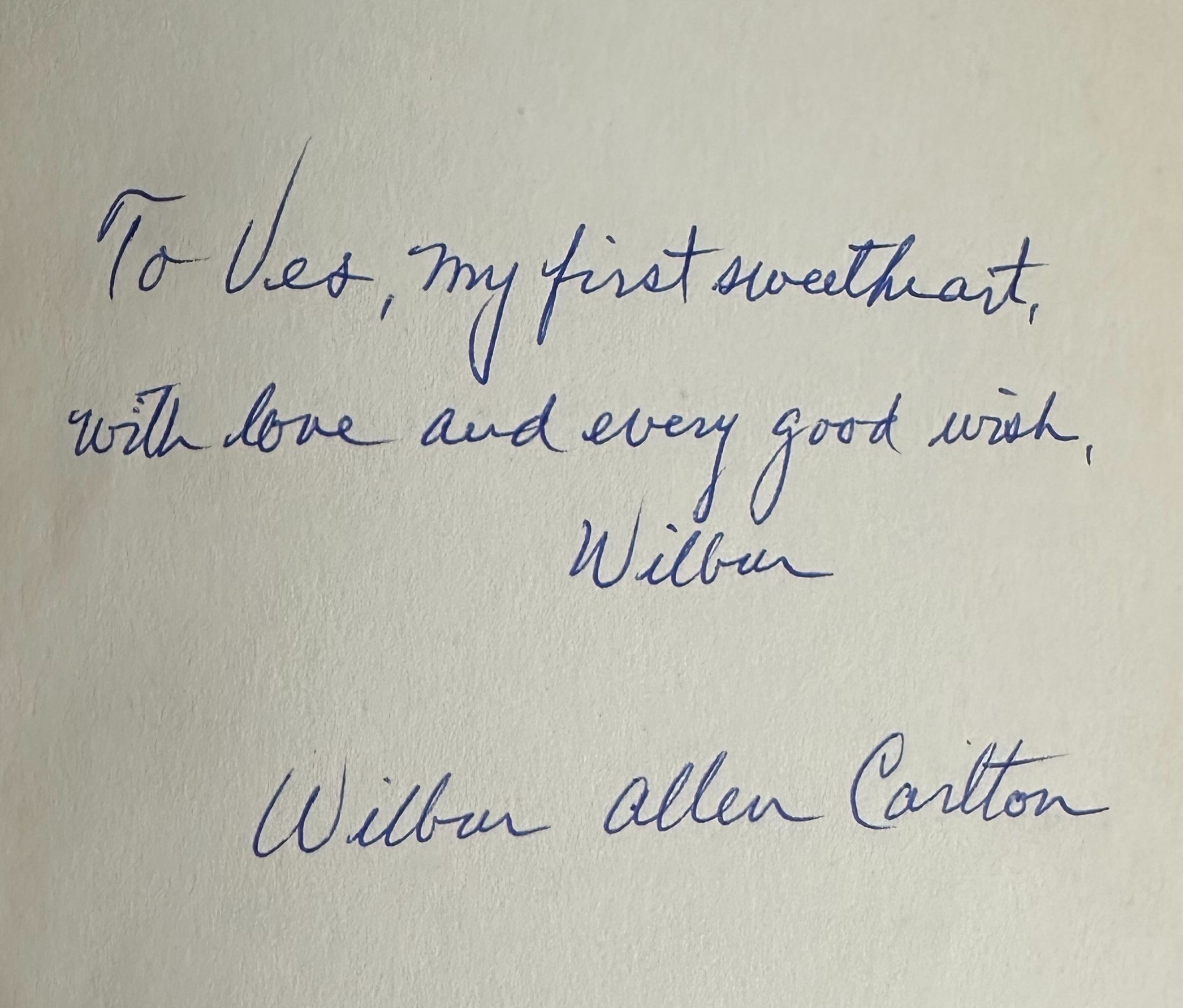
Inscribed by author:
“To Ves, my first sweetheart,
with love and every good wish,
Wilbur
Wilbur Allen Carlton".Context
"In Memory of Old Emory" is a revered memoir and historical account written by Wilbur Allen "Squire" Carlton. Published in 1962, it provides a detailed, nostalgic look at the origins of Emory College, the primitive days of its original Oxford, Georgia campus, and its eventual expansion into the major university it is today.
The book chronicles the transformation of early Emory, which was founded by Georgia Methodists in 1836 as a small school for farm boys and planters' sons. Carlton's accounts paint a vivid picture of a quiet Oxford, completely unpaved and lacking basic plumbing in its earliest days.
The original Emory College operated in Oxford until the early 20th century, when the Georgia Methodist Conference began deliberating its future. With the help of a $1 million donation from Coca-Cola founder Asa Griggs Candler, the university relocated to the Druid Hills neighborhood of Atlanta in 1919, while the Oxford campus was retained and later became Oxford College of Emory University.
Carlton was uniquely positioned to document this history. He was a member of the final graduating class of the original Emory College in Oxford in 1913 before the university opened in Atlanta. He then went on to earn the very first Master's degree awarded by Emory and later returned to teach Greek and Latin at Oxford College for 40 years.
Excerpt from page one:
“At that time, half-a century ago, Oxford was completely without pavement, plumbing in the homes, and electric lights except for the Williams Gymnasium and the Young J. Allen Memorial Church, which were furnished electricity by a dynamo in the boiler room of the gym. And of course, we obtained water from open wells for drinking as well as for all other purposes ... We had to do our studying by the light of a kerosene lamp. There were scarcely any automobiles and absolutely no co-eds at that particular time although there had been a few previously. There was only one college dormitory, Marvin Hall, which was "outmoded" even for 1910 and which could accommodate only a small part of the student body ... Most of the students lived in boarding houses (or private homes), of which there were several ... Such was our beloved Oxford in 1910."
—"Squire" describing his experiences at the school at the time.