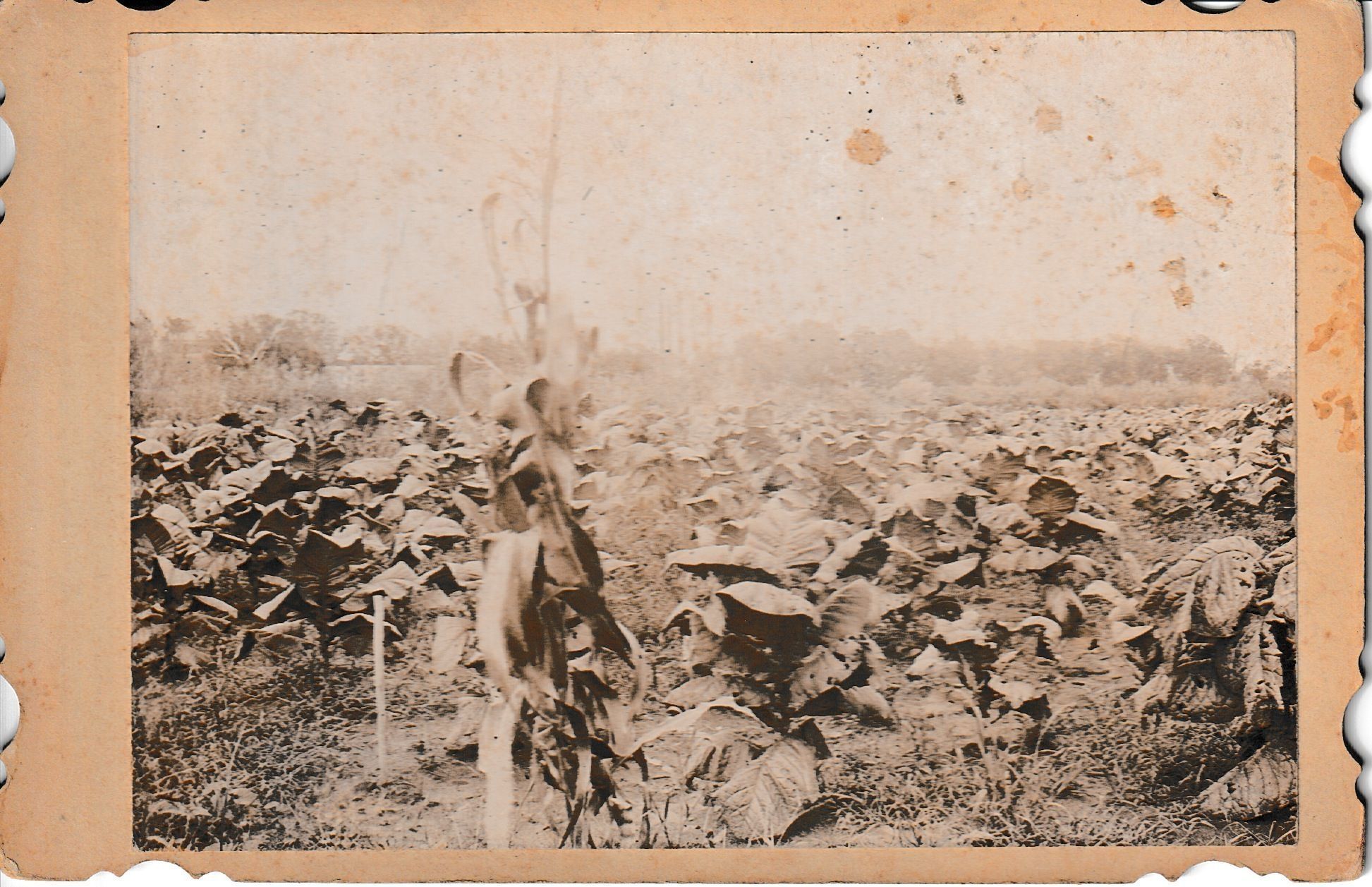
Victoria Tobacco Field [Cabinet Card]
Name/Title
Victoria Tobacco Field [Cabinet Card]Description
Cabinet card of an unidentified tobacco field. Imprint on back: "Petrini, SUPERIOR FINISH. Victoria, Texas." Handwritten on back, "Tobacco field with power house stacks showing in distance."Context
The consumption of tobacco, by means of cigarette and pipe smoking, was a universal custom among the Indians of Texas before the arrival of the Spaniards. The Indians gathered and cured the wild tobacco and also cultivated it in small patches. Early American settlers in Texas introduced several varieties of Kentucky and Tennessee tobaccos that were grown on farms and plantations for home consumption. In 1850 the state produced 66,897 pounds of tobacco. The industry prospered and spread to other counties in East Texas but eventually failed because of impractical methods of growing and handling. Some interest in tobacco culture was revived between 1900 and 1904, when the United States Department of Agriculture discovered that East Texas was capable of producing a high-grade cigar leaf that equaled the imported Cuban product. The department established a demonstration and experimental farm at Nacogdoches, and experimental plantings of tobacco were made throughout East Texas. A total of 425,000 acres in this region was found suitable for tobacco growing. The tobacco industry in East Texas declined rapidly after 1910, as rising cotton prices made cotton a more profitable crop than tobacco. By 1940 annual tobacco production for the state had fallen to 2,715 pounds, and in 1945 only three farms reported tobacco acreage. In 1948 three tobacco manufacturers were operating in Texas, but no acreage was reported.Category
Texas in Focus, Agriculture
Bayou Bend, Being Texas, Bullock Museum