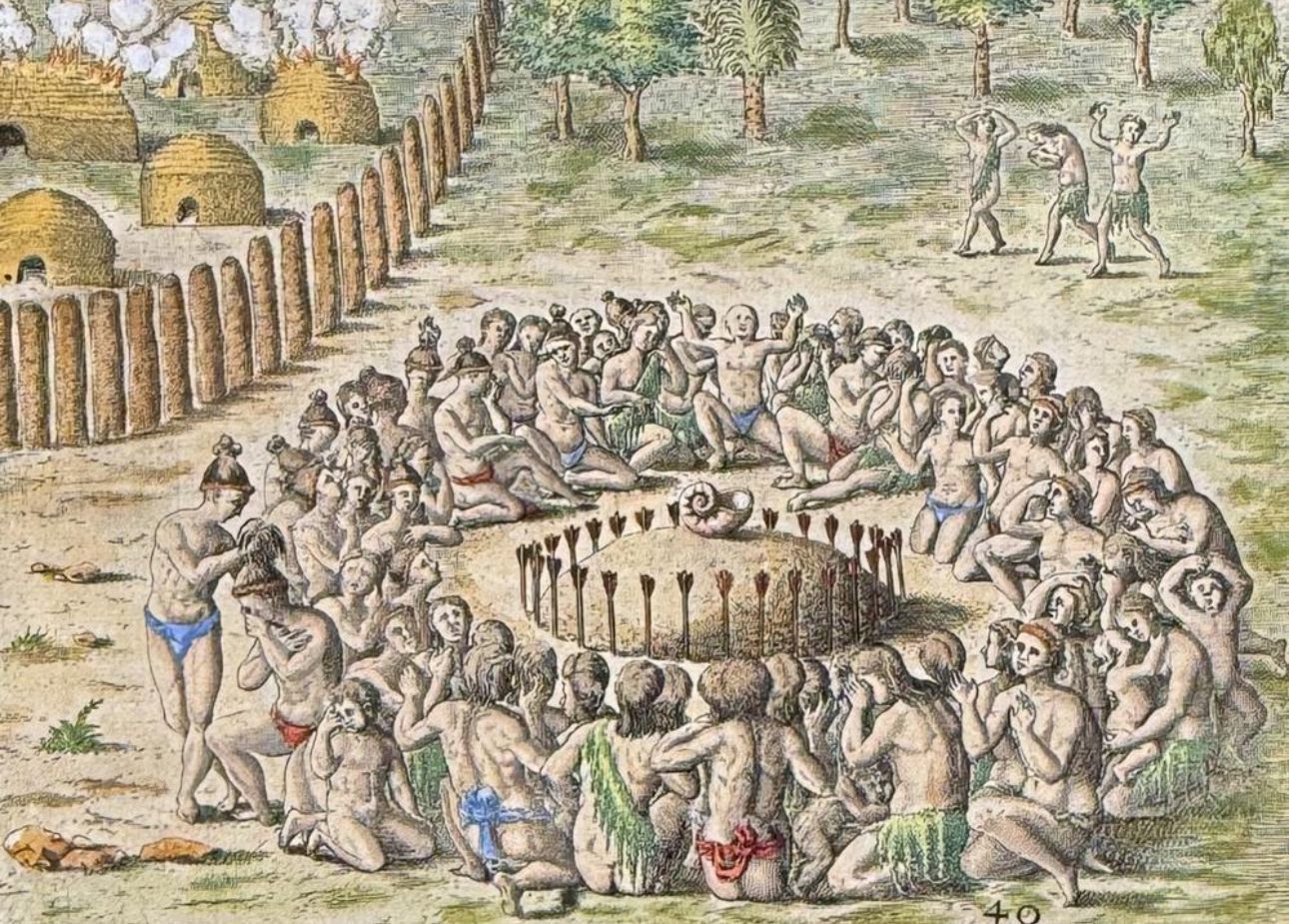
Ceremonies at the Death of a Chief or of Priests (Plate XL) [Engraving]
Name/Title
Ceremonies at the Death of a Chief or of Priests (Plate XL) [Engraving]Description
Plate XL. Ceremonies at the Death of a Chief or of Priests When a chief from that country dies, he is buried with great solemnity. The cup from which he used to drink is placed on his tomb which is surrounded by arrows stuck in the ground. His subjects mourn him for three days and three nights without eating or drinking. All his friends do the same, and in testimony of the affection they held for the deceased, both men and women cut off more than half their hair. During the next six moons, women specially chosen for the task lament the death of their king at dawn, midday and twilight with great howls. All the king's personal property is carried to his house where it is burnt. They do the same thing for priests.Context
This significant, historic engraving is from Theodor de Bry & Jacques Le Moyne's Brevis Narratio eorum quae in florida Americae provi[n]cia Gallis acciderunt ... quae est seconda pars Americae. It is the second part or volume of Grands Voyages which is considered one of the most remarkable collections of voyages published in the Age of Discovery. The work was published in Frankfurt by Theodor de Bry. The work began publishing in 1590 with this volume printed 1609. This is from one of the most important volumes published on early North America. It included Jacques Le Moyne de Morgues's illustrations of Native Americans. The work described the earliest French settlements that would become the United States. The illustrations were after watercolors drawn first hand in the New World by Le Moyne on the mid-1560s expedition led by Jean Ribault and René Goulaine de Laudonnière. His illustrations of the Florida Indians are some of the most important visual records of American Indians and their culture before the 19th century. In 1591 Dutch engraver and goldsmith Theodor de Bry published Grand Voyages, which contained the earliest known European images of Native Americans in what is now Florida. For Grand Voyages and later publications de Bry relied on accounts by men like John White, a member of the failed Virginia colony at Roanoke; Hans Staden, who endured nine months of captivity among the Tupinambá Indians of Brazil; and Jacques Le Moyne de Morgues, a member of the short-lived French colony in Florida, Fort Caroline. This collection features 42 plates from the first German-language edition of Grand Voyages, published in 1591. De Bry obtained Le Moyne’s original sketches shortly after his death in 1588. Le Moyne served as the artist for René de Laudonnière’s expedition to Florida in 1564. In September 1565, Spanish soldiers led by Pedro Menéndez de Avilés laid waste to the French colonists in an event known as the Fort Caroline Massacre. Le Moyne survived the attack and sought refuge in England. De Bry’s renditions of Le Moyne’s sketches are both historically significant and highly controversial. Scholars point out that certain aspects of the engravings do not match later depictions of the Timucua Indians encountered by the French in northeastern Florida, and also contend that de Bry certainly altered the images prior to publication. Artistic license is evident in several of the images included here. For example, in the scene depicting Timucua warfare against the Potanou [Plate XIII], mountains are visible in what is supposed to be northeastern Florida. Other images also contain items not found in Florida, such as the Pacific nautilus rather than the Florida whelk shell as a Timucuan ceremonial object [Plates XIX and XL]. In other instances, more reliable clues about Timucuan culture emerge. For example, in Plate XVIII, “The Chief Applied to by Women Whose Husbands Have Died in the War or by Disease,” the Timucua chief is adorned with numerous tattoos. Because Europeans were largely unfamiliar with tattooing for decorative purposes, it is unlikely that either Le Moyne or de Bry fabricated Timucuan body art. Later ethnographic information confirms that tattooing was common among the southeastern Indians. Regardless of authenticity, the images created by Le Moyne and published by de Bry constitute the earliest known visual representations of Florida and its indigenous people. Although the illustrations provide only a small window into the lives of the Timucua, they reveal a wealth of information about European aspirations to colonize Florida. Indeed, we learn more about Europeans than Native Americans from de Bry’s engravings. Engravings such as Plate XIV, “Order of March Observed by Outina on a Military Expedition,” were meant to promote colonization. This image conveyed the notion that the Timucua obeyed authority, were organized and fit for war, and could perhaps aid the Protestant French against their Catholic enemies vying for control of the Americas. The images depict the Timucua as less sophisticated than Europeans, both in terms of dress and weaponry, and therefore they were seen as potential candidates for accepting French religion and civilization.Category
16th Century Settlements
History of Florida