Label
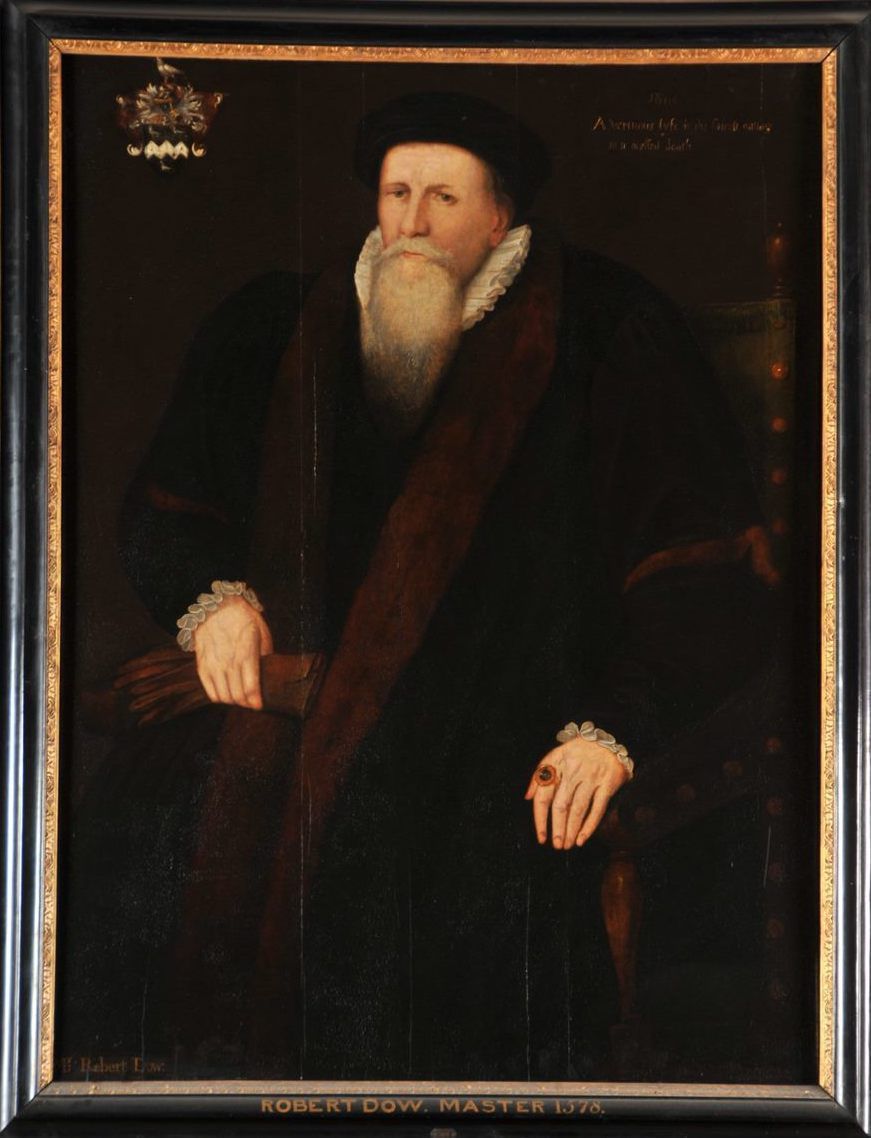
Robert Dowe was born in 1523. He was a practicing tailor, a notably committed member of the Company Court, and became Master of the Merchant Taylors' in 1578. In his later life, he generously donated large sums to the Company to support the Company almshouse, and the City’s elderly and poor. He also supported the penniless historian John Stow, Merchant Taylor, in his final years.
He left money for an annual dinner in his memory, Dowe’s Convivium, which still continues today. Members of the Company and their wives were invited to attend, as Dowe stated 'the more the merrier'! He attended the first one himself in 1611 at the age of 88. Robert Dowe died in 1612, and was buried in St. Botolph Aldgate, where the Company erected a monument to him in 1622.
Here, Dowe is posed in three quarters view looking directly at the viewer - typical of Elizabethan portraiture. He wears the clothes of a wealthy English gentleman, with a fur trimmed robe, a modest ruff and a black felted hat. On his left index finger, he wears a ring embossed with a skull. This was a typical symbol, often worn by the wealthy middle-class of the period to show humility and awareness of their own mortality despite their wealth.
New research has proven that Dowe’s portrait was painted by John de Critz (d.1642). The Company accounts of 1606-7 record a total of £10 paid to “John Decreete” for making three portraits; Sir Thomas White, “Mr Dow his picture in a faier frame”, and the (now lost) portrait of Prince Henry, eldest son of James I. John de Critz was the King's painter from 1603, serving both James I and Charles I. It would have been the height of sophistication to be painted by de Critz.
Find Out More...
John de Critz grew up between Antwerp and Augsburg, before his parents settled in England in 1552 after fleeing the persecution of Dutch Protestants. He was apprenticed to painter Lucas de Heere (a native of Antwerp) for four years in the parish of St Benet Fink, while his parents kept their family home in Cripplegate. De Critz’s career took off in the 1580s, when he was given the patronage of Sir Francis Walsingham to act as his courier on the Continent. De Crtiz’s reputation rose through the 1590s, as he became one of the most fashionable portraitists amongst London’s merchants and gentry, until 1603 when he caught the eye of the King. From this moment his future was sealed, and he spent his remaining years in the King’s employ.