Label
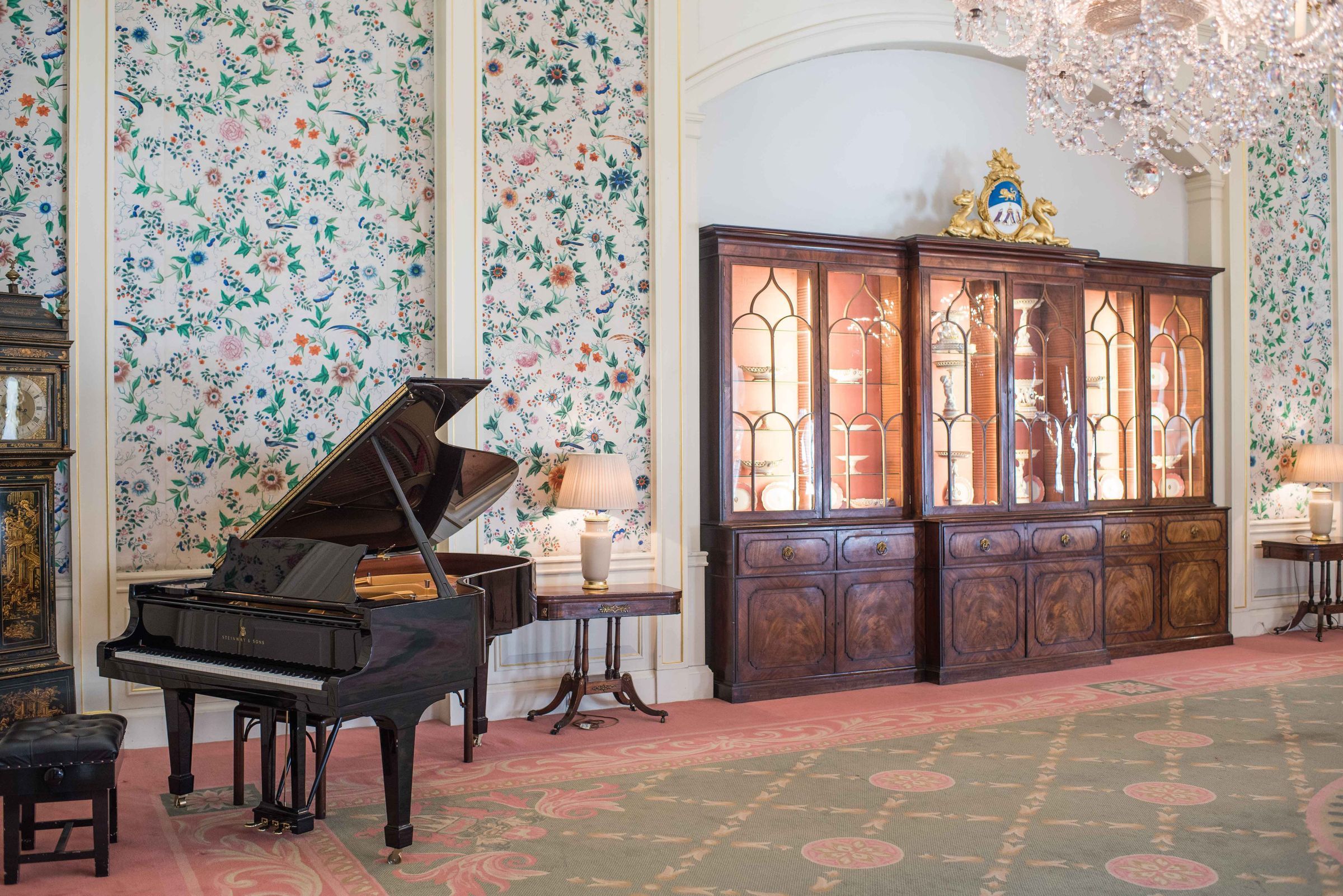
The large mahogany bookcase in the Drawing Room was bought by the Company at Sotheby’s on 13th April 1956, as part of the campaign to refurnish the Hall after war damage. The former Drawing Room had been completely burnt out, with its contents, by an incendiary bomb.
Sotheby’s described the bookcase as “a fine large Regency secretaire bookcase in mahogany, the upper part enclosed by three pairs of doors with Gothic pattern tracery, and glazed with Crown glass [an early type of hand-blown window glass], the centre portion with a well-fitted writing drawer enclosed by a fall-front”.
The enormous size of the bookcase leads us to believe it must surely have come from a stately home. An inventory of the Hall contents, now in the Muniment Room, says that it was supposed to have come in 1920 from “Ickenham Hall, Bury St Edmunds”. “Ickenham” most likely refers to Ickworth, the former seat of the Hervey family outside Bury St Edmunds, now owned by the National Trust.
The present Ickworth Hall was built by the absurdly wealthy Frederick Hervey, 4th Earl of Bristol. He was known as “the Earl-Bishop” because he was also Bishop of Derry in Ulster. He has been described as “lively, odd and half-mad, a bishop who did not go to church, and rarely visited his Irish see.” The Earl-Bishop spent much of his time travelling in Germany and Italy, indulging his passion for art-collecting. His huge new house at Ickworth was intended to display his art collection, but the collection was sadly seized by Napoleon when the French entered Rome in 1798. When the Earl-Bishop died in 1803, his coffin was shipped back to Ickworth labelled as containing an antique statue, so as not to upset the crew.
The Company arms we see in the bookcase were added at a later date, after the bookcase had been installed in the Drawing Room. Prior to its life here at the Hall, this bookcase likely once furnished the “half-mad” Earl-Bishop’s home, standing alongside his fine collection of art and antiquities.
Find Out More…
The Herveys were promoted to be Marquesses of Bristol in 1826. Later heads of the family include Victor, the 6th Marquess (d.1985), jailed for three years for his part in a jewellery robbery; and John, the 7th Marquess (d.1999), who squandered his fortune on cars, parties, misguided business ventures, alcohol and drugs, and died aged 44. The Herveys were not all bad. Their sale of the bookcase in 1920 would fit well with the careful restoration of the house by Frederick William, the 4th Marquess, a Rear-Admiral and amateur tree surgeon. AC Blomfield was commissioned to alter and improve many parts of the house, including the state rooms.