Label
Stephen Jenyns’ commitment to education is one of the earliest examples of the Company’s involvement with our foundational pillar of education. In 1508, Jenyns bought land at Wolverhampton, and on 22nd September 1512, the Company obtained a licence to establish Wolverhampton Grammar School using the proceeds of that land. In 1513, Jenyns gained a licence to give his land at Rushocke Manor – worth £15 a year – to the Company, so they were able to pay masters at the newly founded school. The remainder of the funds were used to build accommodation for the School Master and Usher, built on what is thought to have been the site of Jenyns’s family home on St. John’s Street, Wolverhampton.
Jenyns ran the administration of the school himself until his death in 1523, after which his son-in-law, Merchant Taylor John Nicholls, took over. On Nicholls’ own death in 1531, the school was placed under complete control of the Merchant Taylors’ Company, and it remained under the company's jurisdiction until 1784.
The Merchant Taylors’ Company built a gallery St. Peter’s church in Wolverhampton in 1611. This gallery was for use by the boys at Wolverhampton Grammar School, when they attended the local church for services. The balcony bears the arms of the Company and of Sir Stephen Jenyns.
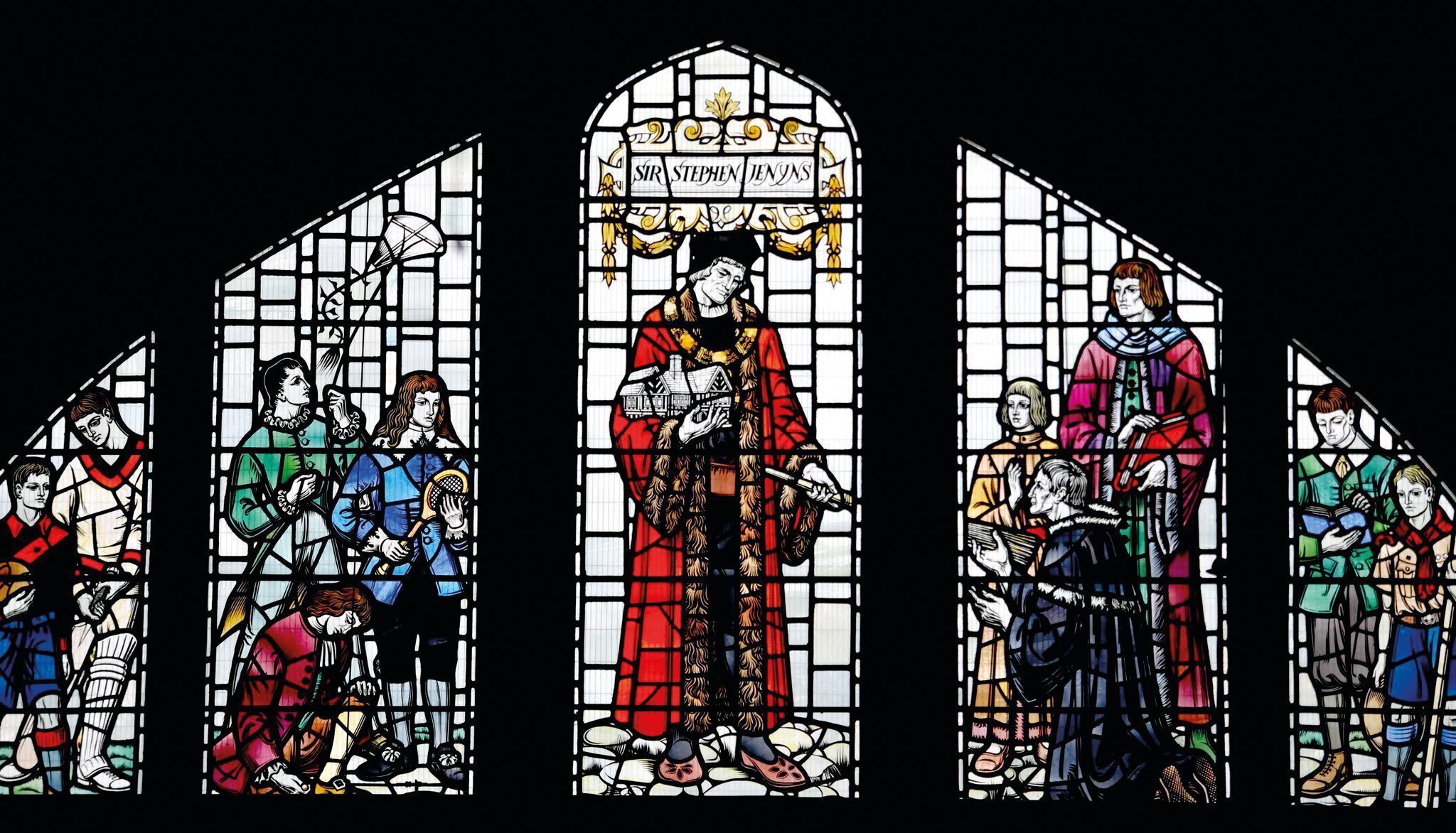
This stained glass window was installed at Wolverhampton Grammar School in 1945-6. In the centre, we see Jenyns holding a miniature of his school, as he passes what look to be the sheaf of school deeds to the first Headmaster on his left. On his left and right are schools masters and students who were recipients of his benefaction of the school.
Recent research by Dr. Chris O’Brien suggests that this design was likely put to the school Governors in 1943-4. A design for a section of glazing at the school survives, and matches a portion of extant window. This design was signed by James Powell & Son of the Whitefriars glaziers firm, and it is possible that Whitefriars’ completed the full 1940s glazing project at Wolverhampton, including this window.