Label
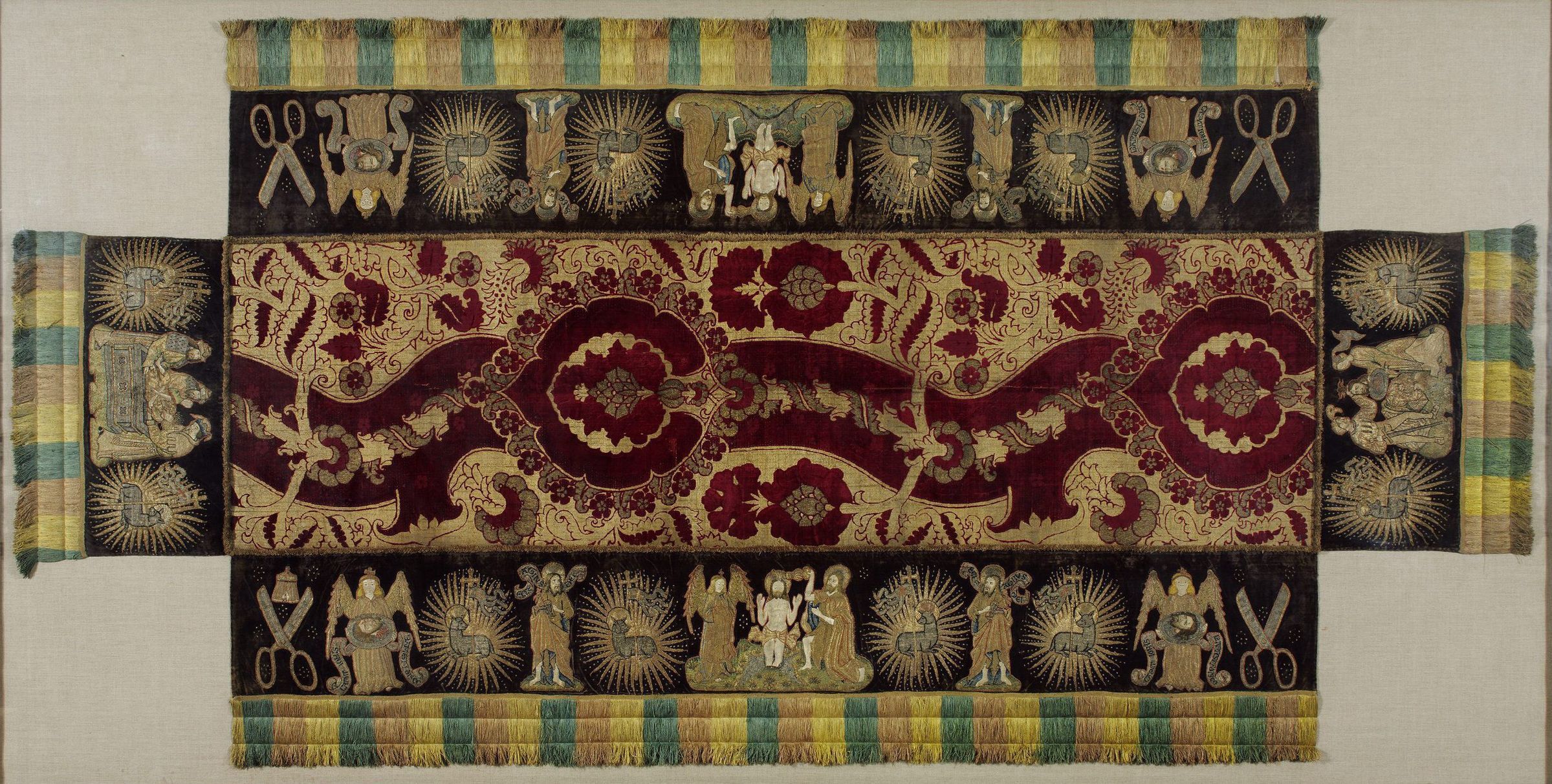
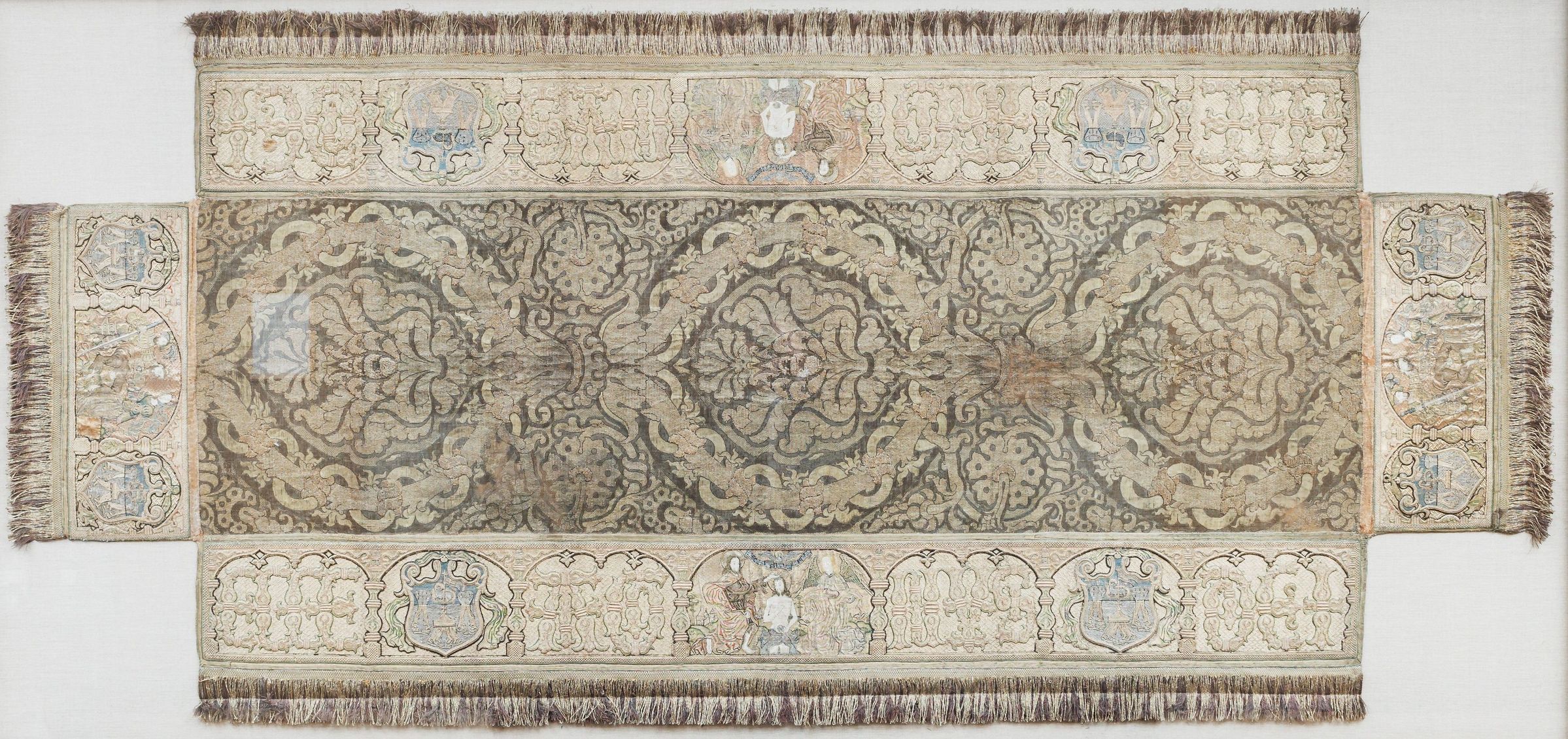
These two textiles are relics of the Company’s early history. They are known as hearse cloths, or pall cloths, and were laid on top of the coffins of members of the Company. The central panels of Italian velvet would lie on the top surface of the casket, while the embroidered panels would hang down covering the sides.
When the Company was founded in 1327, it was created as a community of tailors and merchants, but also as a religious group, or fraternity, dedicated to St John the Baptist. St John has long been the traditional patron saint of European tailoring guilds. Alongside their business pursuits, the Company was responsible for the spiritual well-being of their members. When a guildsman died, members of the Company were obliged to attend the burial. Often, Company officials would carry the coffin, attend the funeral mass, and mourners would reconvene at the Hall for a meal in remembrance of the deceased. If the departed guildsman could afford to, he would pay for these proceedings himself, however the Company had funds to support the funerals of their poorer members.
These two cloths were likely made in London in the first half of the sixteenth century. The central panels of both cloths are made of Italian velvet (likely from Florence or Venice). The embroidery on the side panels is heavily influenced by Flemish needlework, but was likely made in London in a Flemish style by an English or Netherlandish embroiderer. Of thousands of hearse cloths that once existed in England, fifteen survive. Eight of those are in London Livery Companies, and two are cared for here at Merchant Taylors’ Hall.
The images on both cloths focus on moments from the life of Saint John the Baptist (when he baptised Christ in the river Jordan, his beheading, and his burial) reflecting the Company’s dedication to the Baptist as their patron saint. Symbols indicative of the Company’s identity can be seen embroidered on both cloths, in the tailor’s scissors, the Lamb of God (from the Company’s coat of arms), the tent, and the Company’s heraldry. Any person in medieval London who saw a procession through the streets, with these textiles laid atop a coffin, would know that the man or woman beneath was a Merchant Taylor.
Find Out More…
Surviving the Reformation and many centuries is no mean feat, but on 17 September 1940, the Hall was hit by eight incendiary bombs as part of the Blitz. This caused huge damage to the Hall and irrevocable damage to several of the Company’s treasures. The hearse cloths were soaked up to ten inches, thanks to the efforts by fire fighters, but were unharmed further. These two cloths that hang quietly in the Hall entrance have been party to so much real, earth-shattering history: plague, fire, political unrest and civil and world war. They stretch back to the earliest days of the Company and continue to witness its activities now.