Label
Reference: Add MS 45131 f.86r
Collection: The British Library
Medium: Pen and ink on vellum
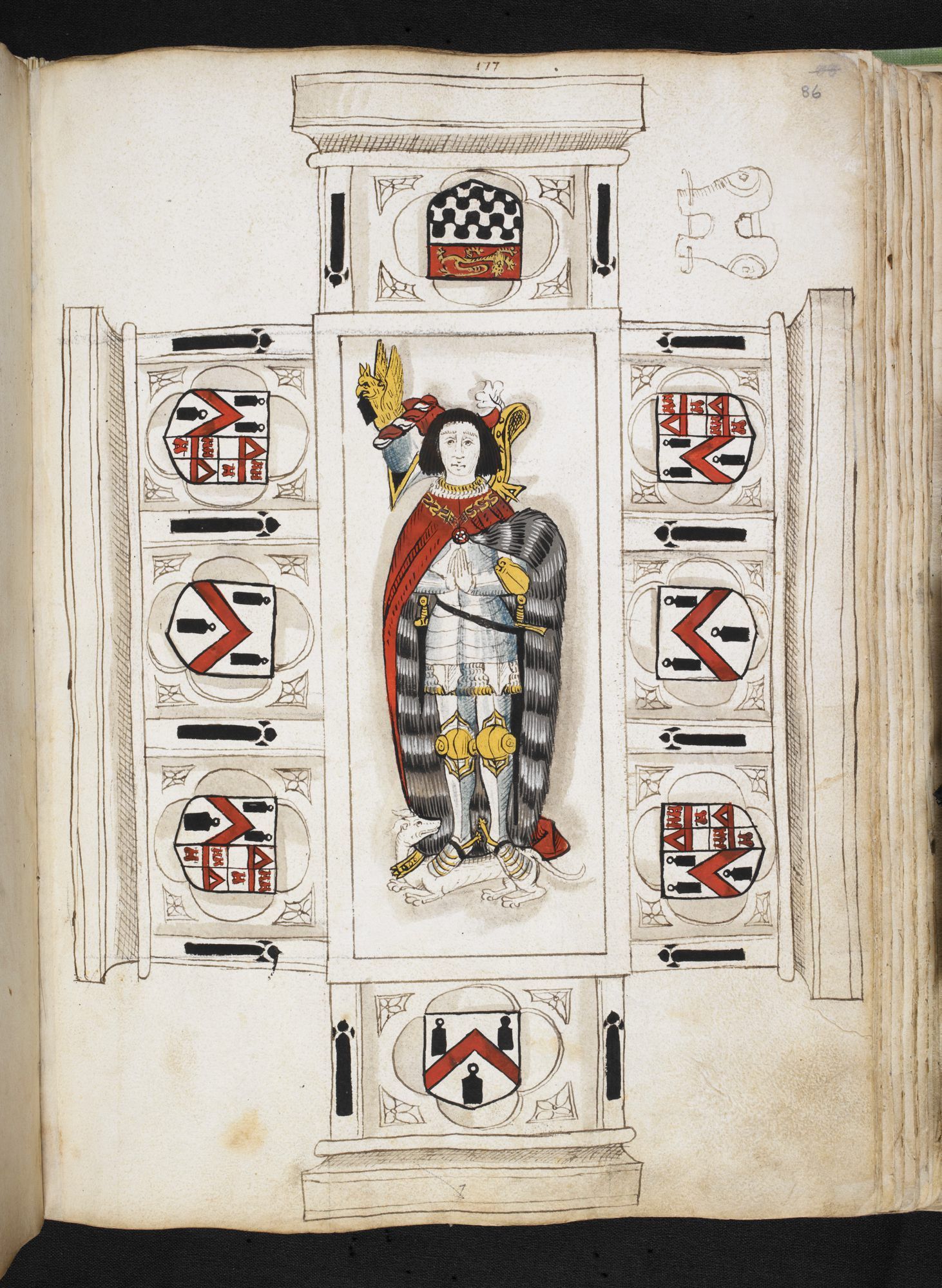
Stephen Jenyns died on 6th May 1523. In his will, he requested to be buried at Grey Friars ‘under the tombe that I have there prepared’ within the chapel of St. Francis. He had chosen this position for maximum visibility, so that when the Lord Mayor and Aldermen processed into Grey Friars on St. Francis’s Day, they would pass directly by his tomb. As a knight, his funeral was arranged by the Lancaster Herald at the College of Arms. Banners, mourning robes, votive funeral armour and helm, wax tapers, newly made pall cloths and much more were commissioned for the occasion.
The Master, Wardens and Beadle of the Merchant Taylors’ Company were present at Jenyns’s funeral, and continued to observe his annual requiem mass. The Grey Friars were left money in Jenyns’s will to maintain the tomb, preserve the inscriptions on it, and to perform masses beside it.
Thomas Wriothesley, Garter King of Arms, included this drawing of Jenyns’s funeral monument in his heraldic collections after attending the funeral. We can see from this drawing that the grave was topped by a fine alabaster tomb chest. The side pieces were divided into three panels, within which were quatrefoils containing carved heraldry. The central quatrefoil along each side, and at Jenyns’s feet, contain his personal coat of arms. The flanking shields on each long side are again, Jenyns’s own, impaling the Kirton family arms (those of his wife). By his head are the arms of the Merchants of the Calais Staple, of which he was Master.
The recumbent tomb effigy, likely sculpted of alabaster, is typical of a man of Jenyns’s standing. He is shown full-length in armour, wearing his red fur robe and collar eluding to his role as Mayor in 1508-9. His hands are held in prayer, as he leans on his heraldic helm, topped by a griffin’s head.
In 1546, Goldsmith Sir Martin Bowes was appointed Commissioner for Chantries in London and began a programme of iconoclasm in the City (including his own Company Hall). In 1547, he was made Treasurer of St. Bartholomew’s Hospital. In order to raise funds for the maintenance of St. Bartholomew’s, he instructed for the tombs at Grey Friars to be taken to pieces, and the stone and brass to be sold off. Jenyns’s tomb fell victim to this project, and our only evidence for what it looked like is this drawing by Thomas Wriothesley.