Label
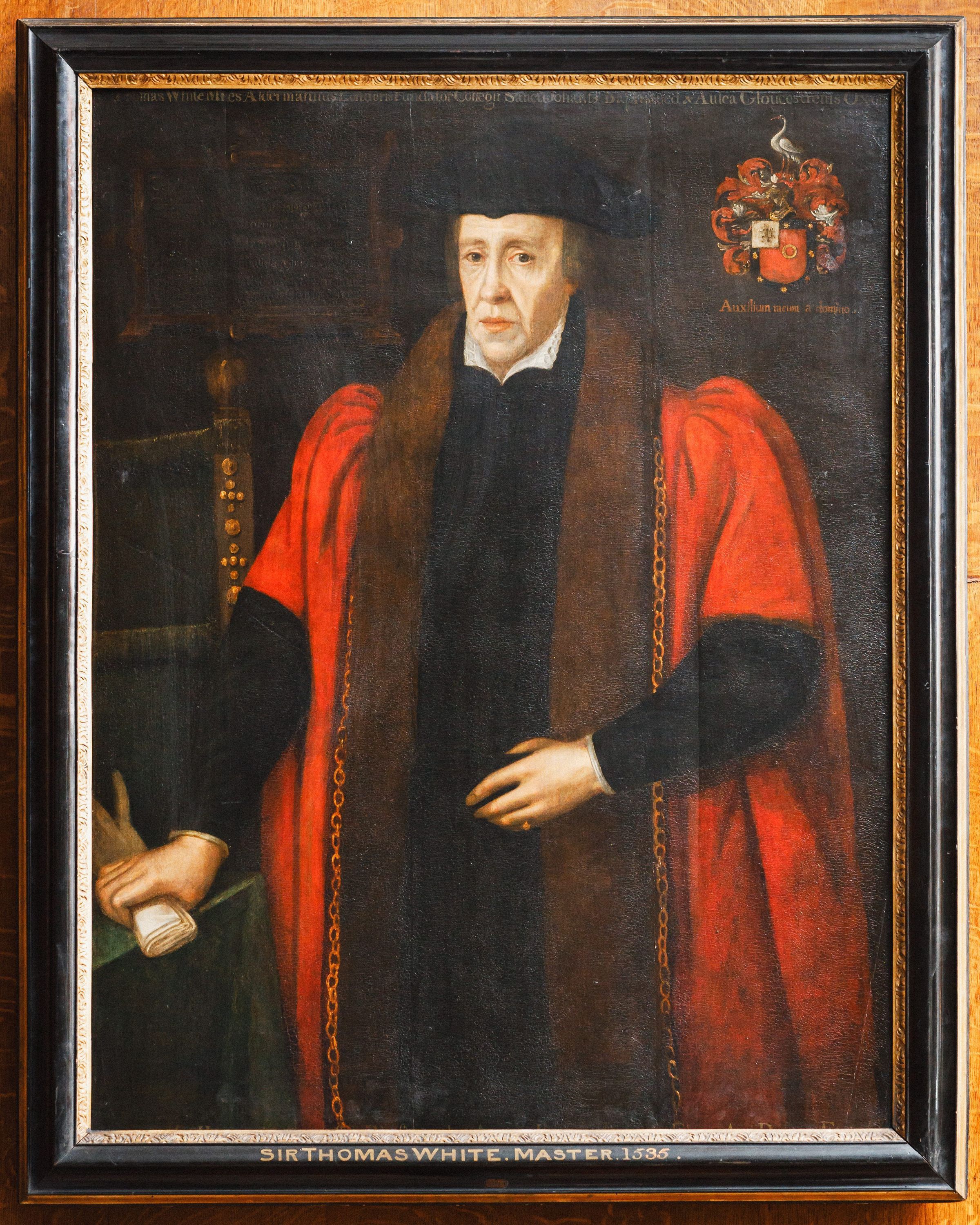
This portrait shows Sir Thomas White, in three-quarter length, dressed in a black gown, a small white ruff, a flat black velvet cap, with a scarlet furred robe and long gold chain. His right hand rests on a table, holding his gloves. A shield with his coat of arms is above his top left shoulder.
White was born in Reading in 1492. In 1504, he travelled to London to become an apprentice to Hugh Acton, a prominent Merchant Taylor. Acton supported White by giving him a loan to establish his own cloth business in 1523, through which White became one of the most successful cloth merchants in the City.
Sir Thomas White rose quickly through the ranks of the Merchant Taylors' Company; in 1533 he was elected Warden, and in 1535 he became Master. He began in career in City government, and was elected Alderman in 1544, Sheriff in 1546 and Lord Mayor in 1553. He was knighted in the Winter of 1553, and in 1555 he founded St. John's College, Oxford.
Find Out More...
A savvy and talented businessman, Sir Thomas White accrued great wealth over his lifetime, which he put enormous effort into giving away. Just as his Master, Hugh Acton, had supported him with a loan to start his business, White established funding grants across England to support poor tailors. White is one of the most painted Englishmen of all time, due to his wide-reaching philanthropy. Portraits of him survive at Merchant Taylors' School and St John’s Oxford (where he was a founder). They also survive in the Corporations of Canterbury, Coventry, Salisbury, Norwich, Reading, Lynn, Bristol, Gloucester, Chester, Southampton, Winchester, Exeter, Lincoln, Nottingham and Oxford, where he had established loan charities.
New research has suggested that this portrait may have been part of a commission by the Company from James I's court painter, John de Critz (d.1642). However, the quality of this portrait differs greatly to the one opposite (depicting Robert Dowe) which was likely the one commissioned by the Company in 1606-7 from De Critz. The portrait of Sir Thomas White, therefore, is likely not the one bought from De Critz, and is perhaps, an earlier painting. Many copies were made in the sixteenth century of a portrait of Sir Thomas White, painted from life, in 1566. The portrait before us here, may well be one of these contemporary copies.