Transcription
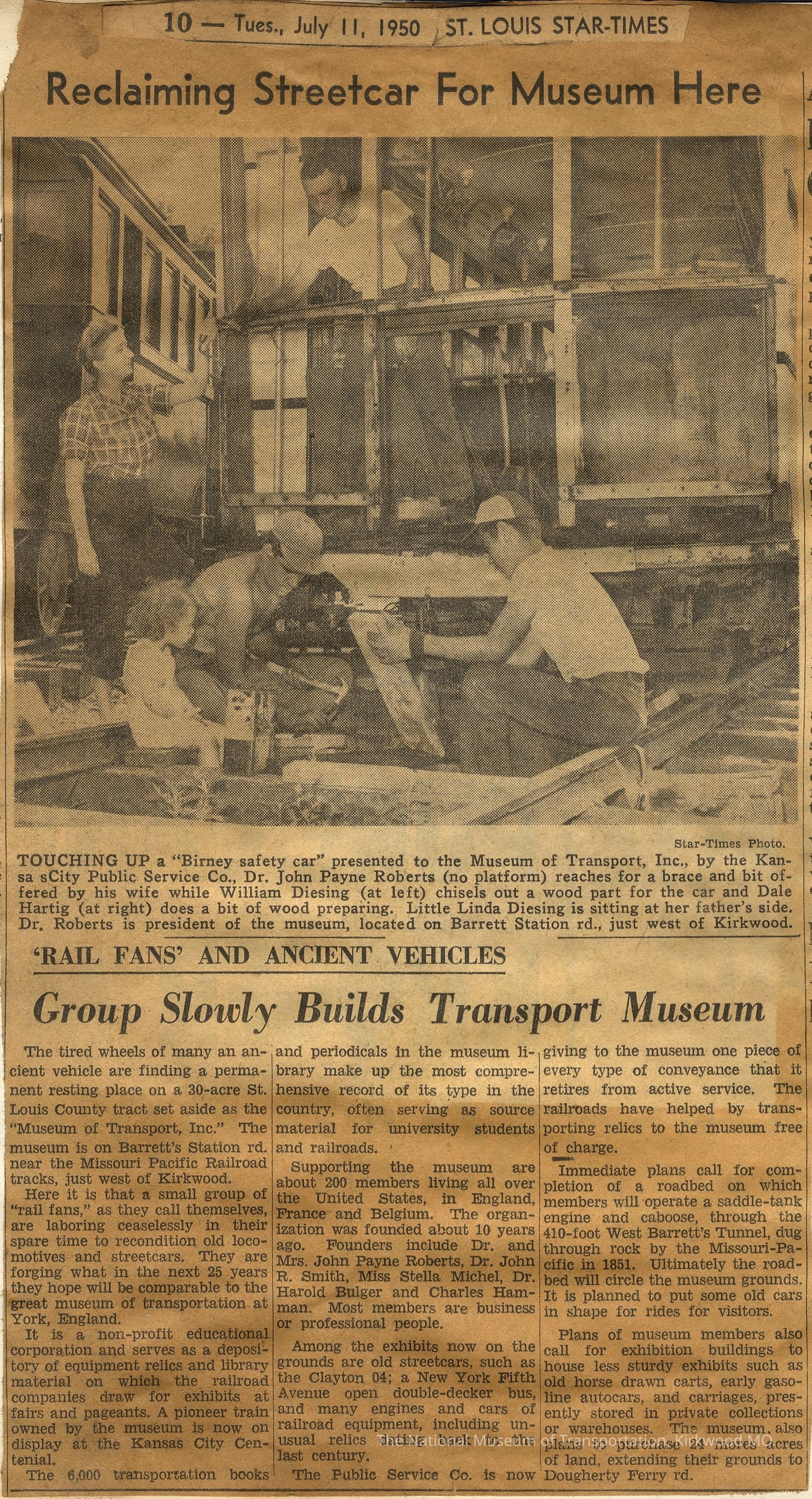
Touching up a "Birney safety car" presented to the Museum of Transport, Inc., by the Kansas City Public Service Co., Dr. John Payne Roberts (no platform) reaches for a brace and bit offered by his wife while William Diesing (at left) chisels out a wood part for the car and Dale Hartig (at right) does a bit of wood preparing. Little Linda Diesing is sitting at her father's side. Dr. Roberts is president of the museum, located on Barrett Station rd., just west of Kirkwood.
---------------
'RAIL FANS' AND ANCIENT VEHICLES
Group Slowly Builds Transport Museum
The tired wheels of many an ancient vehicle are finding a permanent resting place on a 30-acre St. Louis County tract set aside as the "Museum of Transport, Inc." The museum is on Barrett's Station rd. near the Missouri Pacific Railroad tracks, just west of Kirkwood.
Here it is that a small group of “rail fans," as they call themselves, are laboring ceaselessly in their spare time to recondition old locomotives and streetcars. They are forging what in the next 25 years they hope will be comparable to the great museum of transportation at York, England.
It is a non-profit educational corporation and serves as a depository of equipment relics and library material on which the railroad companies draw for exhibits at fairs and pageants. A pioneer train owned by the museum is now on display at the Kansas City Centenial.
The 6,000 transportation books and periodicals in the museum library make up the most comprehensive record of its type in the country, often serving as source material for university students and railroads.
Supporting the museum are about 200 members living all over the United States, in England, France and Belgium. The organization was founded about 10 years ago. Founders include Dr. and Mrs. John Payne Roberts, Dr. John R. Smith, Miss Stella Michel, Dr. Harold Bulger and Charles Hamman. Most members are business or professional people.
Among the exhibits now on the grounds are old streetcars, such as the Clayton 04; a New York Fifth Avenue open double-decker bus, and many engines and cars of railroad equipment, including unusual relics dating back to the last century.
The Public Service Co. is now giving to the museum one piece of every type of conveyance that it retires from active service. The railroads have helped by transporting relics to the museum free of charge.
Immediate plans call for completion of a roadbed on which members will operate a saddle-tank engine and caboose, through the 410-foot West Barrett's Tunnel, dug through rock by the Missouri-Pacific in 1851. Ultimately the roadbed will circle the museum grounds. It is planned to put some old cars in shape for rides for visitors.
Plans of museum members also call for exhibition buildings to house less sturdy exhibits such as old horse drawn carts, early gasoline autocars, and carriages, presently stored in private collections or warehouses. The museum. also plans to purchase 24 mores acres of land, extending their grounds to Dougherty Ferry rd.Language
English