Transcription
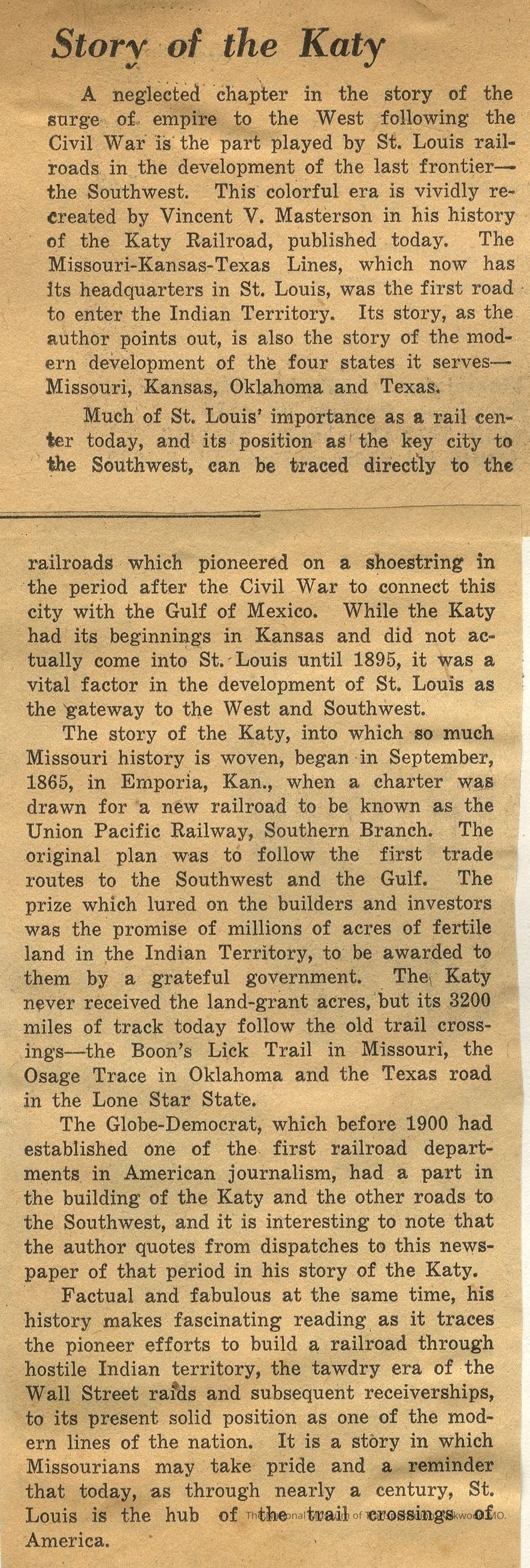
A neglected chapter in the story of the surge of empire to the West following the Civil War is the part played by St. Louis railroads in the development of the last frontier-the Southwest. This colorful era is vividly recreated by Vincent V. Masterson in his history of the Katy Railroad, published today. The Missouri-Kansas-Texas Lines, which now has its headquarters in St. Louis, was the first road to enter the Indian Territory. Its story, as the author points out, is also the story of the modern development of the four states it serves - Missouri, Kansas, Oklahoma and Texas.
Much of St. Louis' importance as a rail center today, and its position as the key city to the Southwest, can be traced directly to the railroads which pioneered on a shoestring in the period after the Civil War to connect this city with the Gulf of Mexico. While the Katy had its beginnings in Kansas and did not actually come into St. Louis until 1895, it was a vital factor in the development of St. Louis as the gateway to the West and Southwest.
The story of the Katy, into which so much Missouri history is woven, began in September, 1865, in Emporia, Kan., when a charter was drawn for a new railroad to be known as the Union Pacific Railway, Southern Branch. The original plan was to follow the first trade routes to the Southwest and the Gulf. The prize which lured on the builders and investors was the promise of millions of acres of fertile land in the Indian Territory, to be awarded to them by a grateful government. The Katy never received the land-grant acres, but its 3200 miles of track today follow the old trail crossings - the Boon's Lick Trail in Missouri, the Osage Trace in Oklahoma and the Texas road in the Lone Star State.
The Globe-Democrat, which before 1900 had established one of the first railroad departments in American journalism, had a part in the building of the Katy and the other roads to the Southwest, and it is interesting to note that the author quotes from dispatches to this newspaper of that period in his story of the Katy. Factual and fabulous at the same time, his history makes fascinating reading as it traces the pioneer efforts to build a railroad through hostile Indian territory, the tawdry era of the Wall Street raids and subsequent receiverships, to its present solid position as one of the modern lines of the nation. It is a story in which Missourians may take pride and a reminder that today, as through nearly a century, St. Louis is the hub of the trail crossings of America.Language
English