Label
"I began quilting 30 years ago, with a background in textiles and clothing. After mastering some basic quilting techniques, and unlearning some old sewing habits, I applied my previous education to my new infatuation. All the “what ifs” and “why nots” began to surface.
I enjoy all the various options of quilting. I do hand and machine embroidery, piecing and appliqué, and both traditional and innovative methods. Techniques are of particular interest to me. For the last 16 years I have pursued a specific interest in the use of bias.
For centuries bias has been used to enhance cling, drape and flow in garments. I thought of the elegance of cowl necklines and the float of Ginger Rogers’ skirts. Contemporary designers continue to find uses for bias in virtually every trend to come along, from spaghetti straps to ruffles; from turbans to evening gowns.
Bias has always been generally avoided by most quilters. I set out to find some way to incorporate it into a quilt. The question took form for me when I encountered June Ryker’s “curved logs”. I began to see possibilities and immediately set out to experiment. This has lead to a series of approximately 16 pieces, with each exploring some variation of the curved technique I developed.
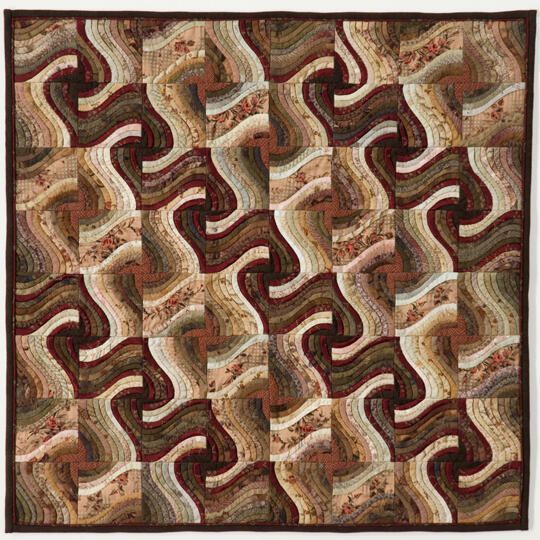
(Statement and Description of Mini)
The controlling factor for the technique of bending bias is size. The amount of curve is limited by the width of the strip. Wide bias strips cannot be curved. This miniature was produced as an experiment to find how small curves can be and produce a successful piece. The 64 blocks measure approximately 2 ½” each, with 48 blocks having 14 strips. Sixteen blocks have 11 pieces, with a fussy cut center extending across the space of four strips. The entire quilt measures approximately 20” square.
Several years ago Daiwabo taupe fabric appeared in advertisements. Information I found indicated this was a line based on reproducing Japanese fabrics of approximately 1870. I was particularly attracted to this fabric. It seemed to me to be a perfect neutral. I was able to locate small amounts in vendor malls. I bought fat quarters from time to time and this miniature provided a perfect chance to experiment. I added some regular quilt fabric to extend the variety of prints and shades. To compliment the taupe tones, I located a piece of dark red necktie silk at the Talbot Tie Outlet.
Bending bias, while tedious and time consuming, is a pleasure to me. I always end with yet another question in mind and another path to pursue."Label
Excerpt from an article written by Sharon for the "NQOF: Seven Sisters" Contest catalogue:
"One day, in the late 1970’s, while searching a closet, I found a box. To this day I have no recollection of how or why that particular box followed me through many years and several moves. The box contained two completed quilt tops from about 1930. I determined that one of the tops, a version of Sunshine and Shadow, had been pieced by my mother as a teenager. My mother had always hated sewing in any form, so I knew she must have labored over every stitch. The result was a shape that was concave on all four sides. I immediately determined, with impish glee, to complete the task and return it to her, almost 50 years after she made it.
As a child, I had found an old treadle machine in our attic. Somehow I learned to make it run. This led me to a career of 30 years, teaching clothing construction at a local college. So…how hard could it be to finish a quilt? At the time, I did not know any quilters. I headed to the library to get some directions. The very few books available all seemed to end the same: “now quilt it.” I ordered a quilt frame from the Sears catalog and proceeded to stitch the layers together. The joke was on me. I became hopelessly entranced by quilting in every way, shape and form.
The advances made in the last 30 years astound me. While I wield a rotary cutter through layers of fabric, I think of when I traced a cardboard template with a pencil. I recall when orange and purple were rare among the tiny calico prints. At the time I began to quilt there were only two ways: a “right way” and a “wrong way”. Anything that works is correct today. Now, with hundreds of books to choose from and speakers coming monthly to our local guild, my options seem endless. There is never enough time to try everything that beckons me.
While I love every aspect of quilting, I am most intrigued with techniques. New tools, new products, new methods, new patterns, new ideas...all of these call for problem solving. I welcome the challenges. I take a wide variety of classes from others and never fail to learn something new. I am always on the lookout for a better way. And then there is the fabric! It is sometimes comforting and calming. Other times it is exciting and inspiring. I have learned why people have more than one machine. I now have several, each for specific techniques. Generally, I do piecing in the daytime and hand quilting a night. Occasionally I am drawn back to appliqué. I find it exciting to work on a show quilt, but I find peace in the construction of quilts for our community outreach. And then there are all the quilters around me; they teach, they inspire, they comfort. My quilt world is a safe haven.
How fortunate I was to find that box in a closet. I can hardly wait to start the next new project!"