Label
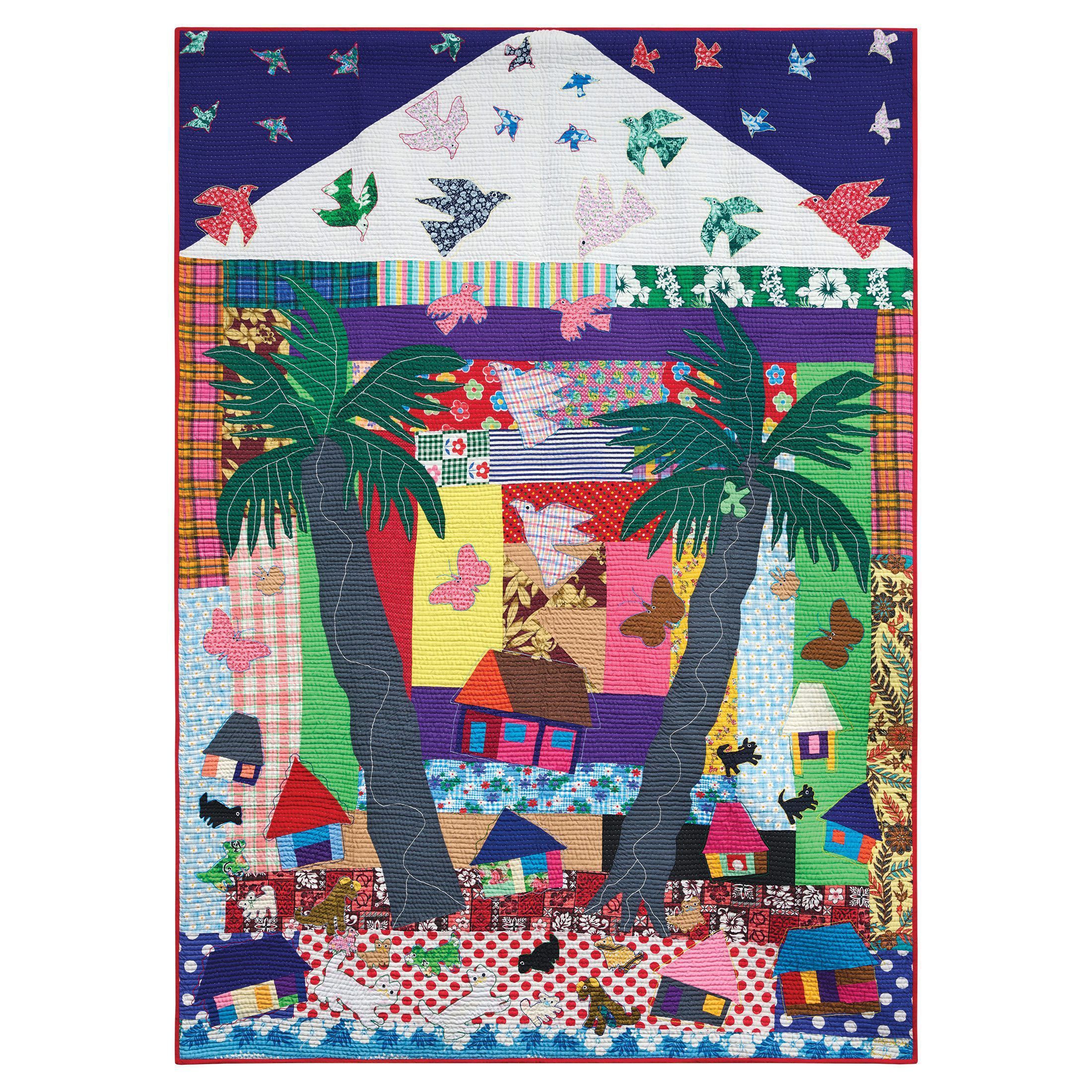
He sees tiny Caohagan Island as one big house. As a pioneer among quilters who used to appliqué on a single piece of fabric, he is now free to boldly appliqué houses and animals on top of the pieced work as a village delight.Label
From "Pagtinabangay: The Quilts and Quiltmakers of Caohagan Island" by Dana Jones, 2015
"Daisy and Ernesto "Erning" Paran"
When Ernesto "Erning" Paran saw that his wife Daisy Paran could make money quilting, he decided to join her, the first man on Caohagan Island to take up quiltmaking. They now work together, making as many as 15 quilts a year. They work at home eight hours a day, treating quiltmaking as a full-time job. They cooperatively design the entire quilt up-front, including selecting borders and binding before they begin. Designs may change some as they work, but for the most part, the finished product reflects their design
"Daisy and I have our next designs in our heads at all times," Erning said. "Our final designs combine our ideas."
They start with Erning planning a large center design element, then Daisy cuts out smaller motifs. Erning plots the design then asks Daisy for advice. She may say it's lacking trees or houses or some other motif needed for a complete look. With the design in place, they are ready to begin piecing and appliqué. Generally, Erning pieces the background. He and Daisy share the appliqué though Daisy usually does more of it. They share the work of adding the borders, then Erning does the quilting. Daisy stitches the bindings to the back side of their quilts.
Erning was the first Caohagan quiltmaker to hang a quilt over a clothesline for quilting.
"I was not comfortable quilting on my lap," Erning said. "I can be more accurate when the quilt is hanging. Some of the quiltmakers say it's tiring to quilt this way but others have adopted my method."
Erning sits or stands depending on which part of the quilt he is quilting. If he's working on the center, the quilt is close to the rope, so he needs to stand. as he works down, it is easier to sit.
Daisy and Erning work on two quilts simultaneously so neither has to wait or the other to complete a step. Many of their quilts feature large coconut palms, probably because Erning knows the palms well. Before he started quilting, he made his living from fishing but also from making coconut wine, a livelihood that requires the maker to climb to the top of the coconut palms. He says making wine is a job for young men.
"I've gained too many kilos to climb fast," he smiled. "My legs tremble when I climb, so I don't make wine anymore.
While a few other men have followed Erning's lead and have taken up quiltmaking, many prefer to vend on the Pontog, Erning said. He's not interested in vending.
"Other men know how to quilt, but they are not giving time to it because they are focused on vending," he said. "You can earn money vending but not always. With quilting, your livelihood is permanent; you always earn money. If vendors make money, they can buy food, but if they don't, they can't. I would rather quilt than vend."
Erning and Daisy married late by Philippine standards. They were in their thirties. Daisy was living on Caohagan Island when Erning, a professional cement worker, came to the island as part of the crew that built the main building of Caohagan House. He met and fell in love with Daisy, they married, and he moved to Caohagan.
"At first, I was lonely," he said, noting that he was used to the faster pace of Cebu City. "I wanted music on all the time. Over time, I liked life here better." He still listens to the radio as he works, usually just outside his home. He enjoys listening to the same radio drama as the quiltmakers who gather at the Quilt House. Like them, he say's it's a funny program.
Daisy and Erning have four children, two girls and two boys. Erning doesn't know if his boys will take up quiltmaking, but his oldest daughter is a quiltmaker who sometimes works with her mother and father.