Label Type
Artist CommentaryLabel
"I make quilts because I love to sew and quilting satisfies my creative needs!
I want to draw the viewer in with a large dramatic design. Then I want them to come close, study the detail and understand how much pleasure I get from making a quilt, maybe inspire them to have a go at stitching any way they want.
If the viewer is never going to sew, I'd like them to go away from my quilt feeling that their day is brighter and better because of what they have just seen.
My aims are to continue to explore and develop my work, to improve, to keep enjoying it all (even the boring repetitive bits!), and to continue to share what I do with others."Label
From "Quilting in the Limelight: The Life, Art & Techniques of an Award-Winning Quilter" by Philippa Naylor, 2008, Dragon Threads Ltd.
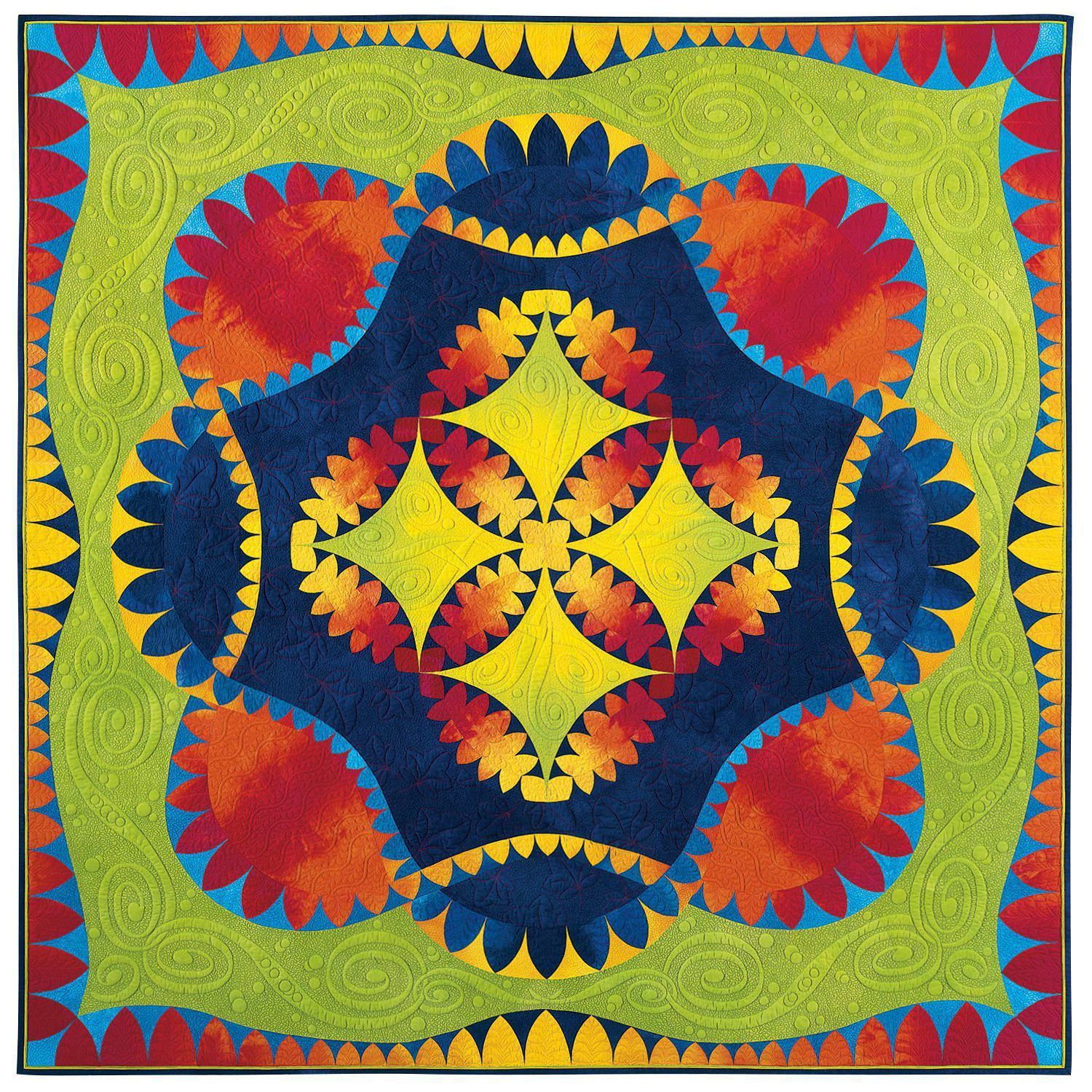
"My most successful quilt, "Lime Light," was the second large curved piecing quilt that I made. It was based on the traditional New York Beauty block which I chose because of its complicated piecing. Like all my pieced quilts "Lime Light" was drawn by hand and templates made for each section. It was the first quilt to have every piece of fabric dyed or painted by me. I include the word 'painted' because some of the fabrics were colored using dyes mixed with sodium alginate. This is a product made from seaweed, and is used to thicken the dye solution. The more sodium alginate you add to the dye solution, the thicker the liquid will become. Very thick and you can achieve very definite lines and distinction between colors. A less thick solution will allow varying degrees of bleeding and merging of colors. For example, the central area of "Lime Light" was painted with acid lemon running into lime green, and the large red/orange areas in the corners of the large central motif were painted orange to red and back to orange. This is not a technique that I have pursued, not because I don't like it; I do; it has endless possibilities. It does, however, require more space and a large area to spread out the fabric. I don't have this space at home but I'm sure I could find somewhere to do this type of work if the desire struck!
As I dyed fabrics for this quilt and cut and pinned the shapes on to my design wall, I felt that I had something that was probably going to work pretty well. There was (and usually is) a certain amount of fabric wastage in getting the color gradations just right, but this didn't seem to matter because the shading combined with the curved lines of the quilt gave an impression of real movement. Although tricky to piece, particularly in the center where there were some very skinny sections, the sewing went surprisingly well. The only major hitch was when I cut the large plain borders around the central motif in a turquoise color. They looked awful, making the whole piece look flat and dead! As usual my family came to the rescue and Peter suggested that the color should be lime green and not turquoise blue. So I dyed more fabric, re-cut, and yippee, the lime green looked fabulous. And I had the name too - "Lime Light!"
Although I had little idea of what the quilting would be when I began the piece, I knew that the large plain areas would be filled with a trapunto design of some type, and so this is where I began. Swirly spiral shapes fitted well with the curved lines of the piecing and were an easy shape to fill the lime green borders. I drew spiral templates in two different size sand intertwined them to create an overlapping design which was positioned evenly around all four sides of the quilt. The smaller of the two spirals was repeated in the four central lime green sections, each of these sections having three spirals in it. However, these three smaller spirals were not positioned the same way in each section. They faced different directions, intertwined differently and were sometimes 'escaping' out of the section. This made the trapunto design less predictable, more contemporary, and also more individual. These are all things which I try to achieve with my quilting patterns. Repeating the swirl design in this way helped to tie the piece together, giving it a well though-out look.
Trapunto circles in many sizes are randomly dotted about in all the lime green sections. When I made this quilt I used both British and American coins as my circle templates. I have continued to use a little pot of mixed coins that I keep especially for this purpose because I'm tempted to think that they are lucky!
In addition to the spirals a free-form feather design is used in several places. It can be seen in the New York Beauty sections, in the curved saw-tooth borders and in the large red/orange shapes at the outer corners of the central motif. Again, repetition gives strength to the quilting design.
A stylized trapunto maple leaf, stitched in red, fills the navy blue sections. This was sewn in three different sizes and the leaves are positioned in such a a way that the 'fall off the edge' of the navy sections. This is to give the impression that the trapunto leaf was stitched on to the fabric before the fabric was cut out - in the same way that a dress made from a floral print has the print design cut at the seams.
"Lime Light" was entered into the 2003 American Quilter's Society show. A few days before the show began I was sitting at my sewing machine in Saudi Arabia when the phone rang. The lady speaking said she was Meredith Schroeder from AQS and that my quilt "Lime Light," had been awarded 'Best of Show.' I nearly fell off my chair! After a somewhat garbled conversation on my part, I turned to Peter to say, 'I've just won Best of Show at AQS." His response was, "And how much is that one?" He could see there might be something in this quilting game after all. I was able to reply, "It's $18,000!!"
Sadly I was not able to visit the show as getting to Kentucky from Saudi Arabia was too tricky in the time I had available. Even so it was the most exciting experience and goes down as one of the best moments in my life.
Sometimes a quilt is naturally what I call a 'happy piece of work.' It just seems to go together well with few real problems and is a joy to make. This pleasure in the craft seems to be reflected in the finished product and somehow the happiness shines out. "Lime Light" was like this. OK, there were some doubts along the way, and some questions on the background color but really it was all a pleasure. "Star Sign" was also like this. There are times that I worry about being a quiltmaker and about the fact that in the big picture it doesn't really mean anything - it's not saving lives. But I do know that I am very lucky to be able to do this and that sending my quilts out to share with others is a positive thing. "Lime Light" has been particularly good at making those people who have seen it feel happier about their day."