Label
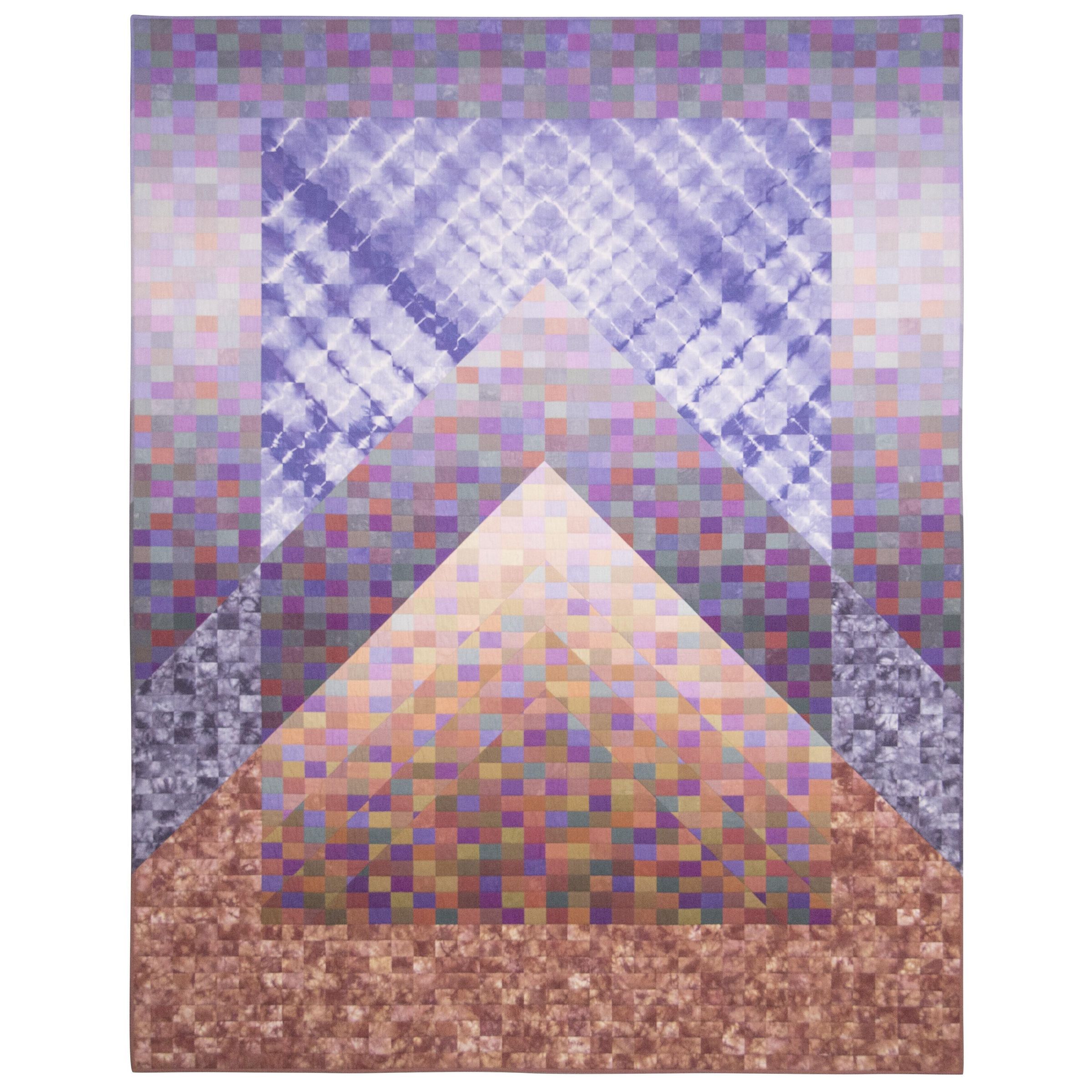
"'Precipice' is made of 100% cotton muslin, dyed with Procion dyes, and constructed entirely of a grid of small rectangles (each 1-1/4" x 2"), with diagonal seams intersecting the constructed grids. Various dyeing techniques were used; some of the fabrics are solids, dyed in gradation (all leftovers from other projects that employed more controlled color palettes), some are "scrunch" dyed to create irregular texture, some were folded and dyed in a deliberate pattern before dyeing.
All of my quilts form one L-O-N-Gi series!, influenced by the previous quilts that I have made and design/color issues I have addressed in them. 'Precipice' has a spiritual quality for me, although I did not set out to create this. The piece seems to divide itself between heaven and hell, and its upward movement presents hope. Often the content of a piece is only clear to me when I am finished and start to realize what forces in my life have unconsciously coalesced in the work. This particular quilt stands on the threshold in many ways.
I was only partially aware of it at the time, but 'Precipice' represents a major turning point in my work. I had 12 years of quiltmaking under my belt when I made it: for 12 years I had been piecing together tiny bits of fabric (mostly solid pieces of fabric) to create design. In the beginning, all of the design was done on paper first, and the subsequent sewing was "by number". In the early 1980's I had also begun to construct quilts that were not preceded by drawings, and these quilts were designed by pre-constructing units (strip- piecing, checkerboards, or crazy blocks) that were then manipulated on my design wall. All of the design was created by the way in which color moved from small piece to small piece.
Just before I made 'Precipice', I had made a small quilt in which I took some leftover "scrunch-dyed" fabrics and tried to arrange them in some sort of linear fashion - responding to the individual marks in the fabric and how I could force them to "link up" from square to square. This was different from working with solid fabrics in an orderly fashion. It dawned on me that if I wanted to explore pattern (not only color) in the fabrics, then I could intentionally create pattern in the dyepot by intentionally folding and binding a large piece of fabric. So I did this with two 2-yard pieces of fabric: one was dyed blue-violet, and one was dyed brick red.
These 2 pieces of tie-dyed fabric were the beginning of 'Precipice' (note that the red one is NOT in the piece). All of my decisions as I began to work on the piece were made in response to those heavily patterned fabrics. It began to form as a long horizontal composition. with the blue at one end and the red at the other. At some point I eliminated the tie-dyed red piece (it showed up in a later quilt) and began to look at the blue dyed piece (which I had cut apart and re-sewn in the same size rectangles as the rest of the piecework) as 'sky,' and the whole thing began to look like a sort of 'heaven-hell' landscape.
I think that 'Precipice' is one of the best quilts that I'd made up to that point in my work. Perhaps I feel this because of the new way in which I had to struggle with the design: really responding to the fabric itself and making design decisions based on the voice of that singular piece of fabric. I have essentially been designing that way ever since. Gradually I got rid of the solid fabrics altogether (over the next 6 major quilts after 'Precipice:' I call my 'major' quilts the ones that I have to struggle over. I am always doing a few "easy" ones in between - the crazy quilts, or some other tried-and-true design approach using a new color palette). In 1992 I made 'Birch Eyes,' constructed of 6 arashi shibori (pole-wrap) panels with a small amount of piecing in the center section. The patterning created by the mechanical resist (pole-wrapping in the instance of 'Birch Eyes') predicated the final design.
Looking back, I can see that 'Precipice' really was the threshold piece for this new way of thinking and working. I have said this many, many times when showing the development of my work. Right now, I seem to be waiting for that next threshold piece."