Name/Title
Rittenhouse OrreryEntry/Object ID
0000.2510.0001Description
An orrery is a mechanical model of the solar system, demonstrating the motions of the planets and their satellites around the sun. These models (sometimes called planetariums) became popular early in 18th century in Europe, and one maker, John Rowley, named his device an orrery after his patron, the Earl of Orrery.
Between about 1767 and 1770, Rittenhouse built his first orrery. He sold this device to John Witherspoon for the College of New Jersey, now Princeton University (where it remains today, although only partially intact). William Smith, Provost of the College of Philadelphia, convinced Rittenhouse to construct a second orrery, and that is the device at Penn.
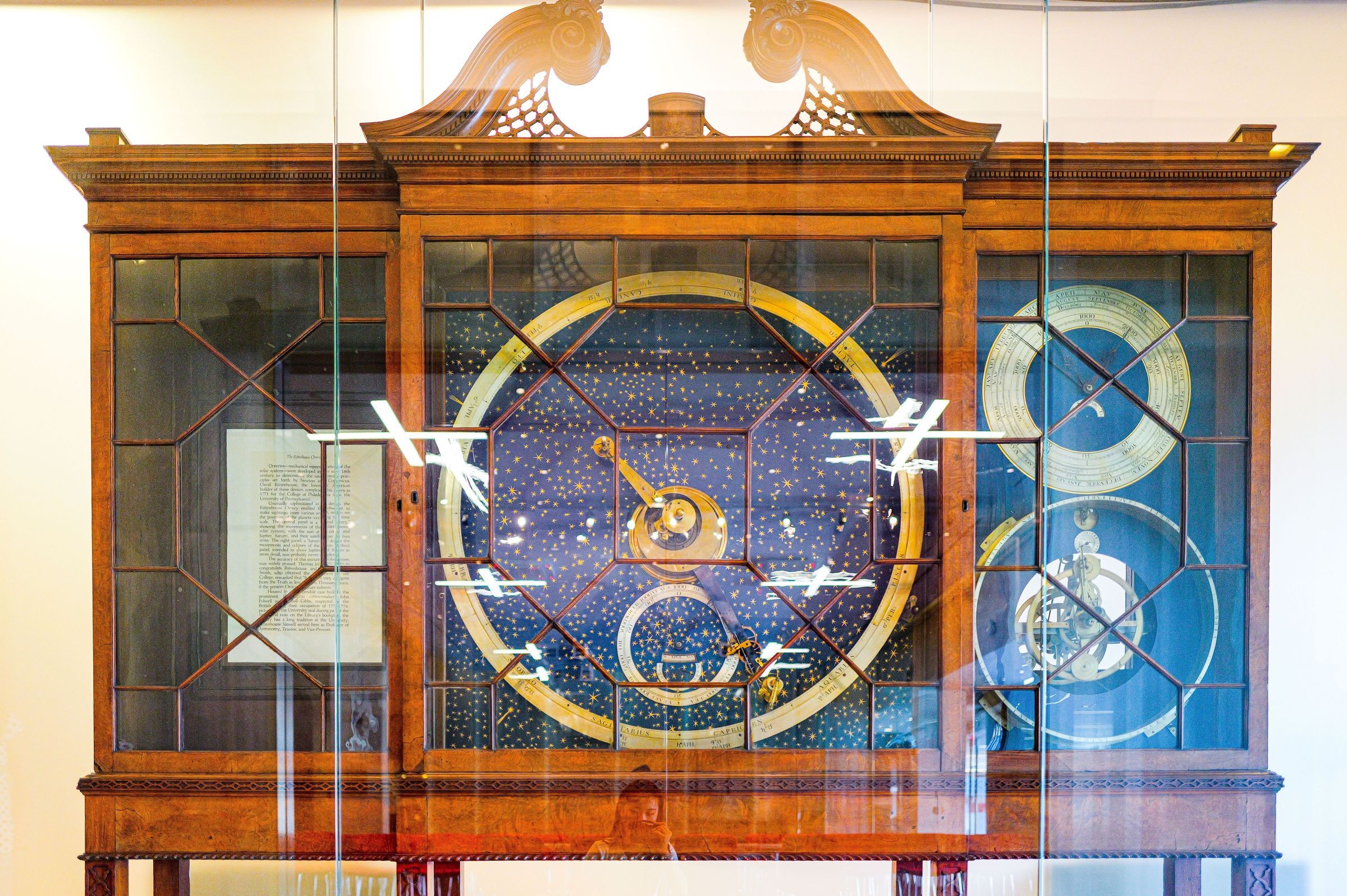
Rittenhouse's model is larger and more complex than most earlier orreries. Once wound with the clock mechanism, the machine would rotate the planets on mechanical arms into their proper relative positions on any given date, past or future.
The central panel is a "grand orrery," showing the movements of the entire known solar system, with the sun at its center, and Jupiter, Saturn, and their satellites on the two arms. The right panel, a lunarium, depicts the movements and eclipses of the moon. A third panel, intended to show Jupiter and Saturn in more detail, was probably never completed.
The orrery is housed in a Chippendale-style case built by Philadelphia cabinetmakers John Folwell and Parnell Gibbs, with Folwell perhaps the lead joiner/carver. It was examined and conserved in the 1970s, but its mechanism has not been made to function in modern times.Dimensions
Dimension Description
SizeHeight
118 inWidth
108 in