Name/Title
Social ConsciousnessEntry/Object ID
L.2019.1.1Description
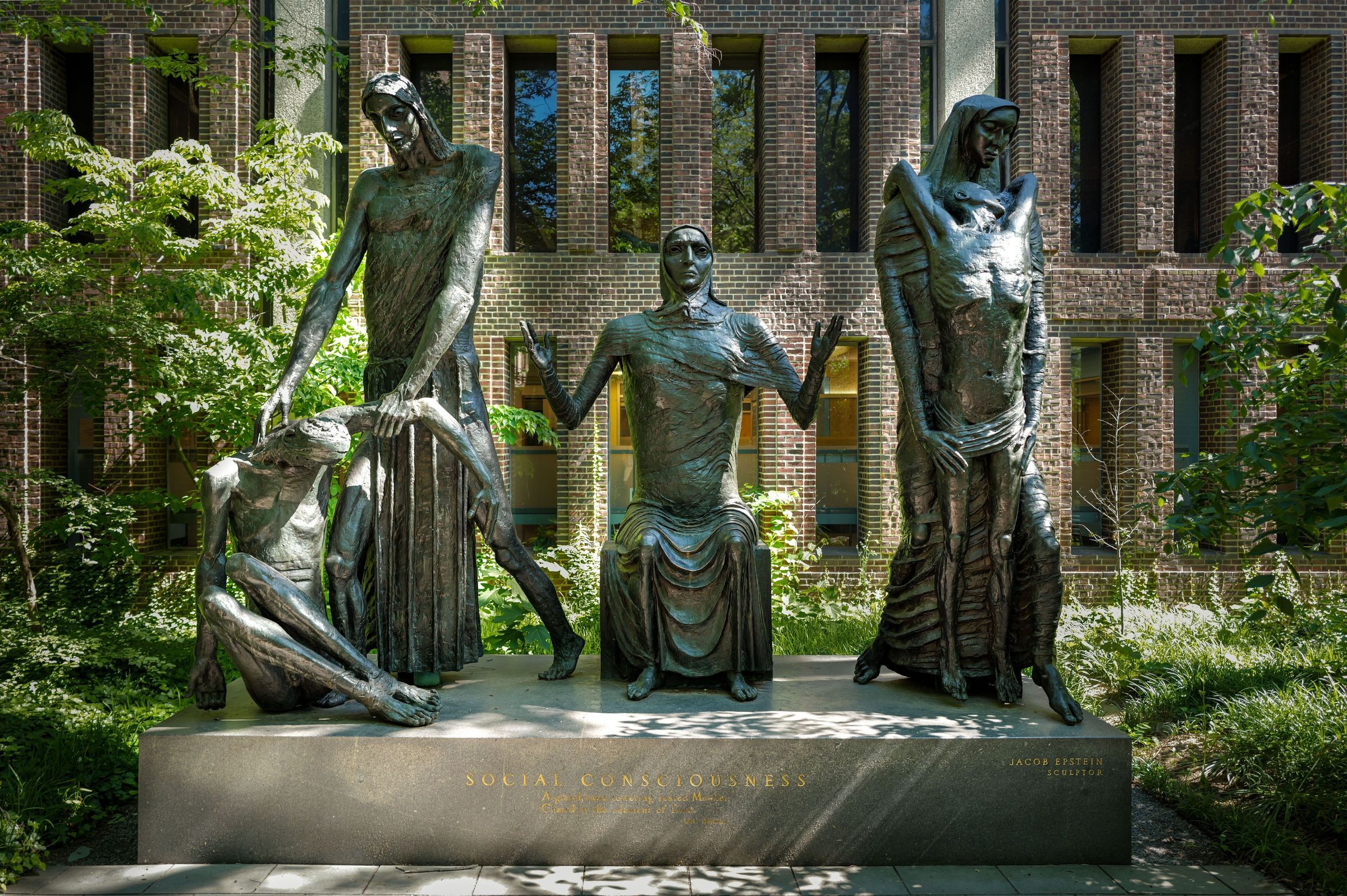
The Eternal Mother, seated with arms outstretched, casts a stern, sorrowful look at passersby on the University of Pennsylvania campus.
Flanking her are two standing female figures: one representing Compassion, reaching down to comfort a stricken youth collapsed at her feet; and another that personifies Succor (or Death), supporting at the hips a young man who bends backward to embrace her shoulders. The entire group by Jacob Epstein suggests not only the tenderness and sympathy of humankind but also the affliction that makes these virtues necessary.
Epstein was one of the first Westerners to develop a deep appreciation of “primitive” and traditional art. He displayed a particular interest in images of maternity and fertility. His career was punctuated by controversy, however, and his public commissions often prompted such adjectives as ugly, vulgar, and vile.
The commission for Social Consciousness was awarded to Epstein in 1950 by the Fairmount Park Art Association (now the Association for Public Art), which wanted to include in the Ellen Phillips Samuel Memorial a work expressing the American ideal of compassion. But as the massive sculpture took shape, the artist and the Association realized that the planned site in the Samuel Memorial could not accommodate the work.
Instead, Social Consciousness was installed in 1955 at the West Entrance of the Philadelphia Museum of Art, where it upheld Epstein’s reputation for controversy. In 2019, Social Consciousness was relocated from the West Entrance of the Philadelphia Museum of Art to the University of Pennsylvania, along the Memorial Garden Walkway near the Van Pelt-Dietrich Library.
The sculpture is on long-term loan to the University from the Association for Public Art. It has been placed in a more contemplative site than its previous location, consistent with the artist’s intentions, near works by Alexander Archipenko, Robert Indiana, John J. Boyle, Claes Oldenburg, and Robinson Fredenthal, among others.
Some critics have complained that the figures look unnatural; others have objected to the lack of strong visual unity among the three separate groups. On the other hand, the work has been praised for its amalgamation of Western and Eastern influences and its hieratic stylization that suggests a timeless emotion. It could be argued that the very awkwardness of the figures emphasizes the precariousness and suffering of the human condition.Type of Sculpture
Free StandingDimensions
Dimension Description
SizeHeight
146 inWidth
198 in