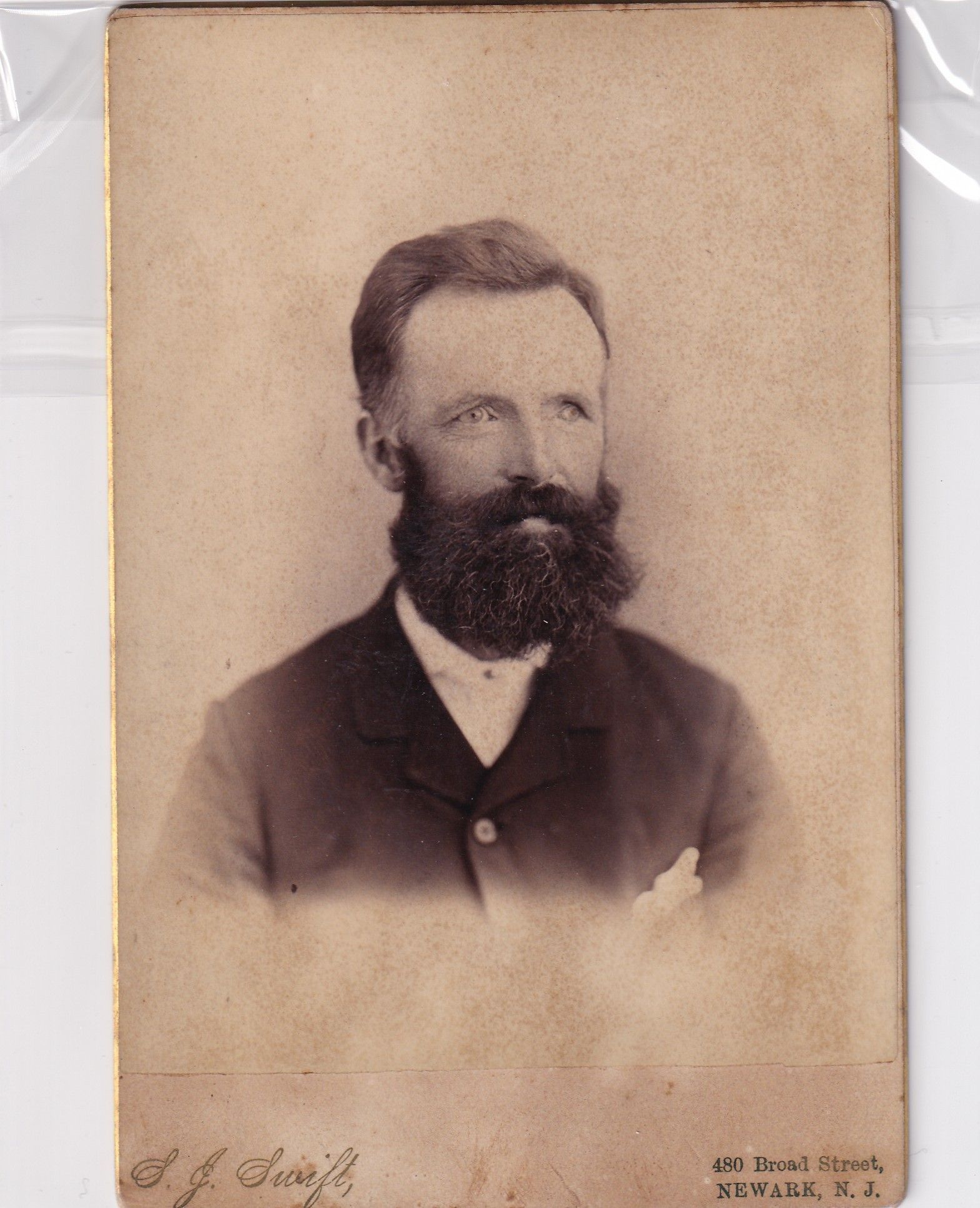
Sepia-toned albumen print mounted on cream cabinet card stock with narrow gold rule border. Lower margin printed:
“S. J. Swift – 480 Broad Street – Newark, N.J.”
Bust-length portrait with soft feathered vignette at lower portion.
Photograph Details
Type of Photograph
Cabinet Card
Category
man, beard, 1870's, Victorian
Made/Created
Studio
S.J. Swift
Date made
1878 - 1888
Time Period
Victorian
Place
State/Province
New Jersey
Notes
Photographer:
S. J. Swift
480 Broad Street
Newark, New Jersey
🧔 Beard Style
Full, natural beard extending below chin
Connected mustache
No trimming into pointed or stylized form
Large natural beards were most fashionable between the 1860s and early 1880s. By the 1890s, mustache-only styles dominate.
👔 Collar
Low, rounded collar compared to the towering detachable collars of the 1890s
No exaggerated height
🧥 Jacket
Simple sack coat
Three-button configuration
Narrow lapels
Minimal shaping
This restrained tailoring is typical of the 1875–1885 period.
📐 Mount Style
The clean mount with minimal ornamentation and gold rule border aligns with cabinet cards of the late 1870s–early 1880s.
Ethnography
Notes
This gentleman appears middle-aged, likely 35–55 years old.
The full beard signals:
Respectability
Maturity
Post–Civil War masculine norms
By this time, full beards were associated with:
Civic authority
Professional status
Religious or moral seriousness
Given Newark’s rapid industrial growth during this period, he may have been:
Merchant
Manufacturer
Skilled tradesman
Clergyman
The simplicity of pose suggests formal studio portrait for family or business distribution.
Condition
Overall Condition
Good
Date Examined
Feb 14, 2026
Notes
Heavy foxing across image field
Even sepia fade
Minor mount discoloration
Structurally stable
General Notes
Note Type
Description
Note
This late nineteenth-century portrait captures a mature gentleman wearing a full natural beard characteristic of post–Civil War masculine fashion. Produced in Newark during a period of rapid industrial expansion, the restrained styling and simple mount reflect the early era of cabinet card photography, when such portraits served as markers of civic identity and respectability.