Portrait of Two Young Children — Kinney Studio, Gary, Indiana
Entry/Object ID
RE-PH-2026-0093
Description
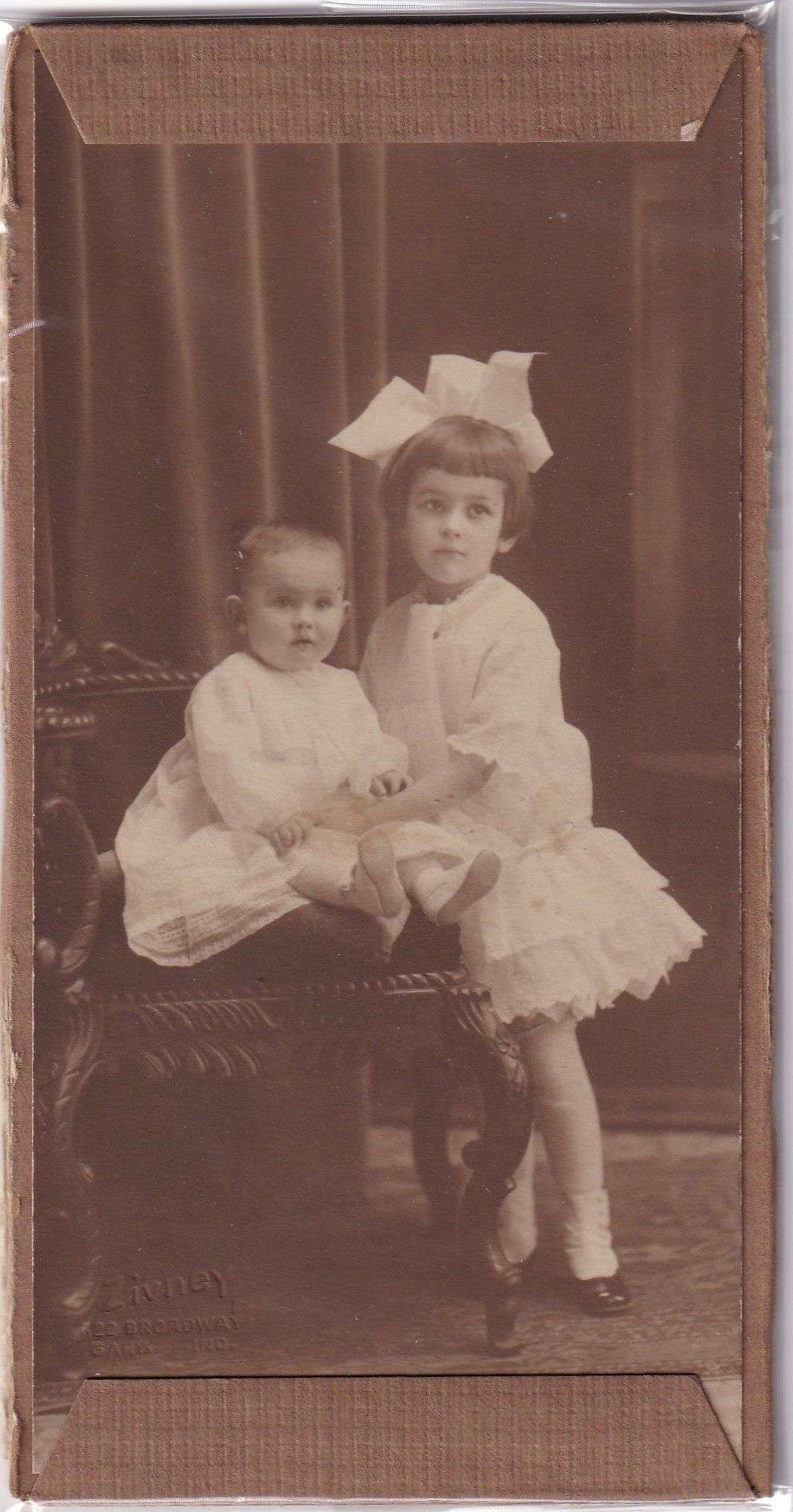
Studio portrait of two young children seated together on an upholstered studio chair, photographed by Kinney Studio of Gary, Indiana. The older child wears a large ribbon bow and lace dress typical of early twentieth-century children's fashion.
Photograph Details
Type of Photograph
Gelatin Print - silver bromide
Category
child, baby
Made/Created
Studio
Zivney
Date made
circa 1908 - circa 1916
Place
State/Province
Indiana
Continent
North America
Notes
Studio Location
Gary, Indiana, United States
Studio imprint visible in lower left corner:
“Zinney
439 Broadway
Gary, Ind.”
Gary, Indiana was founded in 1906, which helps confirm that the photograph must date after that year.
Subject Description
The photograph depicts two young children, likely siblings.
Older child
Approximately 4–6 years old
Wearing a large ribbon hair bow
Short bobbed haircut with bangs
White dress with lace trim
White stockings and dark shoes
Younger child
Approximately 10–18 months old
Wearing a long infant gown or dress
Seated beside the older child
Supported on an upholstered studio chair
The older child appears to hold or steady the younger sibling, a common pose in early twentieth-century children's portrait photography.
Clothing & Dating Analysis
Several stylistic elements suggest an early 1910s date.
Dating indicators
Large hair ribbon bow
Very popular for young girls between 1905 and 1915.
Short child bob haircut
Common for young children in the 1910s.
White lace children's dresses
Typical for formal portrait photography during the Edwardian and early wartime period.
High button boots / stockings
Standard children's footwear of the era.
Together these features suggest a date approximately 1910–1915.
The oversized hair bow worn by the older child is sometimes called a “butterfly bow”, which was especially popular in children's fashion between 1905 and 1914.
Collectors and photo historians often use these bows as very reliable dating clues.
Ethnography
Notes
Studio portraits of children were widely commissioned by families in the early twentieth century to document childhood and preserve images of siblings together. Photographers often posed children on upholstered studio furniture to create a composed yet natural appearance.
Large ribbon hair bows were a hallmark of girls’ fashion during the Edwardian era and were frequently used for formal photographs. White dresses were also commonly chosen for children's portraits because they photographed well and conveyed innocence and formality.
The studio address printed on the photograph indicates that the portrait was produced by Kinney Studio in Gary, Indiana. Gary was a rapidly growing industrial city during the early twentieth century, founded in 1906 by the United States Steel Corporation. As the city expanded, portrait studios like Kinney served the growing population by producing family and children's photographs.
Condition
Overall Condition
Good
Date Examined
Mar 3, 2026
Notes
Minor mount wear at corners
Slight tonal aging
Light vertical exposure streaking from scanning or print aging
Image remains clear and stable
General Notes
Note Type
Description
Note
This studio portrait depicts two young children seated together on an upholstered chair, photographed by Kinney Studio of Gary, Indiana in the early twentieth century. The older child wears a large ribbon hair bow and lace-trimmed dress, while the younger sibling sits beside them in a traditional infant gown.
The photograph was produced using the gelatin silver bromide printing process and bears the studio imprint “Kinney, 439 Broadway, Gary, Ind.” Gary was founded in 1906 as a company town for the United States Steel Corporation, and portrait studios such as Kinney quickly emerged to serve the rapidly expanding population.
Portraits of siblings were a common subject for early twentieth-century photographers, allowing families to commemorate childhood and preserve likenesses for future generations. The clothing and hairstyle visible in this image suggest a date around 1910–1915, during the late Edwardian period.