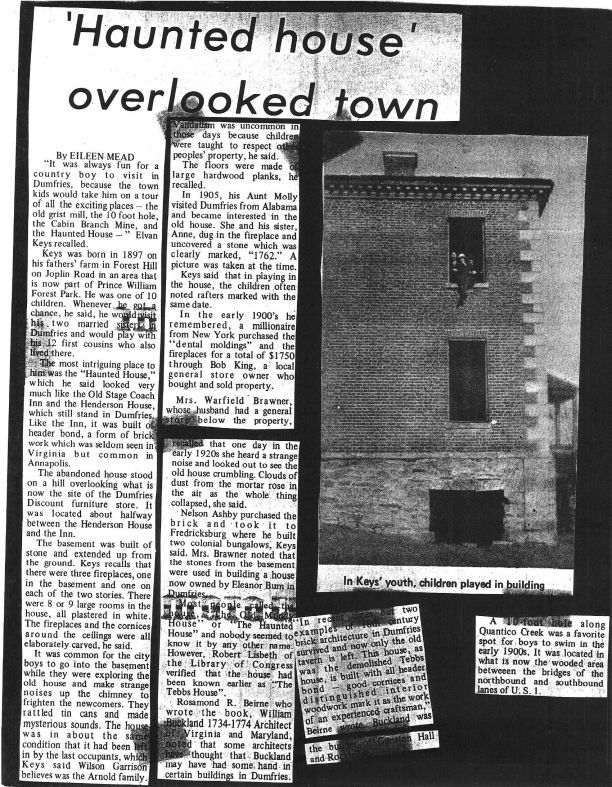
Transcription
'Haunted House' overlooked town'
By: EILEEN MEAD
"It was always fun for a country boy to visit in Dumfries, because the town kids would take him on a tour of all the exciting places - the old grits mill, the 10 foot hole, the Cabin Branch Mine, and the Haunted House -" Elvan Keys recalled.
Keys was born in 1897 on his father's farm in Forest Hill on Joplin Road in an area that is now part of Prince William Forest Park. He was one of 10 children. Whenever he got a chance, he said, he would visit his two married sisters in Dumfries and would play with his 12 first cousins who also lived there.
The most intriguing place to him was the "Haunted House," which he said looked very much like the Old Stage Coach Inn and the Henderson House, which still stand in Dumfries. Like the Inn, it was built of header bond, a form of brick work which was seldom seen in Virginia but common in Annapolis.
The abandoned house stood on a hill overlooking what is now the site of the Dumfries Discount furniture store. It was located about halfway between the Henderson House and the Inn.
The basement was built of stone and extended up from the ground. Keys recalls that there were three fireplaces, one in the basement and one on each of the two stories. There were 8 or 9 large rooms in the house, all plastered in white. The fireplaces and the cornices around the ceilings were all elaboratley carved, he said.
It was common for the city boys to go into the basement while they were exploring the old house and make strange noises up the chimney to frighten the newcomers. They rattled tin cans and made mysterious sounds. The house was in about the same condition that it had been left in by the last occupants, which Keys said Wilson Garrison believes was the Arnold family.
Vandalism was uncommon in those days because children wwere taufght to respect other people's property, he saids.
The floors were made of large hardwood planks, he recalled.
In 1905, his Aunt Molly visited Dumfries from Alabama and became interested in the old house. She and his sister, Anne, dug in the fireplace and uncovered a stone which was clearly marked, "1762." A picture was taken at the time.
Keys said that in playing in the house, the children often noted rafters marked with the same date.
In the early 19800's he remembered, a millionaire from New York purchased the "dental moldings" and the fireplaces for a total of $1750 through Bob King, a local general store owner who bought and sold property.
Mrs. Warfield Brawner, whose husband had a general store below the property, recalled that one day in the early 1920s she heard a strange noise and looked out to see the old house crumbling. Clouds of dust from the mortar rose in the aier as the whole thing collaposed, she said.
Nelson Ashby purchased the brick and took it to Fredricksburg where he built two colonial bungalows, Keys said. Mrs. Brawner noted that the stones from the basement were used in building a house now owned by Eleanor Bum in Dumfries.
Most people called the house "The Old Maid's House" or "The Haunted House" and nobody seemed to know it by any other name. However, Robert Lisbeth of the Library of Congress verified that the house had been known earlier as "The Tebbs House."
Rosamond R. Beirne who wrote the book, William Buckland 1734-1774 Architect of Virginia and Maryland, noted that some archtects have thought that Buckland may have had some hand in certain buildings in Dumfries.
"In recent ............ two examples or four century brick architecture in Dumfries survived and now only the old tavern is left. This house, as was the demolished Tebbs house, is built with all header bond - good cornices and distinguished interior woodwork mark it as the work of an experienced craftsman," Beirne wrote Buckland was the builder of Gunston Hall and Ro..........
A 10 foot hole along Quantico Creek was a favorite spot for boys to swim in the early 1900s. It was located in what is now the wooded area between the bridges of the northbound and southbound lanes of U.S. 1.
A dirt road with an old iron bridge led to the swimming hole which was about 209 feet wide and deep enough that the boys coyuld dive from an overhanging branch into the water. In the winter, the water would freeze over and it was used as a skating pond, hewent on.
Another favorite skating and swimming place was at the Old Grist Mill which was located at a dam off old Mine Road.
The mill was a two-storied stone building similar to the one which is located near Mt. Vernon, Keys said. A group of boys could spend a whole day going through the mill swimming, and walking under a waterfall there.
In about 1907, Bob King restored the mill as a hobby and actually ground flour there.
Keys said that his grandfather was a carpenter and an expeert at woodworking and he made the cogs for the waterwheel by hand for King. Nothing is left of the old mill, he said.
The Cabin Branch Mine was also a great place for a boy to visit, keys recalled. Many of the grownupsfrom Dumfries worked in the mine and they would allow the children to visit as long as they didn't get into any dangerous areas.He believes that the shaft went down about 2200 feet. The opening was about 10 to 15 feet wide, he said. He believes that the mine was established in 1870 and operated until 1918.
Keys said that the boys enjoyed watching the miners pack tallow tightly into the little lamps which they wore on their hats. They called the tallow, "Sunshine", he rwemembered. Later, the miners used carbon in their lamps.
Dumfries, in Keys childhood days, was a pretty little town with wide streets and five stores. George Radcliffs' store sold coffins and shoes and people used to say, "If you needed the coffin then you wouldn't need the shoes," Key....
Bob Waters, Hamp McInteer, Bob King, and warfield Brawner all owned stores there at that time, he remembers.
Geneologist traces history
Tebbs family lived in historic Dumfries
By Eileen Mead
It was Foushec Tebbs who lived with his family in the brick and stone house which once stood between the now historic Stagecoach Inn and the Henderson House in Dumfries, according to Mrs. Edith Ashby Turnbull, 74, a geneologist now living in Stafford County.
Mrs. Turnbull has done extensive research on the families which once occupied the areas now kniown as Prince William, Fauquier, Loudoun, and Stafford counties, as well as in areas much further south.
Mrs. Turnbull and her sister, the late Marian Ashby Berg, began searching records in 1930 when another sister, Emily Santemma, said that she would like to have the family traced so that she could join the Daughters of The American Revolution.
By the time the two sisters had traced the family ancestry back to the Revolution, and their sister had joined the Lord Sterling Post of the DAR in Long Island, Mrs. Turnbull and her sister had become so interested in geneology that they continued their quest throughout the years. Now Mrs. Turnbull has such extensive records that the DAR is interested in obtaining them, she said.
It has been 12 years since Mrs. Turnbull retired from her job as record and statistical clerk with the Navy Department in Washington. She had held the position for 36 years.
After reading about "the Haunted House of Dumfries in earlier issues of the Potomac News, Mrs. Turnbull said she felt that perhaps others would like to know about the Tebbs family which had lived in the house in the 1700s.
Mentioned in the will of Daniel Tebbs which was probated on June 29, 1742 in Prince William County were his wife Charlot; daughters Jannah Hartley, Margret Atwall, Charlot, and Sarah; and sons Daniel, James, William, George, and Foushee.
Daniels' sons William and Foushee became the most prominent members of the family in the history of Dumfries and Prince William County.
Young Daniels' name appeared on a resolution appealing the stamp Act signed in Leedstown on Feb. 27, 1766 and on Lees' document at Leedstown.
James and his wife, Mary apparently took the Southern trip by Cumberland Gap staying in Southwest Virginia for a spell and then moving into North Carolina and into Tennessee before traveling through Kentucky into Indiana. A descendent apparently became an indian fighter with Daniel Boone, Mrs. Turnbulls' records show.
Prince William County was formed in 1730-31. The seat of government was established at what was then the center of the settled portion of the county, on the south side of Occoquan Creek near the present Woodbridge.
Among the first burgesses from Prince William to go to Williamsburg in 1732 were Foushee Tebbs, Thomas Blackburn, Richard Blackburn, William Fairfax, John Colville and Henry Lee.
In December of the same year, Foushee Tebbs and William Tebbs were appointed to the commission of safety which had just been organized.
Prince William County is called the second settrlement of the old English families, according to historians, Mrs. Turnbull said. It seemed as though the second and third genetations came to Prince William County from Stafford and Westmoreland counties seeking more land in which to expand.
Dumfries settlers were primarily of Scotch ancestry. In the early 1700s "Scotsmen were everywhere sailing the high seas in search of wealth." In 1696 there was a settlement at Chippawamsic on Quantico Creek, which was supposed to have been the begining of the Town of Dumfries, named for Dumfries on the Clyde in Scotland.
There were extensive warwehouses and flour mills in the area and a second custom house was established in 1730. Wheat was milled at the village salted provisions and lumber for staves were items of export. Tobacco from the surrounding countryside was the main export.
The water was never deep enough in Quantico Creek to permit vessels to sail up to the docks, so small boats lightered the goods to and from the ships lying in the river.
In 1749, Richard H. Lee caused a bill to be passed in the House of Burgesses incorporating the town of Dumfries which was at the time the largest place in Northern Virginia, according to population and commercial activity.
When the town was enlarged for the third time Foushee Tebbs was one of the incorporators named. It was noted that the list included the names of the men of highest importance in Virginia; William Carr, Richard Henry Lee, and Henry Lee, and many more.
Major William Tebbs was a prominent attorney and had as his client Daniel Payne, a merchant who had over 350 clients in a 50 mile radius. Customers included George Washington from Mount Vernon and persons from Stafford County
Accounts showed that in addition to being a storekeeper, Payne was a general banker to the people, he paid thweir church levys, their general taxes, and advanced cash on prospective crops of tobacco. Judgments, aided by Major Tebbs his attorney, were rather frequent but always for small sums.
Dumfries merchants in those days amassed great fortunes for the times. In the pre-revolutionary days Dumfries possessed a bank, a newspaper, The Gazette, and an academy for the teaching of its youth; as well as a considerable numberof stores of various kinds.
In 1797 a Masonic Lodge was organized and was active until 1845 when it was discontinued. It was Lodge 50.
Church on Sundays was divided into three parts: before the services announcements were given, letters of business concerning the townspeople were read, and things were settled including the price of tobacco and grain, and the age, lineage, or qualities of a favorite horse.
The church services portion of the day was dispensed with quickly, according to records and then there was the social hour. A visitor described the neighborhood as "civil and polite" and one might be invited home for dinner by parishoners if he were visiting the community.Transcriber
Rachel Hughes