Transcription
6 July 78
NO SLUDGE! 150 are residents register protests
By FRANK RATHBUN
Some 150 residents of the Cherry Hill
and Possum Point Road areas
registered protests Wednesday over the
proposed construction of a $10 million
sludge treatment plant on Cockpit
Point.
The concerned residents lodged their
protests with the Prince William
Planning Commission during an orderly,
three-hour public hearing at Gar-Field
High School, which ended with the
commission voting unanimously to
continue the public hearing on July 29,
at the school.
If ultimately approved, the plant,
located on a 46-acre site, would transform
some 900 tons of sludge and 800
tons of solid waste per day into
marketable compost.
However, in order to build the plant,
which would be the largest such facility
in the nation. Dano Resource Recovery
Inc. must obtain a special use permit
from the Prince William Board of
Supervisors.
The task of the commission is to pass
a recommendation - favorable or not -
on to the supervisors.
Individual protests concerned a
number of potential problems, including
traffic to and from the plant on
Possum Point Road, odors emanating
from the plant and potential health
hazards associated with the incoming
sludge.
"Why did the (Dano) company select
Prince William to build the (plant)?"
asked James A. Bishop of Dumfries.
"They (Dano) know how weak Prince
William is. That's why they made the
application in Prince William.
"They are not here for our benefit,"
Bishop told the commission in the midst
of considerable applause. "They are
here to make money. You can't kick
them out (once they are in), but you can
keep them out."
"Should the citizens of this area be
called on to suffer the discomfort and
indignity of processing debris from
Washington, D.C.?" asked Donald
Curtis, chairman of the Prince William
Historical Commission.
"Please let's not become the world's
largest dung processor." Curtis
lamented.
The Prince William planning staff
has recommended that the county
approve the special use permit contingent
on at least 16 conditions, several
of which attempt to eliminate any odor
problems associated with the plant.
As one condition for approval, the
staff has recommended that sludge and
solid waste be brought to the plant by
rail or barge and not by truck on
Possum Point Road.
The condition also states that "All
vehicles - whether barge or rail that
transport sludge, solid waste or (plant)
rejects - must be sealed."
A related condition of approval states
that the "unloading of sludge and solid
waste must be conducted within an
enclosed structure ... with appropriate
odor control filtration."
Two additional conditions would
place a limitation of one day's sludge or
solid waste on the site at one time and
that "the enclosed facility be designed
and constructed such that it may be
cleaned as often as necessary to
maintain sanitary conditions."
These and other conditions apparently
did little to subdue the opposition
to the plant from area
residents.
Former Supervisor Ralph Mauller
told the commission that the proposed
plant presents a "dangerous situation."
"We could (end up) handling (sludge
treatment) for the entire eastern
seaboard of the U.S.," Mauller told the
commission.
"This may be farfetched," he said,
but "once you get one of these things
started ... the entire operation could
explode. Refuse this permit this time
and anytime in the future."
Delegate Floyd Bagley told the
commission: "I fail to see any
redeeming feature in this (sort) of
industrial development."
Bagley, who lives on Possum Point
Road, added. "The people are against
this proposal, (and) if it's approved,
you'll just be in for a law suit."
Jack Garrison of Dumfries asked the
commission: "Why have all other
jurisdictions in the area said no to the
proposition? Is there a market for the
compost or will it have to be landfilled
in Prince William?
"I don't think we would want the label
of being the outhouse of Northern
Virginia," he concluded.
Staff planner Jeff Middlebrooks, who
recently visited a similar plant in
Leicester, England, said there exists a
"strong market (for compost) in the
U.S., particularly in this region."
Composting "is not a huge moneymaker,"
Middlebrooks said, adding, it
is a "good way to dispose of solid
waste."
"Some of us are concerned that
everything (sludge and solid waste)
will come in and nothing (compost) will
go out," said commissioner C.D.
Thomaidis.
"This compost is not something our
people are dying to get," he added.
"Whether or not a corporation makes
- See SLUDGE, pge A-4
- Continued from page A-1
SLUDGE
a profit is the corporation's own
business," responded David Dodd,
director of the Prince William office of
Economic Development.
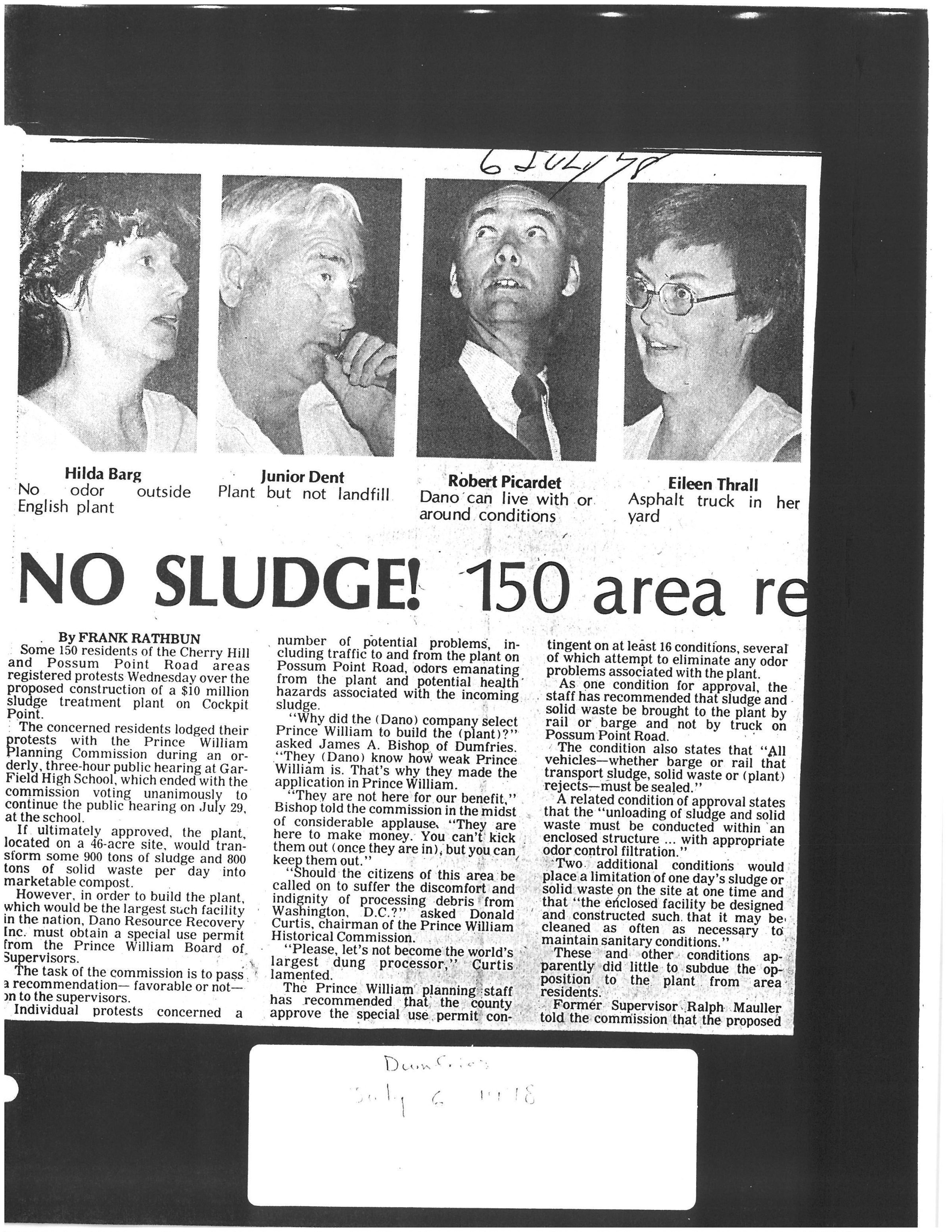
Hilda Barg, a resident who journeyed
to Leicester, England with Middlebrooks,
said there was no odor 50
feet away from the plant, although
"inside the plant smells terrible."
Residents living in the vicinity of the
Leicester plant, Ms. Barg told the
commission. "all seemed to be glad to
have the industry.
"I'm not in any way pushing Dano,"
she added. "This is the best, most
honest report I can give."
Junior Dent, who had visited the
plant in England, spoke in favor of the
composting plant, but not a landfill.
Ed Dent was against the whole idea.
Citing pictures she could show of an
asphalt truck in her front yard, Eileen
Thrall spoke against the increased
truck traffic she believes the plant
would bring.
Middlebrooks said Leicester
residents had "quite violently" opposed
that plant, built in the early 1960s.
Now, he added, the residents say
there is no impact on the community
from the plant "except a slight odor on
still days."
Additional conditions placed on the
recommended approval include:
- A detailed plan of operation must be
submitted and approved by a separate
Board of Supervisors resolution.
- This plan must contain a detailed
transportation plan of barge or rail
delivery. These vehicles must be inspected
and approved by the county
prior to their use.
- No material other than finished
compost may be stored on the site in
open air.
- Should odor from the open air
compost be detected, the county
reserves the right to require full enclosure
with odor filters or the removal
of the compost from the site.
"We (Dano) can live with or around"
the conditions, said Robert Picardat,
vice president of Dano.
Picardat limited his time on the
podium to fielding questions from the
commissioners and quoting from a staff
report.
Quoting from the report, Picardat
said: "The land has been zoned industrial
for a long period of time. To
deny a permit for an industry would not
go unnoticed by those who are looking
at Prince William (for business
location) ... and would be contrary to
the steps that the county is taking in
order to attract industry.
"A more intangible benefit (of the
Dano plant) could be the enhancement
of the county's image," Picardat said.
The Dano plant, he concluded,
"solves a regional problem resulting in
revenues for the county and can also
reduce the cost of our own sludge
disposal in the near future."
"Since composting is a resource
recovery process, Prince William
should take this opportunity to become
involved," Picardat said.
Picardat confirmed that Dano is
currently involved with Fairfax County
officials over a proposal to build a
similar plant near Dulles Airport.Transcriber
Adam KitchenLanguage
English