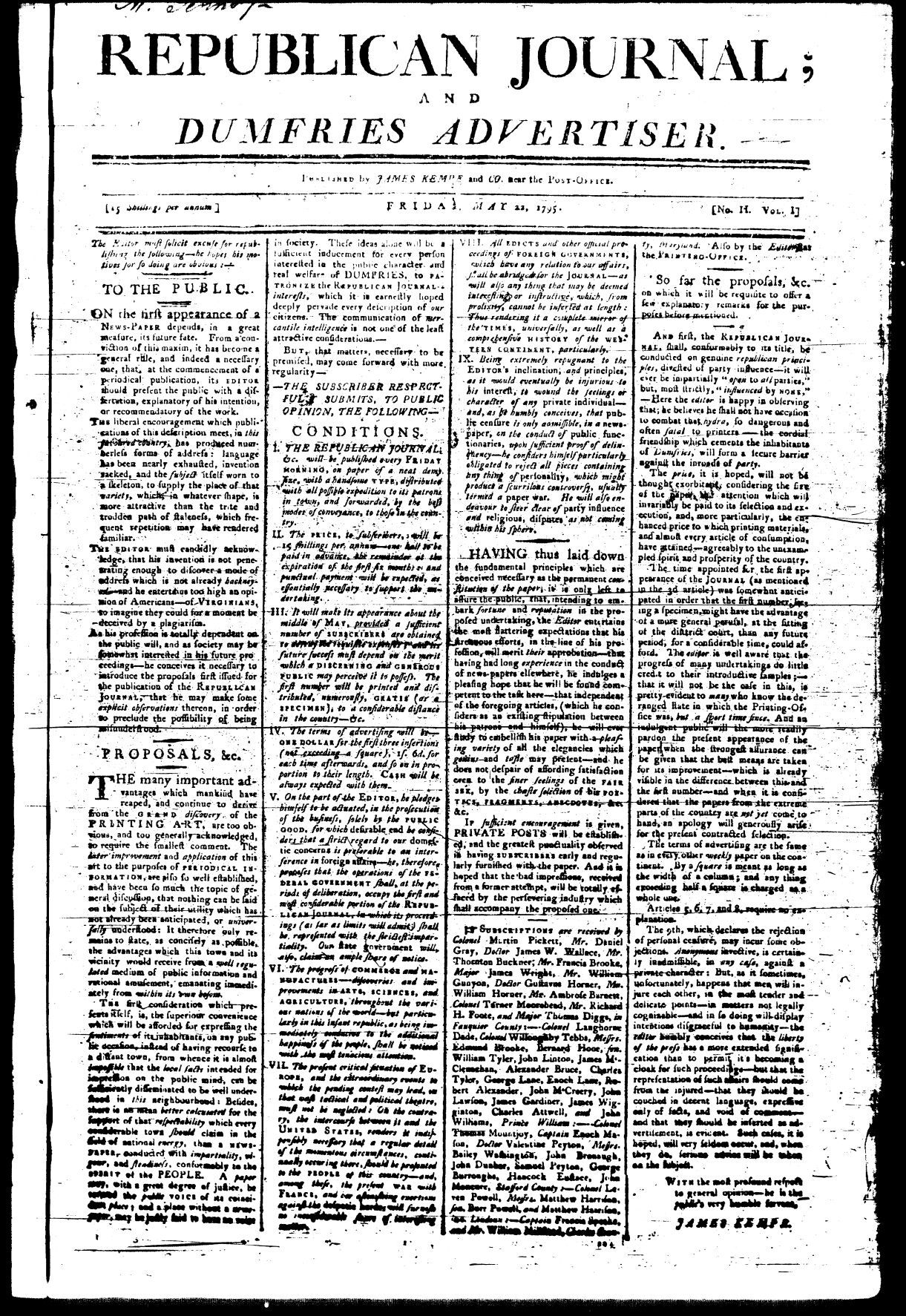
Transcription
REPUBLICAN JOURNAL;
AND
DUMFRIES ADVERTISER.
Published by JAMES KEMPE and CO. near the Post-Office.
[15 shillings per annum] FRIDAY, MAY 22, 1795. [No. II. Vol. 1]
The Editor must solicit excuse for republishing the following - he hopes his motives
for so doing are obvious: -
TO THE PUBLIC.
ON the first appearance of a
News-Paper depends, in a great
measure, its future fate. From a conviction
of this maxim, it has become a
general rule, and indeed a necessary
one, that, at the commencement of a
periodical publication, its EDITOR
should present the public was a dissertation,
explanatory of his intention,
or recommendatory of the work.
THE liberal encouragement which publications
of this description meet, in this
[?atoured?] country, has produced numberless
forms of address: language
has been nearly exhausted, invention
sacked, and the subject itself worn to
a skeleton, to supply the place of that
variety, which in whatever shape, is
more attractive than the trite and
trodden path of staleness, which frequent
repetition may have rendered
familiar.
THE EDITOR must candidly acknowledge,
that his invention is not penetrating
enough to discover a mode of
address which is not already [backneyed?]
and he entertains too high an opinion
of Americans - of VIRGINIANS,
so imagine they could for a moment be
deceived by a plagiarism.
AS his profession is totally dependent on
the public will, and as society may be
somewhat interested in his future proceedings -
he conceives it necessary to
introduce the proposals first issued for
the publication of the REPUBLICAN
JOURNAL, that he may make some
explicit observations thereon, in order
to preclude the possibility of being
misunderstood.
PROPOSALS, &c.
THE many important advantages
which mankind have
reaped, and continue to derive
from the GRAND discovery of the
PRINTING ART, are too obvious,
and too generally acknowledged,
to require the smallest comment. The
later improvement and application of this
art to the purpose of PERIODICAL INFORMATION,
are [piso?] so well established,
and have been so much the topic of general
discussion, that nothing can be laid
on the subject of their utility which has
not already been anticipated, or universally
understood: It therefore only remains
to date, as concisely as possible,
the advantages which this town and its
vicinity would receive from a well regulated
medium of public information and
rational amusement, emanating immediately
from within its own bosom.
THE first consideration which presents
itself, is, the superior convenience
which will be afforded for expressing the
sediments of its inhabitants, on any public
[decasion?], instead of having recourse to
a different town, from whence it is almost
impossible that the local facts intended for
impression on the public mind, can be
[?ntly?] disseminated to be well understood
in this neighborhood: Beside,
there is an [mean?] better calculated for the
support of the respectability which every
considerable town should claim in the
[field?] of national energy, than a newspaper,
conducted with impartiality, [?], and [sentiments?],
conformably to the [?] of the PEOPLE. A pare
[?], with a great degree of justice, be
[?] the public voice of its [coincident?]
place; and a place with out a [?],
may be justly [?] [?] [?] [?]
in society. These ideas alone will be a
sufficient inducement for every [perfon?]
[interelled?] in the public character and
real welfare of DUMFRIES, to PATRONIZE
the REPUBLICAN JOURNAL'S
interests, which it is earnestly hoped
deeply pervade every description of our
citizens. The communication of mercantile
intelligence is not one of the least
attractive consideration. -
BUT, that matters, necessary to be
premised, may come forward with more
regularity -
- THE SUBSCRIBER RESPECT
[FUL?] SUBMITS, TO PUBLIC
OPINION, THE FOLLOWING -
CONDITIONS.
I. THE REPUBLICAN JOURNAL
&c. will be published every FRIDAY
MORNING, on paper if a neat [demp?]
size, with a handsome TYPE, distributed
with all possible expedition to its patrons
in town, and forwarded, by the left
modes of conveyance, to those in the
country.
II. The PRICE, is subscribers, will be
15 shillings per annum - one half to be
paid in advance, the remainder of the
expiration of the first six months [?] and
punctual payment will be expected, as
essentially necessary to support the undertaking.
III. It will make its appearance about the
middle of MAY, provided a sufficient
number of SUBSCRIBERS are obtained
to [?] [?] [require?] expenses and its
future success must depend on the merit
which a DISCERNING and GENEROUS
PUBLIC may perceive it is [possess?]. The
first number will be printed and distributed,
numerously, GRATIS (as a
SPECIMEN), to a considerate difiance
in the country - &c.
IV. The terms of advertising will be -
ONE DOLLAR for the first three insertions
(not exceeding a square), 1s. 6d. for
each time afterwards, and so on in proportion
to their length. CASH will be
always expected with them.
V. On the part of the EDITOR, he pledges
himself to be actuated, in the prosecution
of the business, solely by the PUBLIC
GOOD, for which [defirable?] end be considers
that a strict regard to our domestic
concerns is preferable to an interference
in foreign affairs - he, therefore
proposes that the operations of the FEDERAL
GOVERNMENT shall, at the periods
of deliberation, occupy the first and
most considerable portion of the REPUBLICAN
JOURNAL, in which its proceedings
(as far as limits will admit) shall
be represented with the [strictest?] impartiality
Our state government will,
[rise?], claim on ample share of notice.
VI. The progress of COMMERCE and MANUFACTURE
- discoveries and improvements
in ARTS, SCIENCES, and
AGRICULTURE, throughout the various
nations of the world - but particularly
in this infant republic, as being immediately
[conducive?] to the additional
happening's of the people, shall be noticed
with the most tenacious attention.
VII. The profane critical formation of EUROPE,
and the extraordinary events in
which the pending contest may lead, on
that [most?] [radical?] and political theatre,
must not be neglected. On the contrary,
the intercourse between it and the
UNITED STATES, renders it indispensably
necessary that a regular detail
of the momentous circumstances, continually
occurring there, should be presented
to the PEOPLE of this country - and,
among these, the present war with FRANCE,
and [?] [?] [?] [?]
against the [?] [?] will [?]
[?] [?] [?] [?] [?]
[?]
VIII. All EDICTS and other official proceedings
of FOREIGN GOVERNMENTS,
[wisch?] have any relation to our affairs,
[?]..all be abridged for the JOURNAL - as
will also any thing that may be deemed
interesting or instructive, which, from
[profixity?], cannot be inserted at length;
Thus rendering it a complete mirror of
the TIMES, universally, as well as a
comprehensive HISTORY of the WESTERN
CONTINENT, particularly.
IX. Being extremely repugnant to the
EDITOR'S inclination; and principles,
as it would eventually be injurious to
his interest, to wound the feelings or
character of any private individual -
and, as be humbly conceives, that public
censure is only [a??missible?], in a newspaper,
on the conduct of public functionaries,
upon sufficient proof of delinquency
- he considers himself particularly
obligated to reject all pieces containing
any thing of personality, which might
produce a [scurrilons?] controsversy, usually
termed a paper war. He will also endeavour
to steer clear of party influence
and religious, disputes as not coming
within his sphere.
HAVING thus laid down
the fundamental principles which are
conceived necessary as the permanent
constitution of the paper, it is only left to
assure the public, that, intending to embark
fortune and reputation in the proposed
undertaking, the Editor entertains
the most flattering expectations that his
[?rc??ous?] efforts, in the line of his profession,
will merit their approbation - that
having had long experience in the conduct
of news-papers elsewhere, he indulges a
pleasing hope that he will be found competent
to the talk here - that independent
of the foregoing articles, (which he considers
as an [exiting?] [flipulation?] between
his patrons and himself), he will ever
study to embellish his paper with a pleasing
variety of all the elegancies which
genius and taste may present - and he
does not despair of affording satisfaction
even to the finer feelings of the FAIR
SEX, by the chaste selection of his [PO?TACS?],
FRAGMENTS, ANECDOTES, &c,
&c.
IF sufficient encouragement is given,
PRIVATE POSTS will be established,
and the greatest punctuality observed
in having SUBSCRIBERS early and regularly
furnished with the paper. And it is
hoped that the bad impressions, received
from a former attempt, will be totally effaced
by the persevering industry which
shall accompany the proposed one.
[?] SUBSCRIPTIONS are received by
Colonel Martin Pickett, Mr. Daniel
Gray, Doctor James W. Wallace, Mr.
Thornton Buckner; Mr. Francis Brooke,
Major James Wright, Mr. William
Gunyon, Doctor Gustavus Horner, Mr.
William Horner, Mr. Ambrose Barnett,
Colonel Turner Moorebead, Mr. Richard
H. Foote, and Major Thomas Diggs, in
Fauquier County: - Colonel Langhorme
Dade, Colonel Willoughby Tebbs, Majors.
Edmund Brooke, Bernard Hooe, [son?]
William Tyler, John Linton, James M'Clemehan,
Alexander Bruce, Charles
Tyler, George Lane, Enoch Lane, Robert
Alexander, John [M'Croery?], John
Lawson, James Gardiner, James Wigginton,
Charles Attwell, and John
Williams, Prince William : - Colonel
Thomas Mountjoy, Captain Enoch Mason,
Doctor Valentine Peyton, Messrs.
Bailey Washington, John Burroughs,
John Dunbar, Samuel Peyton, George
Burroughs, Hancock Eustace, John
[Moncore?] , Stafford County : - Colonel [Leven?]
Powell, Majors. Matthew Harrison,
[son?], Barr Powell, and Matthew Harrison
[?], Loudon : - Captain Francis Speake,
and Mr. William [Millford?], Charles County,
Maryland. Also by the Editor of
the PRINTING OFFICE.
So far the proposals, &c.
on which it will be requisite to offer a
few explanatory remarks for the purposes
before mentioned.
AND first, the REPUBLICAN JOURNAL,
shall, conformably to its title, be
conducted on genuine republican principles,
divested of party influence - it will
ever be impartially "open to all parties,"
but, most strictly, "influenced by NONE,"
- Here the editor is happy in observing
that; he believes he shall not have [occation?]
to combat that hydra, so dangerous and
often fatal to printers - the cordial
friendship which cements the inhabitants
of Dumfries, will form a secure barrier
against the inroads of party.
The price, it is hoped, will not be
thought exorbitant, considering the [rise?]
of the paper. [The?] attention which will
invaluably be paid to its selection and execution,
and, more particularly, the enhanced
price to which printing materials,
and almost every article of consumption,
have obtained - agreeably to the unexampled
spirit and prosperity of the country.
The time appointed for the first appearance
of the JOURNAL (as mentioned
in the 3d article) was somewhat anticipated
in order that the first number, [??ing?]
a specimen,might have the advantage
of a more general perusal, at the fitting
of the district court, than any future
period, for a considerable time, could afford.
The editor is well award that the
progress of many undertakings do little
credit to their introductive samples; -
that it will not be the case in this, is
pretty evident to many who know the deranged
slate in which the Printing - Office
was, but a short time fence. And an
indulgent public will the more readily
pardon the present appearance of the
paper when the strongest assurance can
be given that the [bell?] means are taken
for its improvement - which is already
visible in the difference between this and
the first number - and when it is considered
that the papers from the extreme
parts of the country are not yet come to
hand, an apology will generously arise
for the present contracted selection.
The terms of advertising are the fame
as in every other weekly paper on the continent.
By a square is meant as long as
the width of a column; and any thing
exceeding half a square is charged as a
whole one.
Article 5, 6, 7, and 8, require no explanation.
The 9th, which declares the rejection
of personal censure, may incur some objections.
Anonymous invective, is certainly
inadmissible, in any case, against a
private character; But, as it sometimes,
unfortunately, happens that men will injure
each other, in the most tender and
delicate points - in matters not legally
[cogaizable?} - and in so doing will display
intentions disgraceful to humanity - the
editor humbly conceives that the liberty
of the press has a mote extended signification
than to permit it's becoming a
cloak for injured - that they should be
couched in decent language, expressive
only of facts, and void of commons -
and that they should be infested as advertisement,
is evident. Such cases, it is
hoped, will very seldom occur, and, when
they do, serious advise will be when
on the subject.
WITH the most profound [respose?]
to general opinion - he is the
public's very humble servant.
JAMES KEMPE.
By [??Port?] Mary arrives at New York,
from Liverpool, [?oma?n?] papers have
been received to [the?] [?] of [M??],
which enable us to continue our [chain?]
of
European Intelligence.
LONDON, March 11.
Monday a mandate was sent
from the secretary of State's office
[?o] the [Com??] at Newgate, ordering
that Mr. Gerald and Major Sample
should make [ready?] for their departure in
a [relief?] [bound?] for [Lo?any] - Bay.
March 12, As there a [?] in this
country, who talk of peace, and of the
moderate views of [Peace?], were commend
such men to read the concluding paragraph
of very long speech made by
Girand, in the National Assembly, on
the 18th [ult?]:
"It is therefore against England that
our views ought to be directed. No peace
with her, without an indemnity for the
evils which she has [?o??tioned?]; and this
indemnity can only be obtained by force
of arm; by that means, the eyes of
the British nation will be opened to the
gradual [enero?cism?] [has?] of the executive
power, and the people at length [dellroy?]
the influence of corruption. Either this
effect will be soon produced, or the
proud Briton, which is hitherto boasted
that his country is the noblest in the
world, will be forced to confess that it
is the vilest.
But it is necessary that we should accelerate
the event, by depriving George
of one of his means - I mean the Electorate
of Hanover - this Electorate ought
to be used for the destruction of the
British Leopold. In this treaty we ought
to stipulate for free passage for our victorious
armies, in order that we may be
enabled to seize this [offession?] of the head
of the house of Brunswick, who, deprived
of this resource and of the power of
subsidizing the prince of Germany, will
soon be forced to bend beneath the [genint?]
of the Republic."
March 13: The Emperor presents in
refuting the loan offered to him by this
country, since the extraordinary movements
in his own neighborhood make it
[?tible?] with the own safety to proceed
in the war. The terms offered him
by the French are too advantageous to
be [retifled?]; and there is little doubt, but
that he, like Prussia, will accept of the
boon that is held out to him, namely,
the guarantee of Bavaria.
The enormous expenditure in this unfortunate
and disastrous War, [mu??ere?]
long, overwhelm the Country; for whilst
the Minister lays on additional Taxes,
the means of paying them decrease daily.
There is every reason to apprehend that
the Revenue this year will be extremely
unproductive, for never were the Commercial
Concerns of this Nation in so
deplorable a state.
A droll requisition was made in Holland
lately, for two thousand cats to be
put into the [corn?] [storage?] to prevent the
[havock?] made by rats and mice.
March 14: On Thursday the receipt
for the new loan of [?8,000,000?] began to
be delivered at the bank, [?] the
whole of which (such is the plenty of
money in the market) were immediately
paid up in full.
March 16: The Queen has furnished
the Princess of Wales's Wardrobe at
Carleton House. The marriage dress is
of the most superb Turkey sattin, the
[pettictat?] [?] trimmed with [sest?ons?] of
[gold?] and acorns. The head dress is of
Messrs. Hammersly's Bankers, in [Patt?]
Mall, the ornaments of which are computed
[?] [?] [?] [?]
March 17: Yesterday a board was held
[in?] the admiralty office, at which Earl
[Spincer?] and the other Commissioners
attended, when three frigates were ordered
to be put into commission.
Yesterday some dispatches were received
at the admiralty office from the
Mediterranean, by the way of Gibraltor
and Lisbon. Admiral [Horham?] is returned
to his station off Toulon, watching
the French flees, which will [conti???]
in that part, though they have long
been refitted and ready to fall. The
British commander in chief has received
[?] intelligence [?] want of [?],
timber, & [?] Toulon.
An order has been offered from the pay
office [?] 100,000 to be sent to the
[?] by the [?] frigate, for the
service of the enemy.
Be letters received from [?] [?]
leave that [?] [?anith?] [?] [?] had
[?] there, and brought [in?] will [?]
a French privateer mounting is gone.
BRITISH ARMY.
[?] [?] [?]
[?] [?] [?] [?] a [?] corps
country of the 27th, 28th, [?] and
84th regiments with their [artillery?]
[with?] [our?] retreat began, and [?]
very [c?c???tous?] tour through [We?]
[Frie???d?] and [and?g?] the borders of the
Province of Groningen a very [?]
province. We were entirely wide of the
British army, and [?d?] near the [ZayderZee?].
The object of this march seemed
to be to found [the?] disposition of the
people, but it appeared to answer no
purpose. The people, in our province,
were staunch, and treated both officers
and men with the most] extravangant
symptoms of loyalty to the cause of the
Prince, but these only lasted till our
departure
We marched without a halt for upwards
of 170 miles, through the dreary
country, suffering much from extreme
cold and fatigue.
We passed within 6 miles of Groningen,
and Lord Cathcart received deputies
from the city offering to open
their gates to us, if his lordship infilled
on it, but rather wishing that we would
not enter, as there were two [partica?n?]
the town. They assured us of every
supply to the brigades of shoes, [?c?]
which we stood much in need of. We
halted three days at [Hage?at?], about 9
miles from Groningen. A particular
thaw coming on, we marched across the
Embs into Prussia, and before we had
remained there three days, at a town
called Lear, we were ordered to [repass?]
the Embs and advance to this position,
where we have taken possession of the
three Dutch fortresses on the frontiers
of Holland, viz. Bourlang, Oldskans,
and Neuskans, which form our advanced
post. The enemy's advanced polls are
about two miles from ours. Our advanced
corps is strong, and [scry?ably?]
commanded by Lord Cathcart.
Orders have been received at the war
office for the 83rd and 98th regiments in
barracks at Poole, to hold themselves in
readings to embark on some secret expedition.
The Dutch commissioner who left
this country a few weeks [finer?], for the
purpose of communicating the British
minister's answer on the detention of the
Dutch ships, arrived in town yesterday
with [frosh?] instructions from the provisional
representatives of Holland to their
deputies in London on that subject.
It is believed that government has information
of a formidable expedition
intended against [Corsion?]. The following
is an extract of a letter from a gentleman
in Italy dated January 31, 1795.
"The fleet in Toulon roads is ready
for sea. There are a great number of
men on board it, but a general [wall?] of
able seamen. There are 8000 troops
encamped ready to be embarked at a
regiment's notice, so that the plan of
an expedition is not yet given over."
A great mercantile house in the city
is said to have received a letter from
Frankfort, announcing the truth of a
negotiation now carrying on between the
emperor of Germany and the French
republic. The object of this treaty
is said to be the change of Batavia against
the Austrian Low [Countries?].
We have the satisfaction of stating
the arrival at Falmouth of the [Lanza?ate?],
a Spanish pocket, after a very
quick passage of only these days from
[Gorunna?], which brings advice of the
Spanish army in Rouillon having attacked
the French, killed 700 and taken
[1000?] prisoners, with [20?] [piece?] of
cannon.
The account of Admiral [Languara's?]
squardron having captured four French
frigates is confirmed.
March 20. It is with great satifaction
we have to record the spirit, activity
and success that now distinguish our naval
operations. Sir Edward Pellew, that
gallant and enterprising officer, on the
[9th?] [?] fell in with a French convoy,
consisting of 50 sail, which had failed on
the preceding day from [Bred?] for Bourdeaux
- He captured [?] or 19 vessels and
[disperted?] the convoy. To our Falmouth
letter we refer for all the particulars
that were known at the time of [?] [?].
A [?] [?] our [?] of [?]
is [on?] the point of being [overlooked?]. [Over?]
[?] [have?] already hired three vessels
in the [p??ure?] of bringing home the
[?] [?] [and?] have given four
[?] [?] [?] who were
[?] from [Martinque?], [?] go [?]
[?] [?] [?]
We are [?] [?] [?] [?] [?]
[?] [?] [?] [?] of Holland,
[?] [?] [?] [?] [?] of [?]
[?] [?] [?] [?] 5 or 0 [?]
[?] [?] [?] [?] [?] [?] [?]
[?] with the [?] coast; they
are [?] twenty to [?] [?].
March 21. [?] [?] of yesterday
[?] stated, upon the information of a correspondent
there, the arrival at Yarmouth
of [?] Dutch merchants and an Englishman,
the [mate?] of an English [transport?]
[?unk?] at [?otterdam?], was made their
escape from the [Tesel?] on Monday [might?]
last in a [Schl?it?]. As the intelligence
was not contained in the whole of our
impression of yesterday, we beg leave to
recapitulate it to-day for the satisfaction
of all our readers.
There has been no particular occurrences
at Amsterdam, but letters had been received
there with very extraordinary intelligence
from Paris.
These letters state, that on Wednesday
the 11th instant, late in the afternoon,
judgment of death was pronounced
by the revolutionary tribunal against
[Hectare?] and his accomplices. The same
night, on some rockets being fired from
the Observatory, a [banditti?] assembled in
the [suburb?] of St. Germain, St. Mareau,
and St. Antoine, led on by the most
enraged of the Jacobins, and accompanied
by a shoat of [Pois?ards?], to the number
of about 15,000. - They proceeded to
the Touilleries, beset the guards of the
district, and took [pollession?] of the [barriers?]
and the bridges.
The general cry was "a [bas?] les Moderes,
vivant les Jacobins," while another
part of the mob exclaimed, "Du
[Pain?], et [ne?] Roi!" The issue of this
tumult was not known when the accounts
[came?] away. - The ferment had
been some time brewing, as was evident
from several circumstance, particularly
from the cry that was raised in the Parterre
of the opera of the night before, "a [bas?] les
[Malendina?]," on the entry of Madame
Tallien or [Cabarres?], in her superb
Greek dress into one of the boxes.
In the course of the night a large
party was detached from the Carousel to
the Temple. From the divided sentiments
of the mob, it appeared quite uncertain
what was their design, whether
to put to death the illustrious prisoners
confined there, or liberate and proclaim
Louis XVII.
Such is the statement which reached
us yesterday, and which we thought it
our duty immediately to communicate.
We have this day nothing to add in support
of its credibility, having, when
this paper was put to press, received no
further account nor confirmation. We
shall look however with more than usual
anxiety for Paris papers of the date of
the rumoured transaction in the capital.
March 23. Our Portsmouth correspondent
gives us, this morning, information
of the arrival there of an American
vessel from [Haver?] de Grace, which
place the left on the 19th instant. By
this vessel an account is brought of the
trial, condemnation and execution of
Barrere and his accomplices. Nothing
is said of any tumult at Paris, but the
confirmation of the above important
event, proves that our intelligence of
Friday was not entirely unworthy of
credit, and forms our complete jurisdiction
in laying it before the public.
March 24. A letter from Gibraltar,
dated the 29th of last month, of which
the following is an extract, has just been
received by Mr. Vanderhorst, the American
consel at [Brid?d?]. - Maley Golyman's
cruizers are [earh??????] [??] [de??n?]
all vessels belonging to the United States
of America, and for that [end?] will certainly
leave Sallee, and cruize as far as
Madeira as [?] as the weather shall
favour them."
Sir William [Erkine?], Bart died last
week, at his [home?] at [Tur?r?], near [Aios?].
He had received his majesty's commission,
to go instantly to Ireland, to take
upon himself the command of the troops
in that kingdom; he was preparing for
his departure when this [most?] distinguished
veteran was [?ei??d?] with a [i?palm?], and
died. He was [?] [?] [?].
The [?] important event which has
occurred lately, as far as [rel????] [to?] the
political [families?] of this country, is the
determination which has been [?]
by the court of [Ruilia?], of entering [?]
into the confederacy [against?] [?]
[?] [?] generally [?], that the [?]
[get?] [alone?] entered into between the [French?]
republic and the court of Berlin, [?] [?]
[?] [the?] [?] [?] to take this [????ee?]
[?] [?] [believed?], that a treaty between
the court of [Ruilia?], and this
Kingdom, either is concluded, or on the
point of [bring?] [to?], by which [that?] [?]
binds [?] to a vigorous co-operation
with us [?] the war in which we are [?on?aged?].
So important an ally, under
the present circumstances, gives us [the?]
most confident hope of a speedy and successful
termination of the present [?]
The fears of the public respecting ireland,
have in a great degree [inos???d?].
We cannot but rejoice in the [line????]
has been taken of averting the impending
danger in its [h???] appearance; [a?dw?e?]
are satisfied, that notwithstanding; [?]
various attempts which have been made
to inflame [the?] minds of the catholic
every thing in that kingdom will [loan?]
return to its former state, and that [load?]
Cambden will shorty remove all the difficulties
which may have been apprehended.
PORTSMOUTH, March 20.
In the evening arrived from Havre-de-Grace
the American ship Swan [C?ll???]
[matter?] She left Havre-de-Grace the [same?]
instant. The matter brings information
of the deputies Darrere, Billaud Varenness,
and Collot d'Herbois, having been
[?reliant?] condemned, and were [executed?]
a few days before said ship sailed from
[Hawa?], according to accounts which
had been [receited?] there; and that [Vadiet??],
the other deputy, who had disappeared,
had been apprehended.
DUBLIN, March 24.
About 30,000 men have left this
country since the commencement of the
present war to spill their blood in defense
of the Protestant crown of which
scarcely [50,000?] are supposed to be of the
established religion; and yet do the
wretched corporation of Dublin [in?] this
awful period, resolve to petition against
the liberties of the [d?serying?] [?] [?]
men.
American Intelligence.
NEW YORK, May 11.
Extract of a letter from a gentleman
known to be a friend of Mr. [Jay?], [?]
[Reusselaer?] county, May 1, 1795.
" ,I will just take the liberty to touch
on our politics at the day; the friend [?]
the virtuous Jay, a few days past, were
extremely sanguine in their expectations
of success in the elections; but contrary
to their expectations, votes have [?]
much in favour of Mr. Yates, at the
different polls, generally speaking, which
leads us to suppose, that Mr. Yates will
gain the election, by a respectable majority."
May 14. Captain Henry, of the [b??]
Diana, from [Gouive?], has very obligingly
communicated to the printer of the Diary,
the following particulars of the engagment
before St. Mark's : -
On the [27?]th April, news arrived at
[Gouive?] of an attack having been made
on St. Mark's by a detachment of mulattoe
and blacks, being part of the army
commanded by general [Tonson?] -
The engagement began on that day [at55?]
P. M. and continued until 10 the next
morning, during the night a detachment
of the British force, by a [circuitous?]
route, get in the rear of the republicans
and attacked them - the army of [Tonson?],
[supporting?]nit to be a reinforcement from
Port-au-Prince, did not perceive their
deception, until the British got considerable
ad... [truncated due to length]Transcriber
Adam KitchenLanguage
English