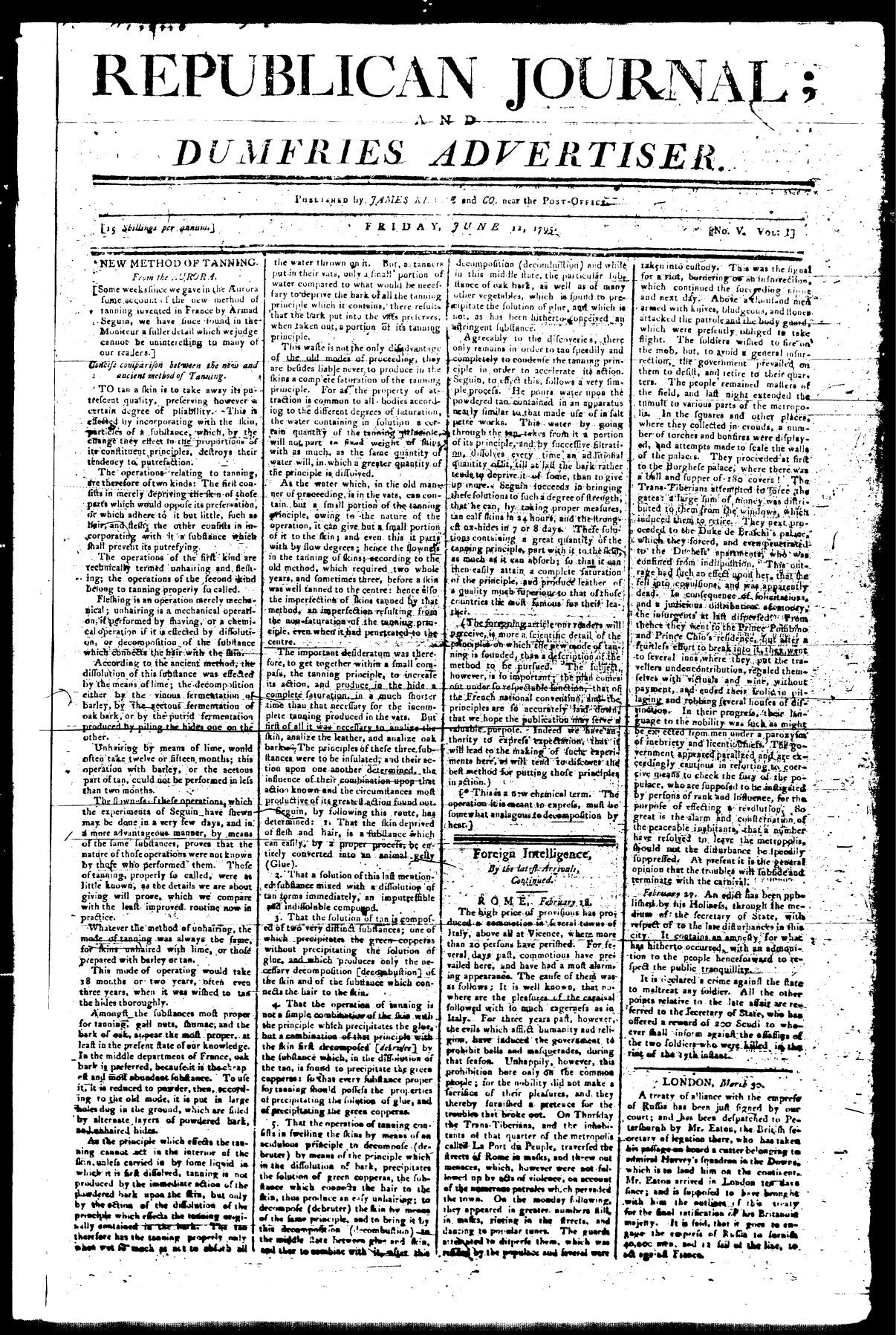
Transcription
REPUBLICAN JOURNAL
AND
DUMFRIES ADVERTISER
PUBLISHED by JAMES KEMPE and CO., near the Post-Office.
[15 Shillings per annum.] FRIDAY, JUNE 12, 1795 [No. V. Vol. I]
NEW METHOD OF TANNING.
From the AURORA.
[Some weeks since we gave in the Aurora
some account of the new method of
tanning invented in France by Armad
Seguin, we have since found in the
Moniteur a fuller detail which we judge
cannot be uninteresting to many of
our readers.]
Concise comparison between the new and
ancient method of Tanning.
TO tan a skin is to take away its putrescent
quality, preserving however in
certain degree of pliability. This is
effected by incorporating with the skin,
particles of a substance, which, by the
change they effect in the proportions of
its constituent principles, destroys their
tendency to putrefaction.
The operations relating to tanning,
are therefore of two kinds: The first consists
in merely depriving the skin of those
parts which would oppose its preservation,
or which adhere to it but little, such as
hair, and flesh; the other consists in incorporating
with it a substance which
shall prevent its putrefying.
The operations of the first kind are
technically termed unhairing and fleshing;
the operations of the second kind
belong to tanning properly so called.
Fleshing is an operation merely mechanical;
unhairing is a mechanical operation,
if performed by shaving, or a chemical
operation if it is effected by dissolution,
or decomposition of the substance
which connects the hair with the skin.
According to the ancient method, the
dissolution of this substance was effected
by the means of lime; the decomposition
either by the vinous fermentation of
barley, by the acetous fermentation of
oak bark, or by the putrid fermentation
produced by piling the hides one on the
other.
Unhairing by means of lime, would
often take twelve or fifteen months; this
operation with barley, or the acetous
part of tan, could not be performed in less
than two months.
The slowness of these operations, which
the experiments of Seguin have shown
may by done in a very few days, and in
a more advantageous manner, by means
of the fame substances, proves that the
nature of those operations were not known
by those who performed them. Those
to tanning, properly so called, were as
little known, as the details we are about
giving will prove, which we compare
with the least improved routine now in
practice.
Whatever the method of unhairing, the
mode of tanning was always the same,
for skins unhaired with lime, or those
prepared with barley or tan.
This mode of operating would take
18 months or two years, often even
three years, when it was wished to tan
the hides thoroughly.
Amongst the substance most proper
for tanning, gall nuts, shumac, and the
bark of oak, appear the most proper, at
least in the present state of our knowledge.
In the middle department of France, oak
bark is preferred, because it is the cheapest
and most abundant substance. To use
it, it is reduced to powder, then, according
to the old mode, it is put in large
hole dug in the ground, which are filled
by alternate layers of powdered bark,
and unhaired hides.
As the principle which effects the tanning
cannot act in the interior of the
skin, unless carried in by some liquid in
which it is first dissolved, tanning is not
produced by the immediate action of the
powdered bark upon the skin, but only
by the action of the dissolution of the
principle which effects the tanning originally
[contained?] in the bark. the [?]
therefore has the tanning properly only
what [was?] [so?] much [as?] act to absorb all
the water thrown on it. But, [as?] tanners
put in their vats, only a small portion of
water compared to what would be necessary
to deprive the bark of all the tanning
principle which it contains, there results
that the bark put into the vats preserves
when taken out, a portion of its tanning
principle.
This waste is not the only disadvantage
of the old modes of proceeding, they
are besides liable never to produce in the
skins a complete saturation of the tanning
principle. For as the property of attraction
is common to all bodies according
to the different degrees of saturation,
the water containing in solution a certain
quantity of tanning principle
will not part to fixed weight of skins
with as much, as the same quantity of
water will, in which a greater quantity of
the principle is dissolved.
As the water which, in the old manner
of proceeding, is in the vats, can contain
but a small portion of the tanning
principle, owing to the nature of the
operation, it can give but a small portion
of it to the skin ; and even this it parts
with by flow degrees ; hence the slowness
in the tanning of skins; according to the
old method, which required two whole
years, and sometimes three, before a skin
was well tanned to the centre: hence also
the imperfection of skins tanned by that
method, an imperfection resulting from
the non-saturation of the tanning principle,
even when it had penetrated to the
centre.
The important desideratum was therefore,
to get together within a small compass,
the tanning principle, to increase
its action, and produce in the hide a
complete saturation, in a much shorter
time than that necessary for the incomplete
tanning produced in the vats. But
first of all it was necessary to analize the
skin, analize the leather, and analize oak
bark. The principles of these three substances
were to be insulated, and their action
known and the circumstances most
productive of its greatest action found out.
Seguin, by following this route, has
determined: 1. That the skin deprived
of flesh and hair, is a substance which
can easily, by a proper process, be entirely
converted into an animal gelly
(Glue).
2. That a solution of this last mentioned
substance mixed with a dissolution of
tan forms immediately, an imputressible
and indissoluble compound.
3. That the solution of tan is composed
of two very distinct substances; one of
which precipitates the green copperas
without precipitating the solution of
glue, and which produces only the necessary
decomposition [decombustion] of
the skin and of the substance which connects
the hair to the skin.
4. That the operation of tanning is
not a simple combination of the skin with
the principle which precipitates the glue,
but a combination of that principle with
the skin first decomposed [[debruter?]] by
the substance which, in the dissolution of
the tan, is found to precipitate the
green
copperas: so that every substance proper
for tanning should possess the properties
of precipitating the solution of glue, and
of precipitating the green copperas.
5. That the operation of tanning consists
in swelling the skins by means of an
acidulous principle to decompose (debruter)
by means of the principle which
in the dissolution of bark, precipitates
the solution of green copperas, the substance
which connects the hair to the
skin, thus produce an easy unhairing; to
decompose (debruter) the skin by means
of the same principle, and to bring is by
this decomposition (decombustion) [to?]
the middle state between glue and skin,
and [then?] to combine with it. After this
decomposition (decombustion) and while
in this middle state , the particular substance
of oak bark, as well as of many
other vegetables, which is found to precipitate
the solution of glue, and which is
not, as has been hitherto conceived an
astringent substance.
Agreeably to the discoveries, there
only remains in order to tan speedily and
completely to condense the tanning principle
in order to accelerate its action.
Seguin, to effect this, follows a very simple
process. He pours water upon the
powdered tan contained in an apparatus
nearly similar to that made use of in salt
petre works. This water by going
through the tan, takes from it a portion
of its principle, and by successive filtration,
dissolves every time an additional
quantity of it, till at last the bark rather
tends to deprive it of some, than to give
up more. Seguin succeeds in bringing
these solutions to such a degree of strength
that he can, by taking proper measures,
tan calf skins in 24 hours, and the strongest
ox-hides in 7 or 8 days. These solutions
containing a great quantity of the
tanning principle, part with it to the skin,
as much as it can absorb; so that it can
then easily attain a complete saturation
of the principle, and produce leather of
a quality much superior to that of those
countries the most famous for their leather.
(The foregoing article our readers will
perceive, is more a scientific detail of the
principles on which the new mode of tanning
is founded, than a description of the
method to be pursued. The subject,
however, is to important; the plan comes
out under so respectable sanction, that of
the French national convention, and the
principles are so accurately laid down,
that we hope the publication they serve a
valuable purpose. Indeed we have authority
to express expectation, that is
will lead to the making of such experiments
here, as will tend to discover the
best method for putting those principes
in action.)
[* This is a new chemical term, The
operation it is meant to express, must be
somewhat analogous to decomposition by
heat.]
Foreign Intelligence,
By the latest Arrivals,
Continued.
ROME, February 18.
The high price of provisions has produced
a commotion in several towns of
Italy, above all at Vicence, where more
than 20 persons have perished. For several
days past, commotions have prevailed
here, and have had a most alarming
appearance. The cause of them was
as follows; It is well known, that nowhere
are the pleasures of the carnival
followed with to much eagerness as in
Italy. For three years past, however,
the evils which afflict humanity and religion,
have induced the government to
prohibit balls and masquerades, during
that season. Unhappily, however, this
prohibition here only on the common
people; for the nobility did not make a
sacrifice of their pleasures, and they
thereby furnished a pretence for the
troubles that broke out. On Thursday
the Trans-Tiberians, and the inhabitants
of that quarter of the metropolis
called La Port du Peuple, traversed the
streets of Rome in masks, and threw out
menaces, which, however were not followed
up by acts of violence, on account
of the numerous patroles which pervaded
the town. On the mondat following,
they appeared in greater numbers still,
in masks, rioting in the streets, and
dancing to popular tunes. The guards
attempted to disperse them, which was
[refuted?] by the populace and several were
taken into custody. This was the signal
for a riot, bordering on an insurrection,
which continued the succeeding nights
and next day. Above a thousand men
armed with knives, bludgeons and stones
attacked the patrole and the body guard,
which were presently obliged to take
flight. The soldiers [wislied?] to fire on
the mob, but, to avoid a general insurrection,
the government prevailed on
them to desist, and retire to their quarters.
The people remained masters of
the field, and last night extended the
tumult to various parts of the metropolis.
In the squares and other places,
where they collected in crouds, a number
of torches and bonfires were displayed,
and attempts made to scale the walls
of the palaces. They proceeded at first
to the Borghese palace, where there was
a ball and supper of 180 covers! The
Trans-Tiberians attempted to force the
gates; a large sum of money was distributed
to them from the windows, which
induced them to retire. They next proceeded
to the Duke de Bra[?]chi's palace,
which they forced, and even penetrated
to the Ditchels' apartment, who was
confined from indisposition. This outrage
had such an effect upon her, that she
fell into conulsions, and was apparently
dead. In consequence of solicitations,
and a judicious distribution [economy?],
the insurgents at last dispersed. From
thehce went to the Prince Pombino
and Prince Chio's residence, but after a
fruitless effort to break into it, they went
to several inns where they put the travellers
[undercontribution?], regaled themselves
with victuals and wine, without
payment, and ended their frolic in pillaging
and robbing several houses of distinction.
In their progress, their language
to the nobility was such as might
be expected from men under a paroxysm
of inebriety and licentiousness. The government
appeared paralized and are exceedingly
cautious in resorting to coercive
means to check the fury of the populace,
who are supposed to be instigated
by persons of rank and influence, for the
purpose of effecting a revolution. So
great is the alarm and consternation of
the peaceable inabitants, that a number
have resolved to leave the metropolis,
should not the disturbance be speedily
suppressed. At present it is the general
opinion that the troubles will subside and
terminate with the carnival.
February 27. A edict has been published
by his Holiness, through the medium
of the Secretary of State, with
respect of to the [late?] disturbances in this
city. It contains an amnesty for what
has hitherto occurred, with an admonition
to the people henceforward to respect
the public tranquillity.
It is declared a crime against the state
to maltreat any soldier. All the other
points relative to the late affair are referred
to the Secretary of State, who has
offered a reward of 200 Scudi to whoever
shall inform against the [?ss?ssigs?] of
the two soldiers who were killed in the
riot of the 15th instant.
LONDON, March 30.
A treaty of alliance with the empress
of Russia has been just signed by our
court; and has been despatched to Petersburgh
by Mr. Eaton, the British secretary
of legation there, who has taken
his passage on board a cutter belonging to
admiral Harvey's squadron in the [Dowrs?],
which is to land him on the continent.
Mr. Eaton arrived in London [ten?] [dare?]
[siner?]; and is supposed to have brought
with him the outliers of this [tr?aly?]
for the [stool?] ratification if [?] Britannia
majority. It is said, that it goes to [emgage?]
the empress of the Russia to furnish
40,000 men, and 12 sail at the [live?], to
act against France.
By the following letter our readers
will see, that a [pinit?] of the British army
was embarked at Embden for Englan on
the 25th. The French [be?ag?] now
in possession of [Delyzl?], which enables
them, in a great measure, to block up the,
mouth of the Ems, and has called great
alarm at Embden, it is now understood
that the corps, under the command of
lord Cathcart, will be embarked at Bremen,
in Lower Saxony, seated on the river Weser:
"EMBDEN, March 25.
"I have the pleasure to inform you,
that this day the British troops were embarked.
At day-light in the morning,
the commanding officer of the Dedalus
frigate who had received orders previously
from captain Popman, the resident naval
officer at Emblem, displayed a signal
for twelve of the custom-house and [lexcisecutter?]
to proceed up the river Ems, to
cover the embarkation of the troops,
which was effected without the least molestation
from the enemy. They came
down the river in Prussian schuyts, and
other vessels, a little below Embden,
when they were safety re-embarked on
board our transports. The other twelve
sail of our revenue armed cutters had
proceeded to Bremen, where the remainder
of the British army were to be immediately
embarked. The Amphion
frigate is stationed higher up the river."
March 31. It is expected that the generals
of the allied armies will meet at
Osnaburgh to concert the plan of operations
for the approaching campaign.
According to letters received yester
day, by several of the most respectable
house in the city, we learn, that the
king of Denmark has ordered a camp of
30,000 men to be formed in Holstein;
and that the Danish government has given
directions, that neither corn, provisions,
nor merchandize, shall be henceforward
shipped for France under the Danish
flag.
It is circulated upon the continent,
that upon a recent representation from
the regency of Hanover to the king of
Prussia, stating, that with his troops and
those of Upper and Lower Saxony, they
hoped to have an army of 120,000 men
to act against the enemy, he replied, he
should always be ready to co-operate
with them, but that he hoped that peace
would render such exertions unnecessary.
The king of Prussia has given orders
to the Prussian nobility to declare what
quantity of corn they have to spare, and
to send the fame to the royal magazines
at the current market price.
Some bloody engagements have taken
place near Bentheim, in Westphalia.
On the 12th ult. the first attempt was
made by the French to force back the
troops of the allies; but they met with
so vigorous a resistance, that they were
obliged to give up their design, with the
loss of eleven pieces of cannon, and a considerable
number of men. On the 13th,
they renewed their attack, and having
received very strong reinforcements, they
at last succeeded in driving back allies
as far as the Rhine. The loss was great
on both sides. The French entered
Bentheim, and made themselves masters
of the castle, the garrison capitulated,
and was allowed to withdraw.
The excessive price of provisions has
occasioned riots in several towns of Italy,
especially at Vincence, where the military
interfered, and nearly 50 men lost
their lives.
April 2. The two messengers have
brought despatches from the British army,
which they left on Friday last. No
event of any importance has occurred, if
we except the departure of the body of
Austrian troops, the general of whom refused
to obey the orders of the British
general, notwithstanding that his troops
have been in pay of Great Britain, for
upwards of three months.
The issue of pay and subsistance to the
Austrians was, in consequence of this refusal,
flopped; and the Austrian general
and his troops have left the British army,
and are on their return to the emperor's
dominions. - Our good and faithful allies,
through extremely willing to receive
our money, having uniformly objected as
putting themselves under our direction.
Perhaps they think that men, who grant
loans and subsidies with such facility, are
not the most proper perform to point out
the purposes to which such loans and
subsidies shall be applied.
April 3. A letter received at [Hall?],
from the captain of one of the ships;
which failed under [convoy?] at lord Howe's
[Boat?] dated Vigo Bay, February 26, says,
" We made Cape - [Finisher?] on the [?]
[?] very bad weather: the [proud?]
near then [left?] us, and admiral Parker
parted, with near 400 [sa??] for the West-
Indies and America. The [Trusty?] of
30 guns, two ships of 44 guns, one frigate
and a [hoop?] of war, proceeded with
about 50 of us. Eighteen reached this
port on the 25th, the rest were all [disperted?]
in heavy gales of wind and bad
weather."
On Wednesday night captain Horncastle,
late of the Princess Royal East-Indiaman,
taken by the French and carried
into the Mauritius, arrived from on board
an American ship, in which he escaped
from L'Orient. He was about a fortnight
on his passage; but his situation
would not admit that he could bring any
news. Capt. Horncastle has been treated
with much severity during his confinement,
and the provisions on which he
has lived, have been bad in the extreme.
Government has at length come to a
resolution of making the most strenuous
exertions to reduce the banditti at St.
Domingo. In their view, an advice boat
has been despatched to Barbadoes, with
orders to send thither, without delay,
the 2,800 men, who were on board the
last convoy expected to fail in the
course of next week, is to carry thither
3000 men more.
"YARMOUTH, April 1.
"By a letter from a cutter, arrived in
the Ems, dated March 26th, we are informed,
that the French had fifty thousand
men, and twenty pieces of cannon,
within four miles of Embden. The allied
army is about 20,000, but the Prussians
and Austrians are reported to be
coming thither in great force, The
French have drawn all their army from
Amsterdam to Embden."
The Dutch government have sent a
deputy of the name of Starkenburgh to
Paris, to claim the protection of the national
convention for the Dutch possessions
in the West-Indies.
Several letters from Hamburgh by the
last mail state, that admiral Kingsberges,
and some other friends of the Orange
party in Holland, have been guillotined.
The Dutch comissioners may be
compared to a former king of the [Sinis?]
Culottes, who,
With forty thousand men,
Went up a hill, and then came down
again!
As we have little reason to fear that
the French will again appear at sea this
summer in great force, we suggest the
propriety of our grand fleet acting in
detached squadrons; as nothing will so
much contribute to end the war speedily
as preventing the enemy from getting
succours from abroad, as well as from the
capture of our mercantmen.
Sir Peter Burrell has given directions
to prepare Westminster Hall for the reception
of the lords and commons, as
judgment will be given on Warren Hastings,
Esquire, soon after the Easter holidays
BREMEN, April [1.?]
Almost all our infantry regiment have
already marched through this place, on
their way to the [cantnaments?] by the
Weser's side, from whence they are to be
conveyed transports in bylanders.
The day for the general embarkation is
not yet finally decided on, but is supposed
that about the 11th instant it will take
place.
I join the landing return of the army,
viz. the guards artillery go up the
river Thames; the 12th, 27th, 28th,
40th, 54th, 57th, 76th, 79th, 80th, and
84th regiments; are to land at Portsmouth;
the 3d, 14t, 19th, 33d, 38th,
42d, 53d, 63d, 77th, 88th, go to Harwich
or Yarmouth; the 8th, 37th, 44th,
55th, 85th, 89th regiments land at Newcastle;
the infantry foreign corps to be
embarked at Stadt.
An almost general change [si??] taken
place in the departments of the army -
Lieutenant Taylor, late under secretary
to his royal highness, remains with [us an?]
secretary to the British commanding general;
lieutenant colonel [Becwich?] is to be
our acting quarter-matter-general. Colonel
Don, our adjutant-general, aided
French duke of that name, now in England,
and honoured with the kind attention
of their majesties. The York hussars,
under the command of lieutenant-colonel
Arthur Irwine, embark [as?] infantry.
General David Dundar, who is here
for the moment, has established his headquarters
at [Dimphold?], where we [?]
[?] [?] as the embarkation shall
have
[?] place.
We are all at Bremen, though, at first,
some objections were made to our coming
into town; while the magistrates [were?]
debating on the property of [a?m?lling?]
the British troops, the brigade of guards
marched in [san?] ceremorie - in some
house a private soldier has two or three
elegant furnished rooms to range through,
and he is sure to sit down to a very good
breakfast, dinner, and supper, every day,
[gratis?].
It seems by no means the intention of
the French to confine themselves to a defensive
war. The army of the north is
already on its march to penetrate into
Hanover. General Moreau will have the
command of the expedition against that
country.
The army of the Sambre and the
Meuse is approaching the Lieppe. The
plan of operations appears to be, to blockade
Weser and attack the allies, who are
very strong in that part.
Another letter from Brussels, says, it
appears that the campaign will be opened
by the siege of Wesel. A great quantity
of heavy artillery and ammunition
has been sent to the Lower Rhine. The
inexhaustible magazines of Holland will
furnish every thing necessary for the
siege.
April 4. Fourteen transports, with British
troops from the Continent, passed
Harwich yesterday, on their way to [Wivenho?],
where the troops were to be disembarked,
for the purpose of proceeding
to Colchester and Chalmsford barracks.
The following passage concerning Holland,
in extracted from the political journal
of Mercier, a member of the convention:
"The Dutch possess an immense
quantity of all forts of materials, collected
and destined for our destruction. Are
we to leave them in their possession? We
may consider them friends or enemies.
Under every point of view, they are obliged
to defray the enormous expense of
our expedition. If we look upon them
as enemies, their treasures are our's by
right of conquest; if we consider them as
friends, they ought to feel happy in reimbursing
what we have spent for the
purpose of enabling them to accomplish
their present revolution."
From the returns of the regulating officers,
received at the admiralty, it appears,
that on the average, about half
the number of men for the navy are likely
to be raised throughout the counties
and that the deficiency will be paid in
money: the average price given in the
Eastern counties is 25l, per man: so that
the one of 10l, added to it, will make
the parissies defaulting advance 35l, in
lieu of a man, for every 68 assessed house.
An adjutant belonging to one of the
Irish militia regiments, has been brought
to Dublin for the purpose of being tried
by a general court martial, on the charge
of having questioned several privates in
the regiment: "Whether, if the people
of Ireland were determined to assert their
rights and liberties, they (the militia)
would assist the English or the Irish nation?"
The court martial is now sitting
in the garrison.
It is well worthy of remark, that for
a considerable time past, the debates in
the convention and the reports of the
committees, have manifested an earnest
desire of peace, and frankly confessed
peace to be the with of the people.
The Empress, it is said, has condescended
to accept from this country a
subsidy of two millions, for the force
which she has stipulated to bring against
France. We have not heard whether the
men or the [guiness?] are to be the first
forthcoming! The king of Prussia seems
very much to regret that any of our
spare cash should go past himself; he now
offers if this country will pay him a subsidy,
to undertake to drive the French
out of Holland!!
April 8. Last night Mr. Ailsworth, the
messenger, arrived from Berlin, with despatches
for government; he came thro'
the British head-quarters, and brought
some letters from
THE ARMY.
"Klies-Borfen, March 25.
"We are here in a state of great suspense.
not knowing whether we are destined
for England, or to remain on the
continent for another campaign. Our
situation is horrid to the last degree. A
field officer and pigs are frequently lodged
in the same apartment. Nothing can
exceed the wretchedness we experience.
Port-[wine?] is the only thing that can
keep us alive, and it is with great [dif????]
we can procure it. Our men die
very fast, and the forage [is?] so scarce that
[our?] [quites?] are wretched objects.
April [15?]. By further particulars of
the engagement of the 13th of March, it
appears the Courageaux bore so much
the [brunt?] [of the?] [?] [?] [?] disabled,
her remaining [masts?] being badly
wounded. Captain Montgomery, and
his first lieutenant. Mr. Thomas Lavie,
had only been appointed to her on the
eve of the fleet sailing from Cortica, when
they quitted the same stations in the inconstant,
to whose lot it fell to take in
tow her late gallant commander. The
two ships sailed into Leghorn together
with the united cheers of both crews.
PLYMOUTH, March 31.
Provisions are now at a very high
price; flour role, in the course of the last
ten days 4 shillings a sack. - an Alarming
circumstance!
DUBLIN, April 1.
Yesterday evening as the lords justices
were returning from swearing in Earl
Cambden, the populace met the carriage
of Fitzgibbon, the lord chancellor, in
College-Green, which they assailed with
stones and brick-bats, one of which hit
his lordship over the temple, which
caused a violent confusion. Were it not
for the coachman who whipt the horses,
which galloped off full speed, and entered
the coach-house just time enough for the
servants to that the coach-house door before
the crowd arrived, it is thought that
his lordship would have fallen a victim
to the rage and fury of the people.
The populace then separated in two
divisions. One party attacked the house
of the speaker, and demolished the windows,
and were prevented by the timely
arrival of the military.
Another party attacked Beresford's
bank, and destroyed a quantity of furniture,
from which a blunderbuss was discharged,
which killed one and wounded
two others; but even this did not prevent
the crowd from pursuing their object,
from which they were alone prevented
by the arrival of the another party of
the military.
When our letters left Dublin order
was restored; but the ferment occasioned
by the injudicious removal of earl Fitzwilliam
was not likely soon to subside.
Our letters further add, that secretary
Pelham has solicited an interview with
Mr. Grattan, which the latter declined.
April 2. Lord Cambden's entry on
Tuesday evening exhibited the most afflicting
scenes possible to peaceable
and well disposed. Emotions of sorrow
and indignation were visible in every
countenance. He was escorted into town
by a party of horse, scoffed and hissed by
the populace as he parted through the
streets: not from any personal dislike to
the man, whose character is partly, if not
altogether unknown to them; but to the
measures of the British cabinet, and his
c... [truncated due to length]Transcriber
Adam KitchenLanguage
English