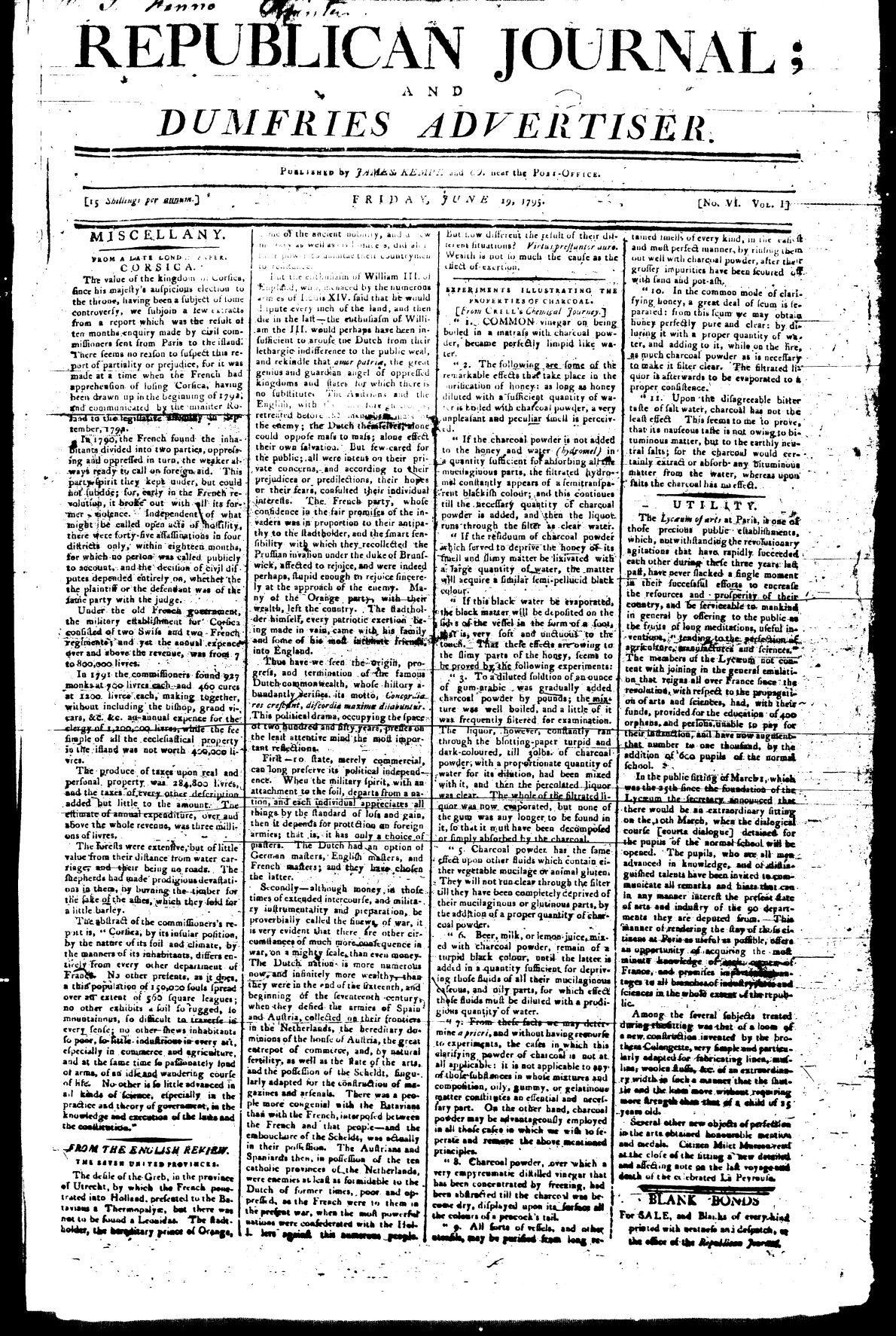
Transcription
REPUBLICAN JOURNAL
AND
DUMFRIES ADVERTISER
PUBLISHED by JAMES KEMPE and CO. near the Post-Office.
[15 Shillings per annum]
FRIDAY, JUNE 19, 1795.
[No. VI. Vol. I]
MISCELLANY.
FROM A LATE LONDON PAPER.
CORSICA.
The value of the kingdom of Corsica,
since his majesty's auspicious election to
the throne, having been a subject of some
controversy, wee subjoin a few extracts
from a report which was the result of
ten months enquiry made by civil commissioners
sent from Paris to the island.
There seems no reason to suspect this report
of partiality or prejudice, for it was
made at a time when the French had
apprehension of losing Corsica, having
been drawn up in the beginning of 1792,
and communicated by the minister Roland
to the legislative [assembly?] [on?] September,
1792.
In 1790, the French found the inhabitants
divided into two parties, oppressing
and oppressed in turn, the weaker always
ready to call on foreign aid. This
party spirit they kept under, but could
not subdue; for, early in the French revolution,
it broke out with all its former
violence. Independent of what
might be called open acts of hostility,
there were forty-five assassinations in four
districts only, within eighteen months,
for which no person was called publicly
to account, and the decision of civil disputes
depended entirely on, whether the
the plaintiff or the defendant was of the
same party with the judge.
Under the old French government,
the military establishment for Corsica
consisted of two Swiss and two French
regiments, and yet the annual expence
over and above the revenue, was from 7
to 800,000 livres
In 1791 the commissioners found 927
monks at 900 livres each and 460 cures
at 1200 livres each, making together,
without including bishop, grand vicars,
&c. &c. an annual expence for the
clergy of 1,200,000 livres, while the fee
simple of all the ecclesiastical property
in the island was not worth 400,000 livres.
The produce of taxes upon real and
personal property was 284,800 livres,
and the taxes of every other description
added but little to the amount. The
estimate of annual expenditure, over and
above the whole revenue, was three millions
of livres.
The forests were extensive, but of little
value from their distance from water carriage,
and their being no roads. The
shepherds had made prodigious devastations
in them, by burning the timber for
the sake of the ashes, which they sold for
a little barley.
The abstract of the commissioners's report
is, "Corsica, by its insular position,
by the nature of its soil and climate, by
the manners of its inhabitants, differs entirely
from every other department of
France. No other presents, as it does,
a third population of 150,000 souls spread
over all extent of 560 square leagues;
no other exhibits a soil so rugged, so
mountainous, so difficult to traverse in
every sense; no other shows inhabitants
so poor, so little industrious in every [art?],
especially in commerce and agriculture,
and at the same time so passionately fond
of arms, of an idle and wandering course
of life. No other is so little advanced in
all kinds of science, especially in the
practice and theory of government, in the
knowledge and execution of the laws and
the constitution."
FROM THE ENGLISH REVIEW.
THE SEVEN UNITED PROVINCES.
The desire of the Greb, in the province
of Utrecht, by which the French penetrated
into Holland, presented to the [Batavians?]
[at?] Thermopalyae, but there was
not to be found a Leonidas. The stadtholder,
the hereditary prince of Orange,
[some?] of the ancient nobility, and [?] [?w?]
[in?] [?] as well as [?] [?] [?], did [al??]
[?] [?] [?] [?] their countrymen
to resistance.
But the enthusiasm of William III of
England, who, [menaced?] by the numerous
armies of Louis XIV, said that he would
dispute every inch of the land, and then
die in the last - the enthusiasm of William
the III would perhaps have been insufficient
to arouse the Dutch from their
lethargic indifference to the public weal,
and rekindle that amor patriae, the great
genius and guardian angel of oppressed
kingdoms and states for which there is
no substitute. The [Austrians?] and the
English, with [the?] [?] [?] [?] [?]
retreated before [the?] [?] [?]
the enemy; the Dutch themselves, alone
could oppose mass to mass; alone effect
their own salvation. But few cared for
the public; all were intent on their private
concerns, and according to their
prejudices or predilections, their hopes
or their fears, consulted their individual
interests. The French party, whose
confidence in the fair promises of the invaders
was in proportion to their antipathy
to the stadtholder, and the smart sensibility
with which they recollected the
Prussian invasion under the duke of Brunswick,
affected to rejoice, and were indeed
perhaps, stupid enough to rejoice sincerely
at the approach of the enemy. Many
of the Orange party, with their
wealth, left the country. The stadtholder
himself, every patriotic exertion being
made in vain, came with his family
and some of his most intimate friends,
into England.
Thus have we seen the origin, progress,
and termination of the famous
Dutch commonwealth, whose history abundantly
verifies its motto, Concordia
res crescent, discordia maxime dilabuntur.
This political drama, occupying the space
of two hundred and fifty years, presses on
the least attentive mind the most important
reflections.
First - to state, merely commercial,
can long preserve its political independence.
When the military spirit, with an
attachment to the soil, departs from a nation,
and each individual appreciates all
things by the standard of loss and gain,
then it depends for protection on foreign
armies; that is, it has only a choice of
masters. The Dutch had an option of
German masters, English masters, and
French masters; and they have chosen
the latter.
Secondly - although money in those
times of extended intercourse, and military
instrumentality and preparation, be
proverbially called the sinews of war, it
is very evident that there are other circumstances
of much more consequence in
war, on a mighty scale, than even money.
The Dutch nation is more numerous
now, and infinitely more wealthy, than
they were in the end of the sixteenth, and
beginning of the seventeenth century
when they defied the armies of Spain
and Austria, collected on their frontiers
in the Netherlands, hereditary dominions
of the house of Austria, the great
[entrepot?] of commerce, and, by natural
fertility, as well as the state of the arts,
and the possession of the Scheldt, singularly
adapted for the construction of magazines
and arsenals. There was a people
more congenial with the Batavians
than with the French, interposed between
the French and that people - and the
embouchure of the Scheldt, was actually
in their possession. The Austrians and
Spaniards then, in possession of the ten
catholic provinces of the Netherlands,
were enemies at least as formidable to the
Dutch of former times, poor and oppressed,
as the French were to them in
the present war, when the must powerful
nations were confederated with the [Hollanders?]
against this numerous people.
But how different the result of their different
situations? Virtus prestantor aure.
Wealth is not to much the cause as the
direct of exertion.
EXPERIMENTS ILLUSTRATING THE
PROPERTIES OF CHARCOAL.
[From CRELL'S Chemical Journey.]
"1. COMMON vinegar on being
boiled in a matrass with charcoal powder,
became perfectly limpid like water.
"2. The following are some of the
remarkable effects that take place in the
purification of honey: as long as honey
diluted with a sufficient quantity of water
is boiled with charcoal powder, a very
unpleasant and peculiar smell is perceived.
"If the charcoal powder is not added
to the honey and water (hydromel) in
a quantity sufficient for absorbing all the
mueilaginous parts, the filtrated hydromel
constantly appears of a semitransparent
blackish colour; and this continues
till the necessary quantity of charcoal
powder is added, and then the liquor
runs through the filter as clear water.
"If the residuum of charcoal powder
which served to deprive the honey of its
smell and slimy matter be lixivated with
a large quantity of water, the matter
will acquire a similar semi-pellucid black
colour.
"If this black water be evaporated,
the black matter will be deposited on the
[sides?] of the vessel in the form of a foot,
[that?] is very soft and unctuous to the
touch. That these effects are owing to
the slimy parts of the honey, seems to
be proved by the following experiments:
"3. To a diluted solution of an ounce
of gum arabic was gradually added
charcoal powder by pounds; the mixture
was well boiled, and a little of it
was frequently filtered for examination.
The liquor, however, constantly ran
through the blotting-paper turpid and
dark-coloured, till 30lbs. of charcoal
powder; with a proportionate quantity of
water for its dilution, had been mixed
with it, and then the percolated liquor
was clear. The whole of the filtrated liquor
was now evaporated, but none of
the gum was any longer to be found in
it, so that it must have been decomposed
or simply absorbed by the charcoal.
"5. Charcoal powder has the same
effect upon other fluids which contain either
vegetable mucilage or animal gluten.
They will not run clear through the filter
till they have been completely deprived of
their mucilaginous or glutinous parts, by
the addition of a proper quantity of charcoal
powder.
"6. Beer, milk, or lemon juice, mixed
with charcoal powder, remain of a
turpid black colour, until the latter is
added in a quantity sufficient for depriving
those fluids of all their mucilaginous
caseous, and oily parts, for which effect
those fluids must be diluted with a prodigious
quantity of water.
"7. From these facts we may determine
a pricri, and without having recourse
ro experiments, the cases in which this
clarifying powder of charcoal is not at
all applicable: it is not applicable to any
of those substances in the whole mixtures and
composition, oily, gummy, or gelatinous
matter constitutes an essential and necessary
part. On the other hand, charcoal
powder may be advantageously employed
in all those cases in which we wish to separate and remove the above mentioned
principles.
"8. Charcoal powder, over which a
very empyreumatic distilled vinegar that
has been concentrated by freezing, had
been abstracted till the charcoal was become
dry, displayed upon its surface all
the colours of a peacock's tail.
"9. All sorts of vessels, and other
utensils, may be purified from long retained
smells of every kind, in the [earnest?]
and most perfect manner, by rinsing them
out well with charcoal powder, after their
grosser impurities have been scoured off
with sand and pot-ash.
"10. In the common mode of clarifying
honey, a great deal of scum is separated:
from this scum we may obtain
honey perfectly pure and clear: by diluring
it with a proper quantity of water,
and adding to it, while on the fire,
as much charcoal powder as is necessary
to make it filter clear. The filtered liquor
is afterwards to be evaporated to a
proper consistence.
"11. Upon the disagreeable bitter
taste of salt water, charcoal has not the
least effect This seems to me to prove,
that its nauseous taste is not owing to bituminous
matter, but to the earthly neutral
salts; for the charcoal would certainly
extract or absorb any bituminous
matter from the water, whereas upon
salts the charcoal has no effect.
UTILITY.
The Lycaeum of arts at Paris, is one of
those precious public establishments,
which, notwithstanding the revolutionary
agitations that have rapidly succeeded
each other during these three years last
past, have never slacked a single moment
in their successful efforts to encrease
the resources and prosperity of their
country, and be serviceable to mankind
in general by offering to the public as
the fruits of long meditations, useful inventions,
"tending to the perfection of
agriculture, manufactures and sciences."
The members of the Lycaeum not content
with joining in the general emulation
that reigns all over France since the
resolution, with respect to the propagation
of arts and sciences, had, with their
funds, provided for the education of 400
orphans, and persons unable to pay for
their [instinction?], and have now augment-
that number.to one thousand, by the
addition of 600 pupils of the normal
school.
In the public fitting of March 1, which
was the 25th since the foundation of the
Lycaeum the secretary announced that
there would be an extraordinary fitting
on the 10th March, when the dialogical
course [courte dialogue] detained for
the pupils of the normal school will be
opened. The pupils, who are all men
advanced in knowledge, and of distinguished
talents have been invited to communicate
all remarks and hints that can
in any manner interest the present date
of arts and industry of the 90 departments
they are deputed from. This
manner of rendering the stay of those citizens
at Paris as useful as possible, offers
an opportunity of acquiring the most
minute knowledge of [?] [?] of
France, and promises [important advantages?]
to all branches of industry, arts and
sciences in the whole excess of the republic.
Among the several subjects treated
during [shoutting?] was that of a loom of
a new construction invented by the brothers
Colangette, very simple and particularly
adapted for fabricating linen, [muslins?],
woolen stuffs, [loc.?] of an extraordinary
width in such a manner that the [shuttle?]
and the loom more without requiring
more strength than that of a child of 15
years old.
Several other new objects of perfection
in the arts obtained honourable mention
and medals. Citizen Milet [Mureasent?]
at the close of the fitting a new described
and affecting note on the last voyage and
death of the celebrated La Pevrouse.
BLANK BONDS
For SALE, and Blanks of every kind
printed with neatness and despatch, [at?]
the office of the Republican Journal.
By the [j??y?] [?], arrived at Philadelphia,
[?] [?] [?] late arrivals,
we have the following
Foreign Intelligence,
ROME, (Italy) March 24.
Letters from Algiers mention, that the
day is inclined to make peace with the
American states, but insists that they
shall purchase it with two millions of
dollars. The usurper of Tripoli, Sidi
Ali Bacha, who had laid siege to the castle
of Tripoli for two montsh past, has
been obliged, by the Unisian troops, to
fly with his Turks and his most valuable
effects, under the convoy of two Neapolitan
frigates.
From the VISTULA, March 26. The
fate of Poland does not seem to be fixed
yet, or rather it does not seem to be decided
yet how the neighbouring powers
intend to divide it: for it is certain that
this empire is to be blotted out of the list
of European states, and this seems indeed
to be the only means of protecting the
inhabitants of this unfortunate republic
against want and famine. The ties of
the old government are too much loosened
to hope that order can be restored
by the same.
Courland felt this first of all, and therefore
at a public dict, has renounced its
feudal connection with Poland. On the
20th inst. the nobility and commons of
the dukedoms of Courland and Semigallie,
together with administrator Ritterberg,
the upper bailiff Howen, and the
counsellor Hahn and Olsenberg, signed a
manifest against Poland, and an act of
submission to Russia; at the same time a
delegation was appointed, consisting of
[?] persons, to carry these instruments to
Petersburg.
NAPLES, April 2. - We have received
certain advices that the late naval expedition
of the French was to land 6000
men at [Orbitella?] and Porto Ercole, two
small forts belonging to the kingdom of
Naples, and situated between Tuscany
and Civita Vacchia. The garrisous
are very weak, and the possession of them
would enable the French to penetrate to
the heart of Italy, by the facility with
which they might then march to Civita
Vecchia, and to Rome in loss than three
days.
Several furnaces for red hot balls were
on board the French transports, and all
sorts of ammunition necessary for a bombardment
and an assault. It is not difficult
to predict what would have been
the consequences of their arrival at a moment
in which troubles had broken out
at Rome, and an important conspiracy
had [just?] been discovered at Naples.
MILAN, April 7. The French fleet
have returned to Toulon. The last advices
mention, that the French army under
the command of general Kellerman
will speedily be put in motion. Out army
has already begun its march.
LINGEN, April 8, - The passage from
here to Holland is now open again, and
much frequented. A number of travellers
come from thence and go there, without
being asked for a passport. In short,
every thing is as quiet here as if peace
was fully reestablished. The batteries
which were thrown up about three weeks
ago only, near the ferry, are now viewed
like the remains of former tunes.
April 19. We live here, thanks to the
peace, in perfect tranquillity. A part of
the French troops have left the opposite
[faure?] of the [Eros?], but the country of Bentheim [in?] [?] wholly evacuated by them.
On the contrary, the districts towards
Zwell are occupied by different divisions
of French troops.
The French skill occupy Aidenzael.
From the frontiers of WESTPHALIA.
April [8?] - From Holland we have accounts
that the cities of Arnheim and Nimoguen
have suffered amazingly; and thatTranscriber
Adam KitchenLanguage
English