Transcription
1
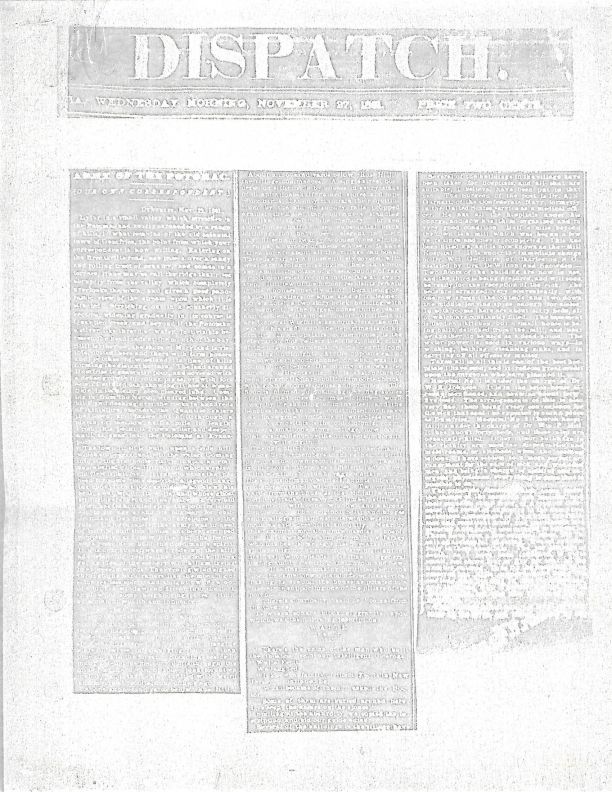
Richmond Dispatch
Wednesday morning,
Nov. 27, 1861
Army of the Potomac (our own correspondent)
Dumfries, Nov. 22, 1861
Lying in a small valley which stretches to
the Potomac and nearly surrounded by a range
of hills, is what remains of the old colonial
town of Dumfries, the point from which your
correspondent is now writing. Entering on the
Brentsville Road, one passed over a sandy and
rolling tract of country, and comes to a terrace.
If one may so cal the ridge that rises abruptly
gtom the valley, which complely overlooks the twon
and gives a good panoramic view of th stream upon
which it is situated. Stretching out in a southerly
direction, widening gradually in its course is
Quantico Creek, and beyond it the Potomac, a silver
like thread of water, just visible between the
headlands at the mouth of the bay. Still further
on, the shore of Maryland is visible, dotted here
and there with farm houses and patches of woodland,
its line of hills forming the distant horizon.
The land around Dumfries is generally poor, and
covered with a dense growth of [yound?] pines, or
with forests of stinted oak, showing it
has at
sometime in its history been cleared land. Coming
in from the north, winding between the hills
2
and dashing over the rocks in hundreds of
miniature cascades, the Quantico enters the town,
and passes out of it through a marsh, or meadow,
half a mile in length. From this point it grows
wider and deeper, until it runs into the Potomac
at Evensport.
The town itself is built upon a side hill,
which slopes gradually to the water. Coming
into it, the first house visible is upon an
eminence called "Rose Hill" from which a
splendid view is obtained. It is an old house that
has been for some time deserted, a legend hanging
about it of a poor suicide who blew his brains
out within its walls, and whose ghost still
lingers around the place. Every old town has
its haunted spot - the point of interest to
strangers and its bugbear for children - and
Dumfries is no exception to the rule. Unfortunately
the army was in need of.boards, and this house
has been stripped completely, and now little
but the framework remains to hold the dead
man's spirit. It was near sunset when I rode
up the hill, and standing beside the haunted
building got an idea of the scenery which I am
trying to express in words. The evening wind
signed through the bare rafters like the morning
3
of some restless spirit, and a night owl flew
out of a broken window and flitted in the dark
shadow of some neighboring pines, built by a
man of worth and influence,
"The house remained awhile,
silent and tenantless - then went to stranger"
since then it has passed through years of neglect,
and has now gone to ruin and decay. To those who
are fond of relics of the past the spot was
of interest, and one could imagine more old
wifes' tales hanging about it than pine cones
in the forest. Standing beside it, many a
delicious memory floats through the mind
like the dream of some long forgotten
melody, and the brain is filled with weird
and mystical recollections of long ago.
About a thousand yards below "Rose Hill"
the village commences. A single street bordered
on either side of houses in every state of
dilapidation - half ruined stores and toppling barn
that only maintain there equlibrium by the air of
sundry rails propped against them; solitary chimneys
standing up like "sacred to the memory," broken
stone fences; half a dozen substantial brick
buildings that have been elegent in their day;
fifteen or twenty wooden ones almost in ruins,
4
a number of sheds whose roofs have fallen
in are about all the village can boast.
There is scarsely a house entirely covered
with weatherboarding or shingles; the sash is
broken, and in the place of grass a bundle of
rags or old clothes glares in the face at
every step. But few of the former residents
remain in their houses, nearly all of them being
occupied by sutlers or some kind of tradesmen.
Love's Hotel, a two story brick building with a basement
is the largest house in the place, and decidedly the most
modern of all -init are General Wigfall's headquarters.
The officers of his staff, and the departments of his
family. In the upstairs, corner room, is the telegraph
office where the click, click, click of the busy
instrument can be heard from morning to night. At
the opposite end of the town is the court-house,
or what was the court house befor the county site
was removed to Brentsville. It is a structure of
peculiar architecture, built of imported brick,
with granite corner-stones and cornices. The floor
is formed of quadrangular flag stones nicely fitted
together, most of them worn away by the shuffling
of many feet, and the benches and the bar, constructed
of heavy oak, have grown rotten and worthless with
age. Near by this is old colonial courthouse,
5
a small one story cottage, now occupied as
a residence by the only person born in town
now living in it.
The date of this house I cannot ascertain;
no one here remembers to have heard, but
I presume the town records will tell, that it
is old enough, there are sufficient indications -
the weatherboard have grown thin under the
storms of many winters, and its sides and roof
are covered with moss. Two or three yards from
the house is the old jail, a small building made
of heavy oak timber, still well preserved, with
one window and a strong double door, the original
bolt and hinges and grating across the single
window still remain as evidence of its antiquity.
Near by this is a brick mansion now used as a
hospital, it is owned by a man from New Jersey
who has been some seventeen years in Virginia,
an ignorant and not very brilliant individual, who
spends his time in general loafing and in swearing
at Lincoln and Seward hearing me making inquiries
about the town he came forward and offered his
service taking us around the house he pointed to a
base-stone supporting one of the pillers of the
porch - "There's a curiosity," said he, "come from
the theatre." It was a square block of granite,
6
upon which was the following inscription:
"Waite
Fecit
1755"
"There is the name of the man who built the
theatre" said our intelligent Cicerone: "Waite Fecit"
We laughed.
"I knew a family of them Fecits in New Jersey."
Continued he.
"What became of them?" asked the doctor.
"Some of them are buried around here: I've seen
the names on the stones."
Smiling at the absurbdity, we copied the inscription
and bid our guide adieu.
Several of the buildings in the village have
been taken for hospitals, and all that are suitable,
I believe, have been put to that use the surgeon of
the post is Dr. A. S. Garnett, of the Confederate
Navy, formerly in the United States service as a
medical officer. He has all the hospitals under his
charge, and now has them organized and in very good
condition. Half a mile beyond the town is a mill
which was begun a few years since and never
completed. This has been fitted up, and is now known
as the "Mill Hospital" It is under the immediate
7
charge of Dr. Wm. Geddings, of Charleston, S.C., assisted
by Drs. DeWilton and Snowden. - two flours of the
building are now in use, and the third is being
prepared, and will soon be ready for the reception
of the sick. The beds are arranged very conveniently,
with one row around the outside and two down the
middle leaving space enough for aisles. In both rooms
there are about sixty beds, all of which are
constantly filled. The basement is used as a kitchen,
but a small house is being built, detached from
the mill, and near by another, to be used as a
dead-house. The water-power is used in various
ways- in washing, bathing, cleaning sinks, and in
carrying off all effeusive matter.
Taken all in all this is one of the best hospitals
I have seen, and it reflects great credit upon the
surgeons who have planned it.
Hospital No. 1 is under charge of Dr. W.R. Johnson.
It is in the Brick-House already mentioned and contains
about forty-five bids the arrangement of this is also
very fine, there being every convenience for the sick
that could be expected in such a place as Dumfries.
Hospital No. 2 (church hospital) is under the charge of
Dr. Wm. P. Hill. It has about forty beds, and there
also are constantly filled. Other manor buildings
in the vicinity are used as dispensaries and
8
mess-rooms of kitchens, when the cooking is done.
I have [?gloom?] seen a mere perfect arrangement for
the care of sick and wounded men, and being in
charge of skillful and energetic physicians.
Everything is done that is possible to do.
The principle diseace which come under the
charge of the surgeons are measles, and their
_____: camp fever of the Typhoid character, the
result of exposure to the damp and melarious
atmosphere of Dumfries: intermittent and
remitant fever, and Pneumonia and Pleurisy
have lately commenced to appear. - There have
been a few surgical cases, the result of
accidental shooting, treated successfully in
these hospitals. The percentage of Death,
as I have been informed is quite small, not
above four or five percent of the number
entered. Thus far the hospitals have recieved
but little support - there being but one
lady who has sent in any contributions and
that was Miss Virginia Tayloe, late of
Washington but who now resides in Fredricksburg.
- Two more line illegible -Transcriber
Adam KitchenLanguage
English