Transcription
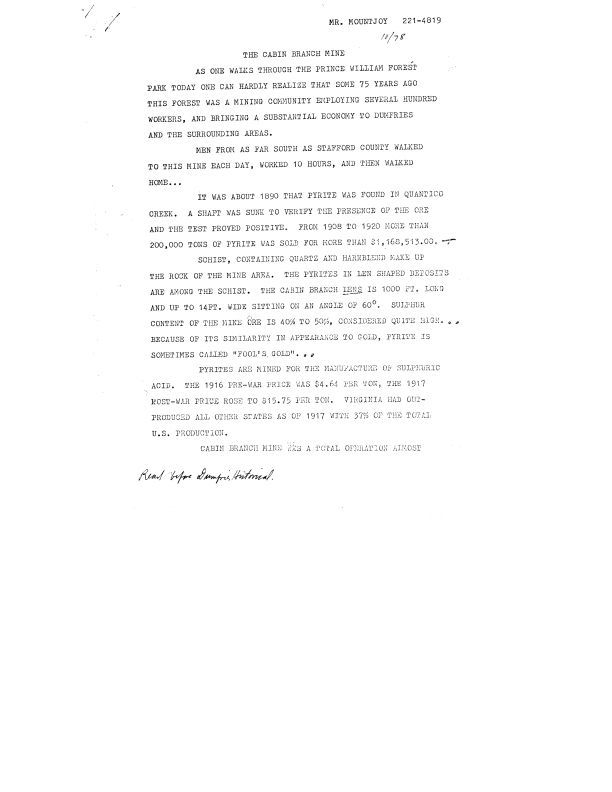
Mr. Mountjoy 221-4819
10/78
The Cabin Branch Mine
As One walks through the Prince William Forest
Park today one can hardly realize that some 75 years ago
this forest was a mining community employing several hundred
workers, and bringing a substantial economy to Dumfries
and the surrounding areas.
Men from as far south as Stafford County walked
to this mine each day, worked 10 hours, and then walked
home...
It was about 1890 that pyrite was found in Quantico
Creek. A shaft was sunk to verify the presence of the ore
and the test proved positive. From 1908 to 1920 more than
200,000 tons of pyrite was sold for more than $1,168,513.00.
Schist, containing quartz and harnblend make up
the rock of the mine area. The pyrites in len shaped deposits
are among the schist. The Cabin Branch lens is 1000 ft. long
and up to 14 ft. wide sitting on an angle of 60[?]. Sulphur
content of its similarity in appearance to gold, pyrite is
sometimes called "Fool's Gold"...
Pyrites are mined for the manufacture of Sulphuric
Acid. The 1916 pre-war price was $4.64 per ton. Virginia had outproduced
all other states as of 1917 with 37% of the total
U.S. production.
Cabin Branch Mine was a total operation almost
Read before Dumfries Historical.
Page 2
self-sufficient. It was the sole support of Dumfries during its production years.
The mine had three shafts, NOS. 1, 2, 3. number
1 and 3 were vertical with number 2 on an incline of 25[?] to 55[?]. Number 3 shaft was the deepest - 2,400 feet according
to two sources. A document written in 1917 reported the
depth to be 1800 ft. which leaves a possibility
of expansion
to 2,400 feet before 1920.
A narrow gauge railroad connected the mine to the
wharves on the Potomac River at Barrows siding about seven
miles distance. Contrary to some reports this narrow gauge
railroad was not part of or connected to the R. F. & P.
Railroad. At the mine site this railroad connected the shaft,
Crusher Mill, and other buildings. Three steam engines ran
on the tracks, The Dewey, Virginia Creeper, and the Dinkey
named because of its size. Also at the mine was a skiff
named because of its size to haul ore up an incline to the
head from where the ore was gathered before being processed.
There were about 70 buildings at the mine including
a blacksmith shop, carpenter shop, workers quarters, sawmill,
commissary, supt. house, and the Detrick House. Today little
remains to show evidence of a once thriving economy.
The mining procedure was explained with great
details as Mr. Cecil Garrison reminisces.
The first step was to construct the necessary
buildings and begin to sink the shaft. Unlike some of the
Page 3
other mines in Virginia, Cabin Branch Shafts had to be [Toz?]
totally supported by timber due to the composition of the
country rock. About every 100 feet or so a horizontal
"level" would be cut into the pocket of ore.. These levels
had to be supported by timbers.
Transporting the ore in each level was accomplished
by pushed wagons on tracks. These wagons
were pushed to the shaft where they would be dumped into
a bucket suspended by a cable from an 80 foot high "pithead"
build directly over the shaft opening. This bucket was
not only used to haul ore, but also to transport the
workers to and from the different levels. Various bells
signified the different loads: men, empty or ore. When
the bucket reached a certain section of the pithead it
would automatically dump the ore into a waiting railroad
car.
At any one time there were 200 to 300 men working
at the mine (above and below ground).
The underground mining process went on 24 hours
a day with 7 hour shift per day. Huge circulating fans and
water pumps ran continuously to keep the underground network
clear of poisonous gasses and seeping ground water.
On each level worked a "crew" which was supervised
by a blaster. This blaster would get paid for the
number of feet he could progress in one day. The
blaster
Page 4
with a good crew could make quite a good salary.
Some of the men in each crew were: The "Driller",
who drilled the holes fro the dynamite; the"Muckers", who
loaded the ore into the wagons; the "Timberman", who made
sure the roof was property supported; and the "Powderman",
who carried the dynamite from the powder house to the level
where it was needed.
After the ore was brought up to the surface it
was transported by the Narrow Gauge Railroad to the ore
bins. From the ore bins, the pyrite was hauled up the
incline or runway to the head frame where the milling
procedure began.
The milling procedure is generally explained
as follows: the product was divided into three classes:
lump, spall and fine. Lump was first grade that required
no sorting. Spall was first grade ore broken to pass a
2.5 inch ring and freed from fines by screening. Fine
ore was under3/8 inch in size in the milling practice at
the Cabing Branch Mine. The ore from the hoist was dumped
on a 2.5 inch grizzly. Oversize ore going to a lump
storage bin. Hand sorting separate the slate from first
class lump which went to a spalling floor. the finer
impure ore went to a roll-jar crusher. The larger lumps
were broken by hand and shipped without further treatment.
The undersize from the grizzly was treated in a 3 compartment
hartz jig or sieve. Clean pebble ore was shipped as
such. Middlings from the jig were treated by roughing
Page 5
rolls of two grades and were finally treated in 2 compartment jigs.
The Had Sorting Process mentioned was performed
by young boys for 50[?] a day. This is where Mr. Cecil
Garrison started his day at the mine.
The jigs or sieves were devices which separated
the country rock from the ore by vibrations and a washing
procedure. Jigs were located in the mill and all of the
treatment was done in the mill. All primary crushing was
done in the crusher house.
From the mill the ore was loaded on the narrow
gauge cars or railroads and delivered to the docks at
barrows siding near Possum Point.
I think we all know the Cabin Branch Mine was
the major supporting industry of Dumfries for a 30 year
period from 1890 to 1920..
Through railroad deeds and other records one
may gather that the Cabin Branch had ownership from 1899
to 1916 and the American Agriculture Chemical Company
from 1917 to 1920.
The original owners were the Ditricks and the Bradleys and their families.
Around 1919 or 1920 it was found that a higher
content of pyrite could be mined more cheaply in Spain
than in the United States. During this period of economical uncertainly, the miners wents on a strike for a pay
increase from $4.25 per day to $4.50 per day. The super-
Page 6
intendent responded by closing the mine down, saying that
he would let the Cabin Branch Mine fill with water and
the frogs jump in before he would re-open it.
Occupation of the area by the Civil Conservation
Corps in the early 1930's resulted in complete dismantling
of the mine. Building materials were used for the Cabin
Camps and the slate dumps were used as roadbed materials.
The economy of Dumfries was greatly enhanced
by the operation of this mine. The town of Dumfries
profited as families moved in, boarding houses opened up
and stores did a thriving business.
Today Cabin Branch Mine is only a memory
recorded on the pages of history.
A. L. Mountjoy
References:
1. Department of the Interior,
Bureau of Mines
2. The Journal Messenger,
Bonnie Atwood, Reporter
3. Interview with Mr. Cecil GarrisonTranscriber
Adam KitchenLanguage
English