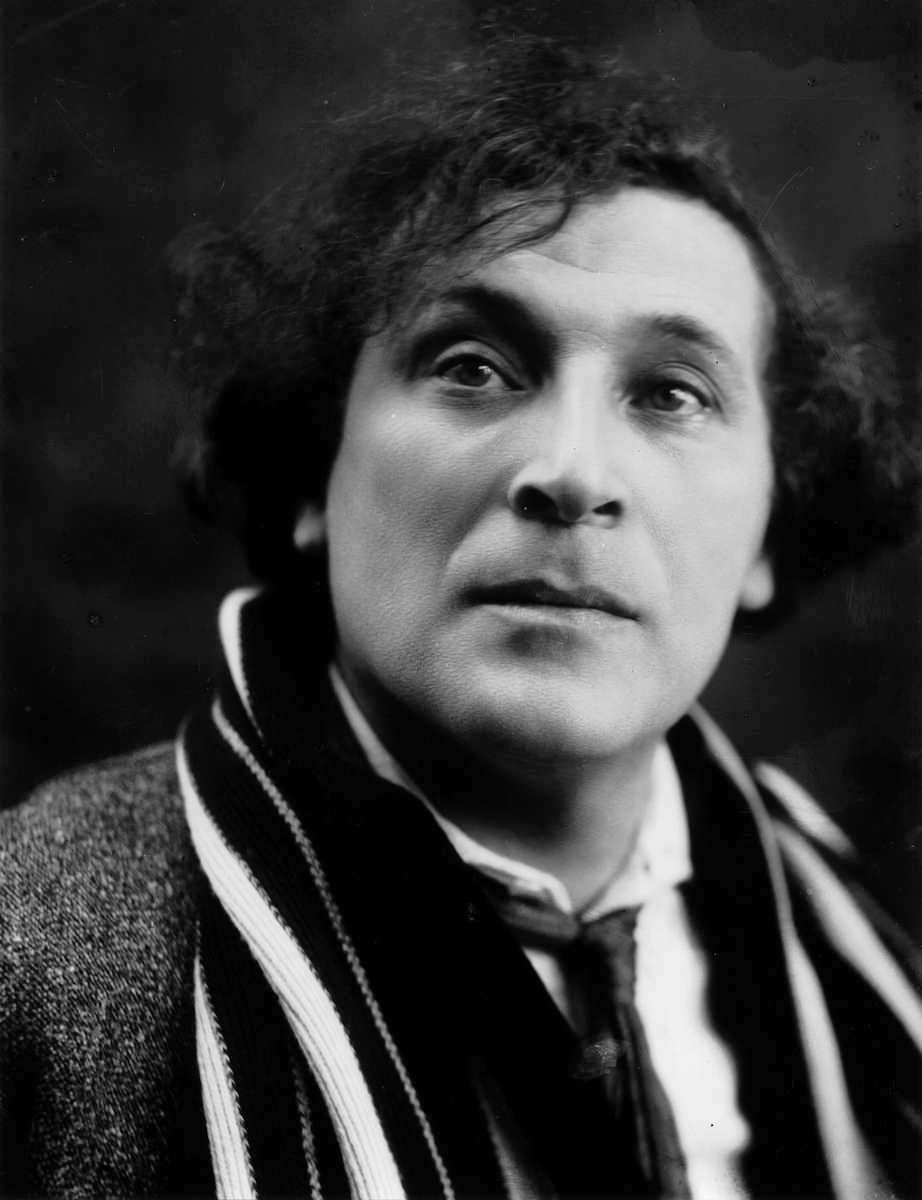
Biography
Born in Vitebsk, Russian Empire (present-day Belarus), Chagall is highly regarded as both an iconic jewish artist and leading pioneer of Modernism. As a child he attended the local Jewish religious schools, as was obligatory for Russian Jews at the time, due to strict discriminatory policies. His studies of Hebrew and the Old Testament would come to inform much of Chagall's content and motifs in his paintings, etchings, and stained-glass work. Early on, Chagall had a love for art and decided to pursue a career in the arts, much to the dismay of his parents. His artistic exploration brought him to Paris in 1910, when the leading role of Cubism was on the rise in the avant-garde movement. He eventually returned to Vitebsk in order to marry his fiancé and begin a family. The turbulence of World War I trapped them in Russia for some time, while World War II forced him and his family to move around before eventually fleeing to the United States. The Museum of Modern Art in New York City included Marc Chagall on their list of artists and intellectuals who were most at risk due to the Nazi’s anti-Jewish campaign, which earned him and his family visas to find sanctuary in the U.S. from 1941-1948.
Chagall experimented with many modernist styles like Expressionism and Cubism, drawing from each of them while maintaining his own personal poetic and figurative style of narrative art. His work is regarded as lyrical and emotional with a dream-like quality. Jewish imagery and themes were also an important characteristic of his artwork. Much like Picasso, Chagall was another modern artist who mastered multiple artistic media, including oil and gouache, watercolor, murals, etching, drawing, ceramics, and stained-glass work. In 1977, Chagall became one of only a handful of artists to have a retrospective exhibition at the Louvre Museum in Paris.