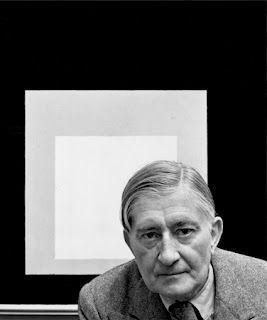
Biography
A German-born American painter, writer, and educator, Josef Albers was a pioneer of 20th century modernism and an innovative practitioner of color theory. Widely known for his series Homages to the Square created between 1950 and 1975, Albers chose squares within squares as the field to explore how colors influence each other. His publication on color theory, “Interaction on Color” was published in 1963 and is still in print today.
Albers studied art education as a young man and entered the legendary Bauhaus school in 1920, where he married artist Anni Fleischmann and later became a teacher, covering a wide variety of media. The Bauhaus shut down in 1933 due to pressure from the Nazi Party. Josef and Anni immigrated to North Carolina to lead the visual arts department of the newly established Black Mountain College.
In 1950, Albers became head of the newly established Department of Design at Yale University School of Art until his retirement in 1958. Following retirement, he created “Formulation: Articulation,” a collection of 127 silkscreen prints of his work. He became the first living artist whose work was the subject of a solo retrospective at the Metropolitan Museum of Art.