Biography
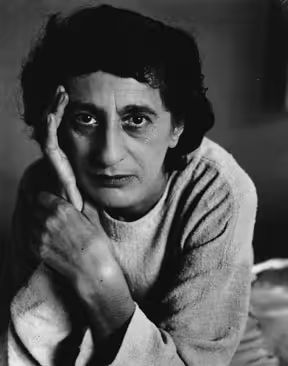
Anni Albers was a textile artist, designer, printmaker, and educator known for her pioneering graphic wall hangings, weavings, and designs. She enrolled at the Bauhaus in 1922 and was assigned to the Weaving Workshop. In 1933, she and her husband, artist Josef Albers, immigrated to North Carolina, where they founded the art department at Black Mountain College.
In 1949, she became the first designer to have a one-person show at The Museum of Modern Art, New York. The exhibition, titled “Anni Albers: Textiles,” travelled to 26 venues throughout the US and Canada. In the 1950s she spent her time creating mass-reproducible fabrics, and developed her “pictoral weavings,” for the exhibition “Anni Albers: Pictoral Weavings” at the MIT New Gallery in Cambridge, Massachusetts.
A retrospective exhibition on the 100th anniversary of her birth in 1999, organized by the Albers foundation and the Peggy Guggenheim Collection in Venice, traveled to the Josef Albers Museum in Bottrop, the Museé des Artes Décoratifs in Paris, and the Jewish Museum in New York. Her seminal book, On Weaving, published in 1965, helped to solidify her status as the single most influential textile artist of the twentieth century.