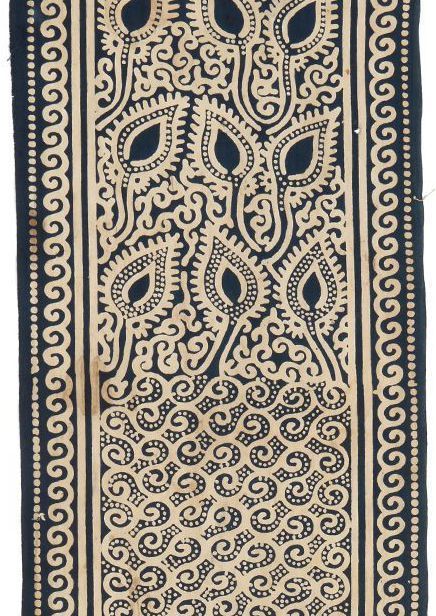
Ceremonial Banner (Sarita)
Name/Title
Ceremonial Banner (Sarita)Entry/Object ID
2023.1.1Description
Sarita are a type of sacred cloth in Sulawesi, identifiable through their long and narrow format. There are several types of sarita, some made locally and others imported from outside of Sulawesi. This particular sarita was made in the Netherlands for the Sulawesi market. It was produced using resist printing applied with wood blocks. The resist is applied only on one side, which leaves the reverse side showing a less clear pattern. This so-called �Dutch sarita� would have been made sometime between 1860 and 1910. Sarita were used in various ways, depending on the ritual context and local tradition. In Toraja, a sarita might be used to wrap buildings and coffins or hung as long banners on poles or gables of traditional houses, the tongkonan. Sometimes they were also used to clothe the effigy of the dead (tau-tau). In the northern region of Palu, sarita were stitched together along the length to create a voluminous women�s skirt. This piece shows its age with some fraying along the edges, small tears where stress occurred during use, and discoloration scattered throughout. At one end of the cloth, there is a name written in ink, likely identifying the former owner of the sarita. As sacred cloths were often lent out to others for ceremonies, this identification ensured that similar-looking pieces would be returned to the rightful family.Acquisition
Accession
2023.1Source or Donor
Sandra SardjonoAcquisition Method
GiftCredit Line
Gift of Sandra SardjonoMade/Created
Artist
Unknown MakerTime Period
19th Century, 20th CenturyPlace
Country
NetherlandsRegion
Northern EuropeContinent
EuropeTextile Details
Technique
Plain Weave, Block-printed wax-resist dyed (batik)Ethnography
Cultural Region
* Untyped Cultural Region
The NetherlandsCountry
IndonesiaCulture/Tribe
Toraja