Note Type
Historical NoteNote
The Surrealist artist, author, critic, impresario, and provocateur Salvador Dalí (1904-1989) burst onto the art scene in 1929 and rarely left the public eye until his death six decades later. The auspicious occasion was the debut of Un Chien Andalou in Paris, a film Dalí made in collaboration with Luis Buñuel. Filmed in Paris, Un Chien Andalou strung together free-associative vignettes and made full use of the avant-garde technique of montage, including, most famously, a scene of a razor slicing into a woman’s eye.
The film catapulted Dalí to the center of the Surrealist community. An artistic and intellectual movement begun by André Breton in 1924, Surrealism championed the unconscious as the primary motor of human behavior, coupling this with an aspiration to political revolution. Although Dalí’s association with Surrealism was late-coming and short-lived (he would be expelled from the group in 1934), his arrival jolted new life into the movement.
Dalí’s chief theoretical contribution to Surrealism was his elaboration, in the early 1930s, of the “paranoiac-critical method”—a process, he wrote, to “systematize confusion and thereby contribute to a total discrediting of the world of reality.”
The method described a deliberately disoriented state of mind that would allow an individual to connect unrelated things, forging fresh avenues of thought and creation. Around the same time, he also published several essays naming and defining the so-called “Surrealist object”: an object “functioning symbolically,” usually constructed from found items or readymade materials, and redolent with psychological power. His Retrospective Bust of a Woman was one such object. Beneath its seemingly haphazardly embellished portrait bust of a woman pulsed a rich network of associations, from references to consumption (corn cobs and a baguette) to putrefaction (an ant swarm, a recurrent motif in Dalí’s work).
Reference: MOMANote Type
Historical NoteNote
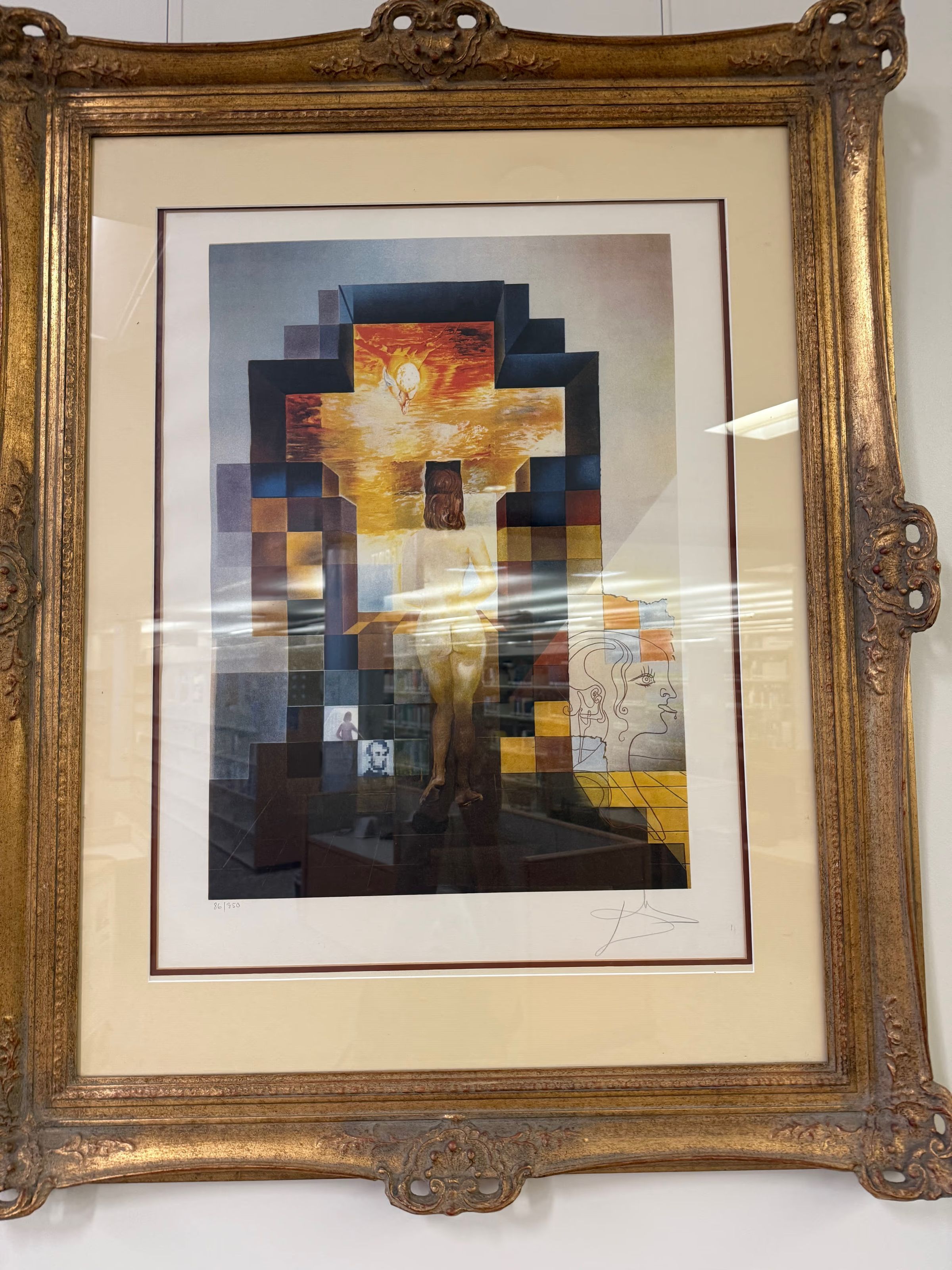
Dalí's paintings Gala Contemplating the Mediterranean Sea, which, at a distance of 20 meters, is transformed into the portrait of Abraham Lincoln (Homage to Rothko), and the original Lincoln in Dalivision lithographs produced from these paintings were among the first examples of the photomosaic artistic approach by a recognized artist. "The Recognition of Faces," by Leon Harmon,[10] was the first published work on photomosaic concepts. Harmon was a Bell Labs researcher who had been developing this concept, and the first image in this article was the well-recognized portrait of Abraham Lincoln from the U.S. five-dollar bill made from a collection of solid gray mosaics. Dalí began his first painting that led to Lincoln in Dalivision in 1974 and finished the version that would be used for Lincoln in Dalivision in 1976. Harmon's Lincoln mosaic was the basis for all of Dalí's Lincoln photomosaics, which is evident by comparing the solid gray mosaics from Harmon's paper and the final works of art by Dalí.
The first painting was completed in 1976 and displayed at The Guggenheim in New York during the U.S. Bicentennial in 1976. Lincoln in Dalivision was originally intended for release in the same year but was not finalized until 1977.