Note Type
Artist’s Intent NoteNote
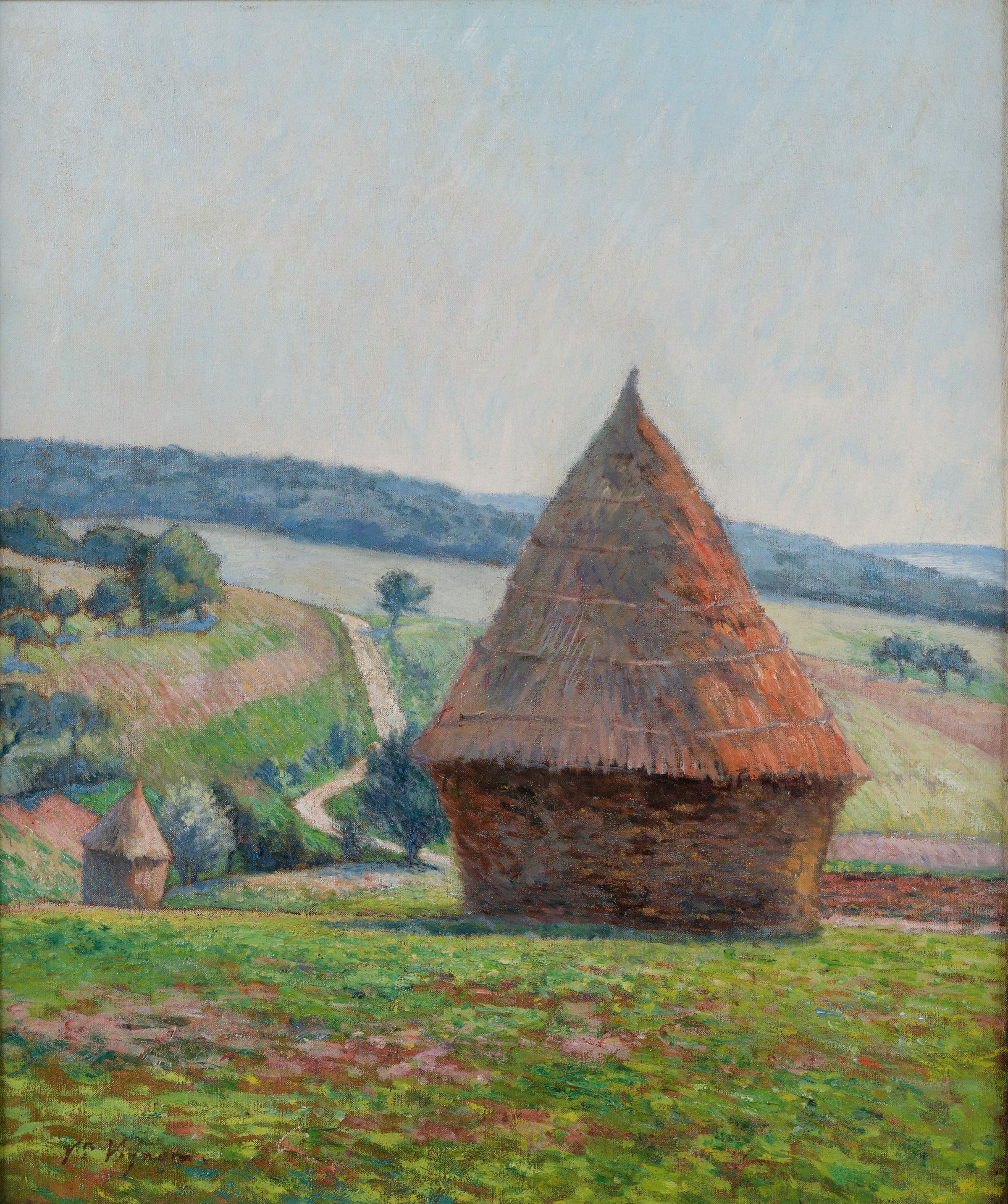
"Both works by Vignon in the Rusinko Kakos Collection feature a high horizon line—a visual device that elevates the earthbound over the atmospheric effects of the sky. Each is foregrounded by passages of coarse, rose-colored earth beneath a grassy groundcover. The Hamlet depicts the thatched-roof cottages of a remote village surrounded by trees. It is conceivable that both works [referring to 'The Hamlet] were executed not far from one another within Val-d’Oise" (Impressionist Legacies 12-13).Note Type
Historical NoteNote
"By 1889, with a heart condition and failing eyesight, Vignon’s health had begun to deteriorate. As a result, his production slowed in the waning years of the nineteenth century. While Vignon had his work included in four of the original eight Impressionist exhibitions mounted between 1874 and 1886, Vignon regrettably has not received the critical acclaim afforded his contemporaries" (Impressionist Legacies 13).Note Type
Historical NoteNote
"Victor Vignon studied under Jean-Baptiste-Camille Corot, a leader of France’s Barbizon school, whose practice of painting outdoors prefigured Impressionism. Beginning in 1869, Vignon learned to structure his landscapes according to Corot’s method, which emphasized the gradual shift between light and dark tones. In 1873, he became the pupil of Camille Pissarro in Pontoise, a rural suburb northwest of Paris. There, and in the nearby village of Auvers-suroise, Vignon painted alongside Paul Cézanne, Armand Guillaumin, and Francisco Oller, developing a style that synthesized academic accuracy with the spontaneity popularized by his peers. A future friendship with Vincent van Gogh and van Gogh’s brother, Théo, was facilitated by a mutual friend, Dr. Paul Gachet, who, together with Théo, collected Vignon’s work" (Impressionist Legacies 12).Note Type
Artist’s Intent NoteNote
"Much like Pissarro and Monet, Vignon shared an affinity for haystacks, a motif that represented the efforts of working-class labor and whose conical form lends themselves to be depicted in nuanced shades of light and color. Together with a winding road that extends beyond our sight, these towers of sustenance for livestock doubly symbolize the presence of people otherwise absent within the scene" (Impressionist Legacies 13).