Note Type
Historical NoteNote
"Henri Lebasque was one of the founding exhibitors of the Salon d’Automne in 1903 where, two years later, he encountered radically new work by a small group of artists that included Henri Matisse, André Derain, Georges Rouault, and Kees van Dongen, whose riotous use of color and free brushwork earned them the collective title “the Fauves” or wild beasts. Not long after, Lebasque began adopting a more playful, expansive style that would animate his creative energies for the rest of his life. While deeply affected by the bold, resounding colors of his contemporaries, Lebasque never abandoned the softer, natural tones of the Impressionists, opting for subtle transitions punctuated by brighter hues" (Impressionist Legacies 74). Note Type
Artist’s Intent NoteNote
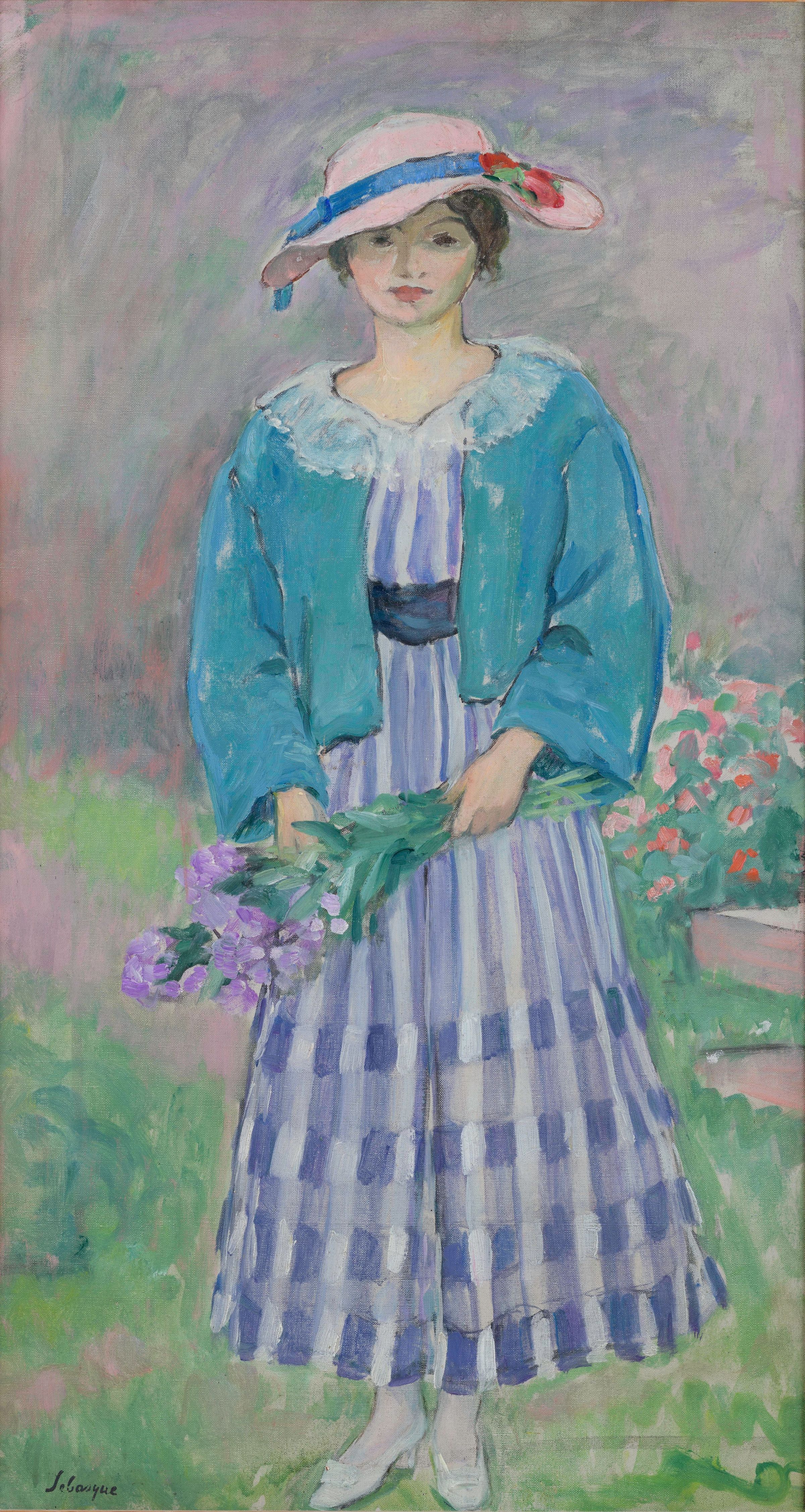
"Much like his friends Pierre Bonnard and Édouard Vuillard, Lebasque sourced his subject matter from daily life, creating intimate familial scenes bathed in luminous color. Marthe Lebasque, the artist’s daughter, posed for this full-length portrait at the age of seventeen while in Vézillon, a rural hamlet on the banks of the Seine fifty miles northwest of Paris. An assured, fashionable young woman, Marthe dons a rose-colored hat decorated with a blue band and holds a bouquet of recently gathered flowers from the family’s garden. Stylizing the violet plaid in her dress, Lebasque emphasizes the graphic quality of the fabric. The creation of this work anticipates Marthe’s marriage to fellow artist Carlos Reymond in 1919 before embarking on a successful career as a concert soprano and painter, elaborating on the style of her father" (Impressionist Legacies 74).Note Type
Historical NoteNote
"Lebasque exhibited widely throughout his artistic career. Among a select cadre of artists representing France, Lebasque’s work was shown as part of the Carnegie International in Pittsburgh on ten occasions between 1922 and 1936" (Impressionist Legacies 74).Note Type
Historical NoteNote
Literature: Henri Lebasque : Catalogue Raisonné t.1, Denise Bazetoux, Artprint: Paris, 2018, pg. 170, no. 561.