Note Type
Artist’s Intent NoteNote
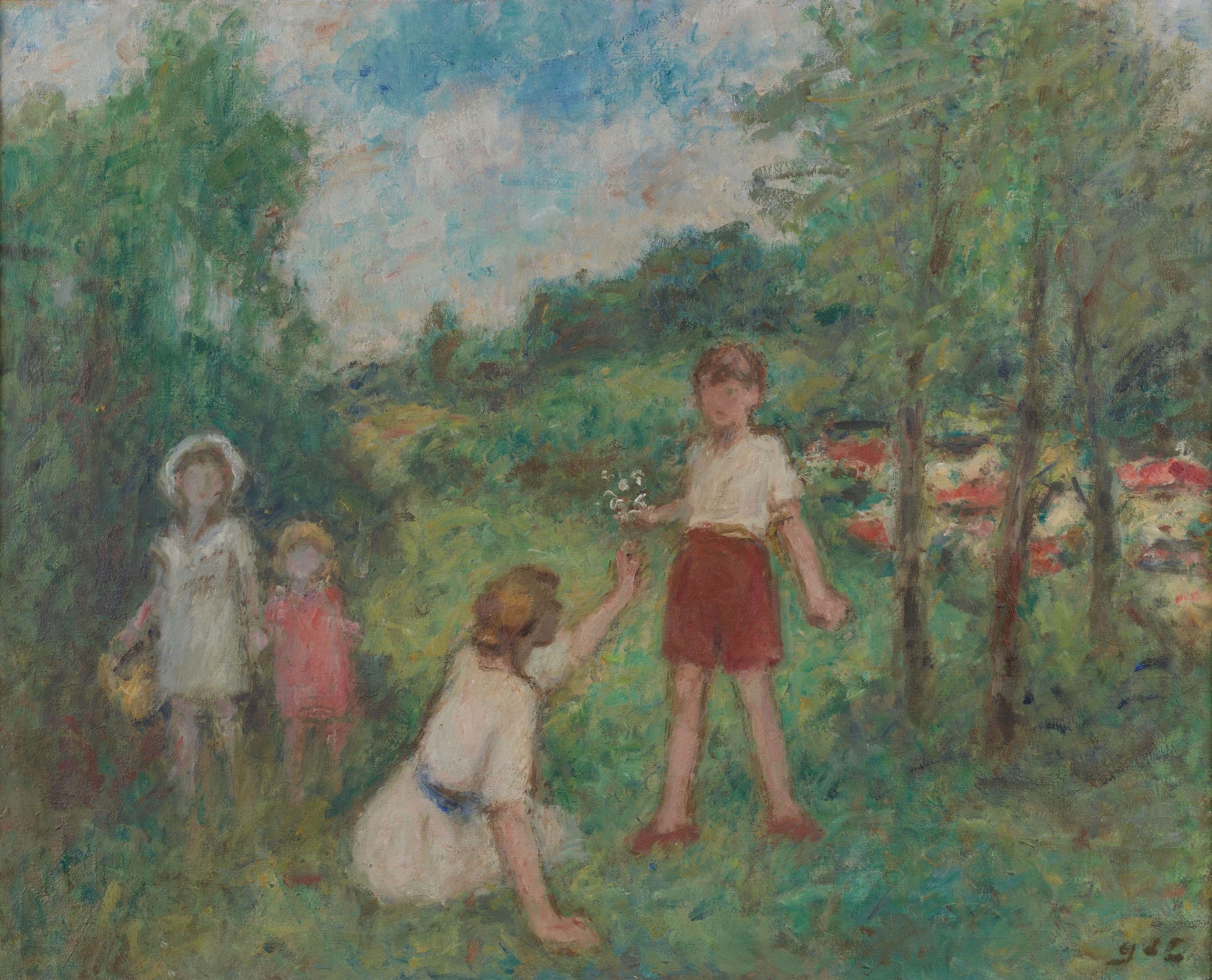
Not long after the conclusion of World War I, when his artistic talents were placed in the service of a French armed forces unit responsible for concealing military equipment through camouflage, d’Espagnat and his family relocated to a hilltop village in Quercy in Southwest France. Nestled within the bucolic environment, d’Espagnat returned to composing small vignettes of figures within expansive landscapes, including Mother and Children. The artist’s wife, Marie Constance Marguerite de Ginestet, reclines in a clearing, reaching to receive a small bouquet of 28 f lowers from her son, Bernard, who stands in the center of the composition. Nearby, two children hold hands, one with a basket to collect wildflowers. The intimate exchange is underscored by the artist’s hazy brushwork, a technique that gives the scene a dream-like quality. Bernard, born shortly after relocating to the area in 1921, was a frequent subject of d’Espagnat’s work and would later become an internationally-recognized physicist exploring the philosophical implications of quantum mechanics. Recalling these formative years and the indelible impact of his father’s influence, he writes: “Without explicitly explaining to me, my father instilled in me the notion that at the heart of active participation in a blossoming [artistic theory], it is very possible to remain oneself by developing one’s own questions and sensibilities.”3
3 Georges d’Espagnat: An Original. Washington, DC: Guarisco Gallery, 1999, Page 8.