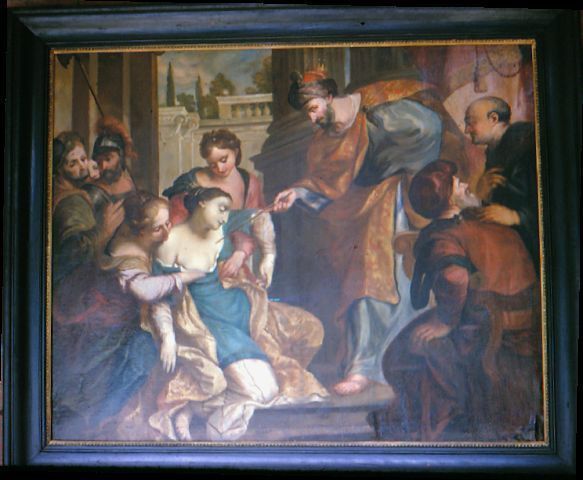
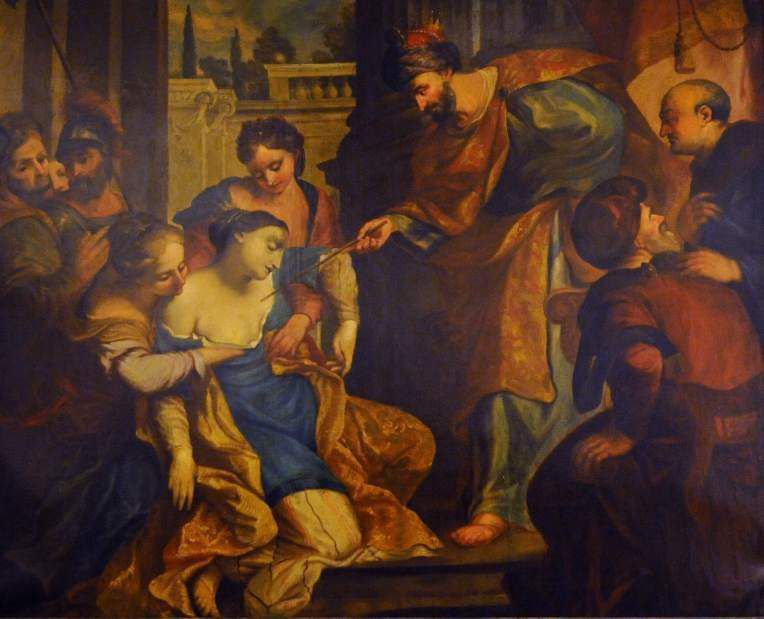
Queen Esther Before King Ahasuerus (after a 17th Century Dutch source)
Name/Title
Queen Esther Before King Ahasuerus (after a 17th Century Dutch source)Entry/Object ID
1853.120Description
Ann Sutherland Harris felt this was inspried by a 17th century Venetian source. Kennedy's felt this was inspired by a 17th century Dutch source. See computer files about chemical analysis tests by Sean Murphy, a chemistry senior, in 2013. St. Vincent College student helps get to bottom of alteration to 18th-century painting Staff Reporter Tribune-Review (Greensburg and Pittsburgh, Pennsylvania) By Stacey Federoff Published: Monday, May 27, 2013, 12:01 a.m. Updated: Monday, May 27, 2013 Students at St. Vincent College noticed something wasn't quite right with an 18th-century painting hanging at the school, but they had only their suspicions to go on until senior Sean Murphy decided to investigate using a new, high-tech piece of equipment. Murphy's research project wasn't really about finding out if the piece had been painted over, because the brush strokes are visible. "When you look at it, you can clearly tell something happened to it or was done to it," he said. Murphy said he wanted to find out when the painting was changed. Murphy, a chemistry major, had taken an interest in the scanning electron microscope newly installed in the renovated Sis and Herman Dupre Science Pavilion - so much so that he condensed a half-dozen 150-page manuals for the machine down to an eight-page standard operating procedures booklet for students. The booklet helps students with common functions such as autofocus, "how not to break it, pretty much, (and) how to turn it on," Murphy said. The microscope can magnify up to 35,000 times the original, enabling Murphy to see the separate layers of paint. Benedictine Brother Norman [sic] Cochran, chairman of the school's visual art department and curator of the art collection, said records indicate the painting came to the college in the 1850s. Biblical story The painting by an unknown artist, called "Queen Esther Before King Ahasuerus," was given to St. Vincent's founder, Bonniface Wimmer, by King Ludwig I of Bavaria. It depicts a biblical woman touched on the breast by the king's scepter while another figure holds her up from behind. Cochran explained the story, told in the Book of Esther. The queen was trying to persuade the king not to kill the Jews in the Persian empire after her cousin Mordecai, a Jew, refused to bow to the king's god. "She bursts into the throne room to intercede on behalf of the Jews. ... She's fainted because she realized what she did," Cochran said. "(The king) takes his scepter, and he touches her on the breast to show that she's forgiven." Modern treatment The modification was made to her breast and the hand below it, so Murphy first used UV fluorescence, which reacts to different pigments in the paint, and showed a separation between the newer layer and the original work in that section. Then he used a Xenon lamp and reflectance spectroscopy to measure the amount of visible, infrared and ultraviolet light that elements in the paint allow to pass through. "We couldn't necessarily date it from there; we could just say it wasn't the same," Murphy said. Under Cochran's supervision, Murphy took small samples of the paint to observe under the microscope. "They let me cut into it myself - very gently, of course," he said. Cochran said Murphy handled the painting with care and did a good job of removing the samples. "He was really worried about working on an 18th-century painting," Cochran said. "It's not every student you would trust to do a project like this, but he definitely is one." With the microscope, he could identify lead in the original layer of paint, while barium was used in the new layer. Barium was introduced in pigments in the 19th century, later than the original painting, Murphy said. Putting pieces together "The fact that it was in an 18th-century painting - something didn't match up," he said. "That was the big 'aha' moment." Cochran said Murphy's research was in line with the record of a monk who had touched up paintings in the 1870s and 1880s, not any 20th- or 21st-century additions. "We knew restoration attempts had been made on a lot of the paintings over the years, but we don't have a lot of documentation when those were done," he said. Engineering science professor Paul Follansbee, who oversees use of the scanning electron microscope, said he was glad a student like Murphy was inspired by the new technology. "I was hoping a student would have this level of interest," Follansbee said. "I think he liked the challenge trying to maximize its use and make it useful for others. ... He didn't have to take his time and help other students, but he willingly did that." Murphy of Marlton, N.J., said now that he has graduated, he has an interest in getting into sales of the equipment now that he has worked with one so extensively. As for the painting, it could be restored, Cochran said, but that would be costly and time-consuming and "not one of our highest priorities" with 4,331 works of art to take care of in the college's collection. Stacey Federoff is a staff writer for Trib Total Media. She can be reached at 724-836-6660 or [email protected].Artwork Details
Medium
Canvas, OilCollection
Archabbey-LudwigmissionsvereinCataloged By
KimAcquisition
Accession
1853.120Source or Donor
King Ludwig I of Bavaria via Joseph Mueller and Pius ReiserAcquisition Method
DonationCredit Line
Gift of King Ludwig I of BavariaMade/Created
Artist
UnknownDate made
1700 - 1800Notes
Date: 18th Century Artist's School: German Technique: PaintingEthnography
Culture/Tribe
European