Name/Title
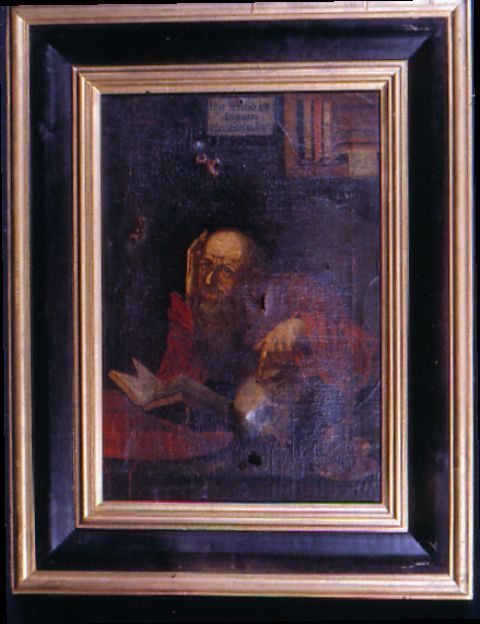
Saint Jerome (after an engraving by Martin van Reymerswaele, Dutch, c 1490-c. 1546)Entry/Object ID
1853.113Description
At the top of the work is the inscription: "Ibit homo in domum aeternitatisluae."
Ann Sutherland Harris said: "Look up Martin van Reemersvaele for possible engraved source."Collection
Archabbey-LudwigmissionsvereinCataloged By
KimAcquisition
Accession
1853.113Source or Donor
King Ludwig I of Bavaria via Joseph Mueller and Pius ReiserAcquisition Method
DonationCredit Line
Gift of King Ludwig I of BavariaMade/Created
Date made
1700 - 1725Notes
Date: Early 18th Century
Artist's School: Dutch
Technique: PaintingInscription/Signature/Marks
Lexicon
Nomenclature 4.0
Nomenclature Primary Object Term
PaintingNomenclature Class
ArtNomenclature Category
Category 08: Communication ObjectsLOC Thesaurus for Graphic Materials
SaintsSearch Terms
Paintings, Saints, ReligiousOther Names and Numbers
Other Numbers
Number Type
Old NumberOther Number
133Dimensions
Height
16 inWidth
11-1/2 inDimension Notes
Frame Size: 17x22Location
Location
Shelf
B-21Room
3rd Floor StorageBuilding
Carey Hall- GalleryCategory
PermanentDate
February 9, 2025Location
Shelf
B-12, B-12Room
3rd Floor StorageBuilding
Carey HallCategory
PermanentLocation
Shelf
B-12, B-12Room
3rd Floor StorageBuilding
Carey Hall- GalleryCategory
PermanentCondition
Overall Condition
PoorDate Examined
Apr 10, 2017Examined By
Rachel WheelerNotes
Large holes at top right corner, and throughout the pieceRelationships
Related Person or Organization
Person or Organization
Saint JeromePerson or Organization
Martin van ReemersvaeleProvenance
Notes
Collected By: Boniface Wimmer, O.S.B.
King Ludwig I of Bavaria began sending paintings and artwork to Boniface Wimmer in 1853. This work is assumed to be one of the 300 paintings sent during the 1850's. When Wimmer wrote to King Ludwig asking him for artwork to decorate the monastery, churches and to use in the instruction of art King Ludwig ordered Joseph Mueller to send paintings through the Ludwigmissionsverein which was administered by Pius Reiser. It is also assumed that many of these works were from the many artworks confiscated from churches and monasteries by Napoleon and then given over to local princes and kings. It is rumored that over 10,000 such artifacts were assembled in Munich alone, and assumed the 300 sent to Saint Vincent came from this group. Today, there are slightly less than 200 such paintings at Saint Vincent. Some were destroyed, and others were sent to foundations established by Saint Vincent.General Notes
Note
Notes: An inscription at the top of the work reads, "Ibit homo in domum aeternitatisluae."
Status: OKCreated By
admin@catalogit.appCreate Date
November 14, 2006Updated By
admin@catalogit.appUpdate Date
February 11, 2025