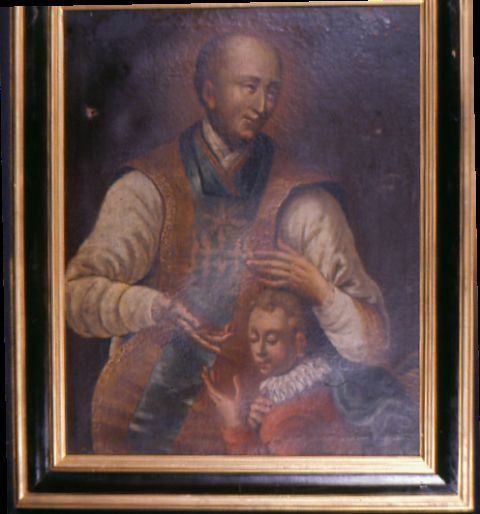
King Ludwig I of Bavaria via Joseph Mueller and Pius Reiser
Acquisition Method
Donation
Credit Line
Gift of King Ludwig I of Bavaria
Made/Created
Artist
Unknown
Date made
1800 - 1850
Notes
Date: First Half 19th Century
Artist's School: German
Technique: Painting
Ethnography
Culture/Tribe
European
Inscription/Signature/Marks
Transcription
NS
Lexicon
Nomenclature 4.0
Nomenclature Primary Object Term
Painting
Nomenclature Class
Art
Nomenclature Category
Category 08: Communication Objects
LOC Thesaurus for Graphic Materials
Saints
Search Terms
Paintings, Saints, Religious
Other Names and Numbers
Other Numbers
Number Type
Old Number
Other Number
163
Dimensions
Height
29-3/4 in
Width
24 in
Dimension Notes
Frame Size: 29.75x35.5
Accessories
Notes
Frame: Yes
Location
Location
Shelf
B-27
Room
3rd Floor Storage
Building
Carey Hall- Gallery
Category
Permanent
Date
February 9, 2025
Location
Shelf
B-132, B-132
Room
3rd Floor Storage
Building
Carey Hall- Gallery
Category
Permanent
Moved By
Bernadette Miller
Date
January 22, 2013
Location
Shelf
B-3, B-3
Room
3rd Floor Storage
Building
Carey Hall
Category
Permanent
Location
Shelf
B-3, B-3
Room
3rd Floor Storage
Building
Carey Hall- Gallery
Category
Permanent
Inventory
Inventoried By
Bernadette Miller
Inventoried Date
Jan 22, 2013
Condition
Overall Condition
Fair
Maintenance
Maintenance History
Date
Nov 15, 2006
Relationships
Related Person or Organization
Person or Organization
Saint Ignatius
Provenance
Notes
Collected By: Boniface Wimmer, O.S.B.
King Ludwig I of Bavaria began sending paintings and artwork to Boniface Wimmer in 1853. This work is assumed to be one of the 300 paintings sent during the 1850's. When Wimmer wrote to King Ludwig asking him for artwork to decorate the monastery, churches and to use in the instruction of art King Ludwig ordered Joseph Mueller to send paintings through the Ludwigmissionsverein which was administered by Pius Reiser. It is also assumed that many of these works were from the many artworks confiscated from churches and monasteries by Napoleon and then given over to local princes and kings. It is rumored that over 10,000 such artifacts were assembled in Munich alone, and assumed the 300 sent to Saint Vincent came from this group. Today, there are slightly less than 200 such paintings at Saint Vincent. Some were destroyed, and others were sent to foundations established by Saint Vincent.