Note Type
Artist’s Intent NoteNote
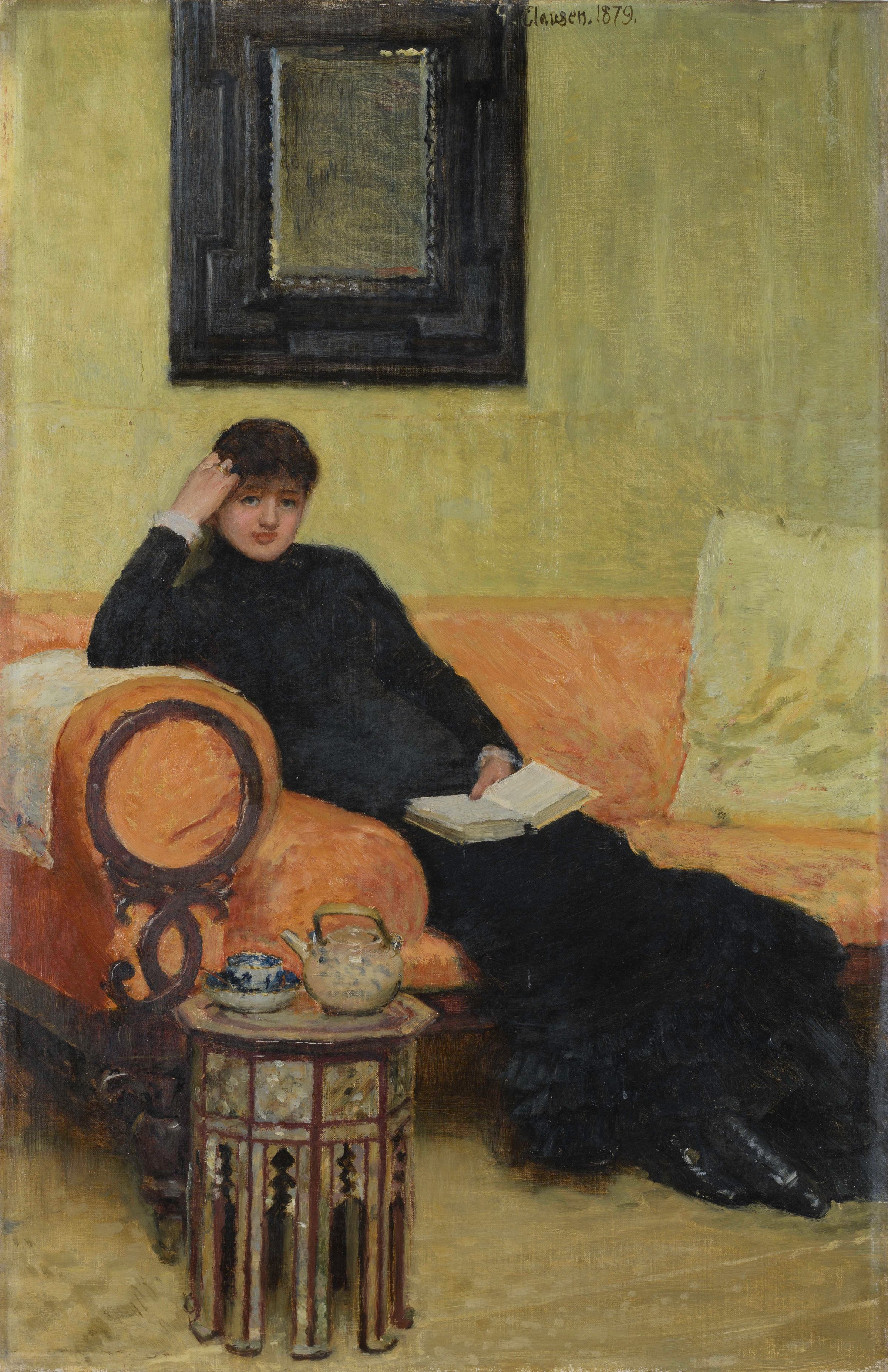
Initially captivated by seventeenth century Dutch genre painting, George Clausen became drawn to the stark realism of James Abbott McNeill Whistler during the 1870s, having seen Arrangement in Grey and Black No. 1, known more commonly as Portrait of the Artist’s Mother (1871), and its companion, Arrangement in Grey and Black, No. 2: Portrait of Thomas Carlyle (1872– 1873). It is during this period Clausen painted several isolated female socialites, including an unidentified woman in The Novel. With an open book on her lap, a sophisticated young woman languidly reclines on a Victorian sofa; the outline of her dress contouring the muted-orange upholstery. Inclusion of imported luxuries such as the porcelain Chinese teapot, cup, and saucer sitting atop an octagonal 52 Jules Bastien-Lepage prompted Clausen’s turn away of portraiture of the elite to pursue an honest austerity of rural life the following decade. Dissatisfied with occasional table inlayed with mother of pearl symbolize her middle class status within English society and point to the expanding presence of the British Empire. A cropped carved Dutch black lacquered frame above the sitter suggests the influence of Edgar Degas and Gustave Callibotte, while unblended brushwork throughout the piece bears additional testament to his awareness of Impressionism. When the painting was exhibited in the winter of 1879 at the Dudley Gallery, The Magazine of Art praised the piece: “Mr. George Clausen adopts this year the prevailing fashion for painting studio arrangements of decorative drapery: The Novel contains a combination of orange-colour and pale green and is very closely lighted.”5
5: McConkey, Kenneth. Sir George Clausen, R.A. 1852 – 1944. Bradford Art Galleries and Museums and Tyne and Wear County Council Museums, 1980, pg. 15.Note Type
Cataloging NoteNote
Literature: Sir Geroge Clausen, R.A., 1852 – 1944, Braford Art Galleries and Museums and Tyne and Wear County Council Museums, 1980, p. 25, no. 15