Note
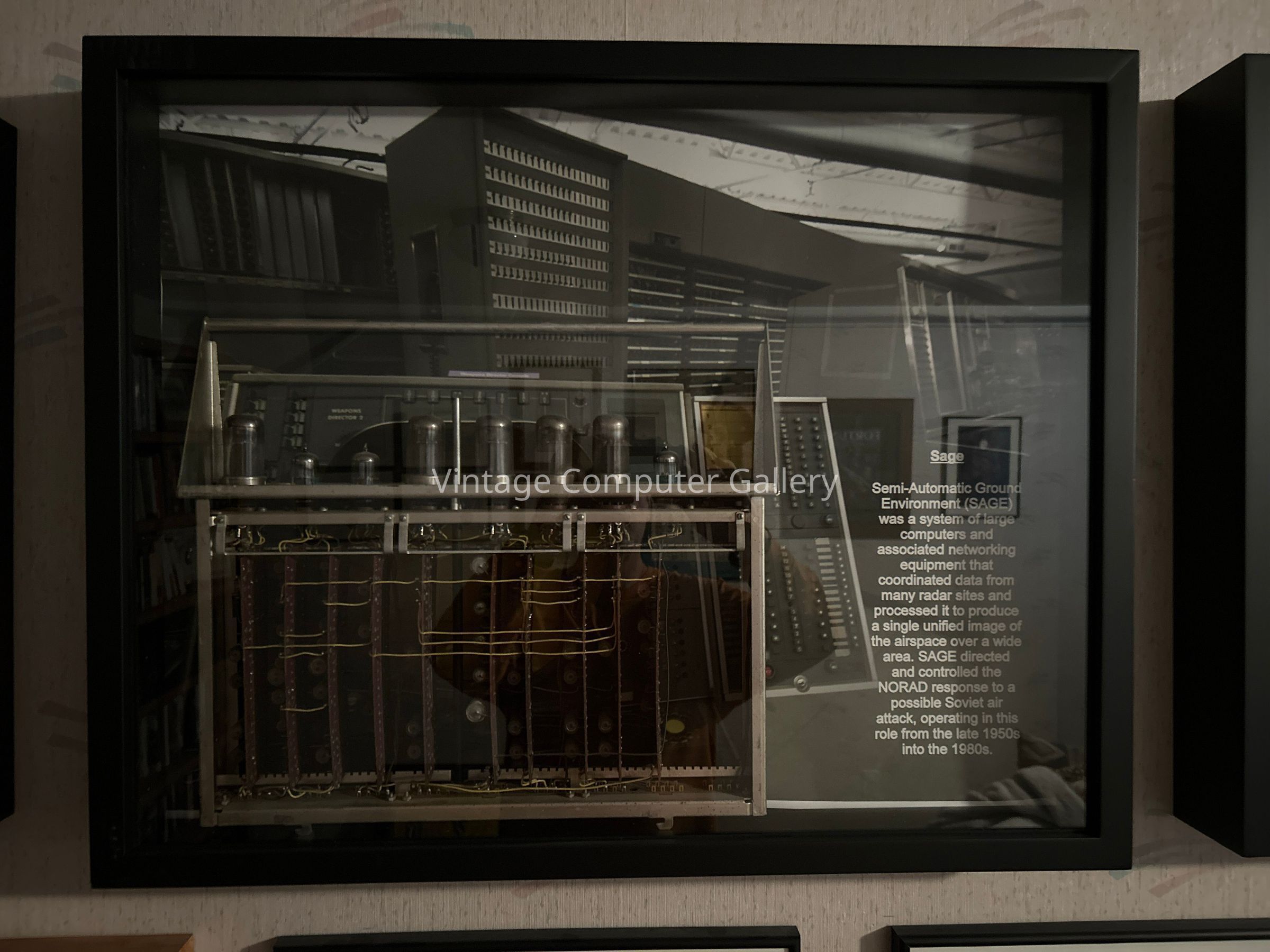
SAGE was designed to coordinate radar stations and direct airplanes to intercept incoming planes. SAGE consisted of 23 "direction centers," each with a SAGE computer that could track as many as 400 airplanes. In 1948, Jay Forrester wrote a lengthy document containing his concept for a plan to improve America's air defense using techniques learned from W.W. II radar development. The SAGE project resulted in the construction of 23 concrete-hardened bunkers across the United States (and one in Canada) linked into a continental air-defense system called "SAGE." . SAGE was designed to detect atomic bomb-carrying Soviet bombers and guide American missiles to intercept and destroy them. SAGE was linked to nuclear-tipped Bomarc and Nike missiles. Each of the 23 SAGE "Direction Centers" housed a A/N FSQ-7 computer, the name given to it by the U.S. Military. The SAGE computer system used 3MW of power and had approximately 60,000 vacuum tubes. It took over 100 people to operate. The total project cost is estimated to have been between 8-12 billion dollars (1964).
Four main contractors were responsible for SAGE: IBM for hardware; Burroughs for inter-Center communications, Massachusetts Institute of Technology's Lincoln Laboratories for system integration; Western Electric for design & construction of buildings; and SDC (part of the RAND Corporation) for software. In 1958, the MITRE Corporation was formed out of the Computer System Division of Lincoln Laboratories. Much of MITRE’s initial work focused on the software development of SAGE’s digital computer system, radar surveillance, communications, and weapons integration. More importantly however, MITRE had the role of integrating many elements of the SAGE system.
The SAGE computer was one of about 30 computers constructed. The SAGE was the largest computer ever built. It was built by IBM and occupied two of the four stories of the SAGE building. It had more than one hundred & fifty display consoles housing a 48 inch long Vector CRT, each with a "light gun" as well as a "Typotron" display tube, capable of displaying more than 25K characters per second.
Operators accessed the SAGE system through cathode ray tube displays and used a light pen to select tracks of potential incoming hostile aircraft and manage their status. When SAGE was deployed in 1963, it consisted of 24 Direction Centers and 3 Combat Centers, each linked by long-distance telephone lines to more than 100 radar defense sites across the country, thereby establishing one of the first large-scale wide-area computer networks. This had a great influence on a lot of people who worked on the program, including J.C.R. Licklider, who later became the first Director of the IPTO and initiated the research that led to creation of the ARPANET. SAGE remained in continuous operation until 1983.
Each one of the 24 installations in fact had two identical CPUs, one of which would be in standby mode and one of which would be running. Each one had about 60,000 vacuum tubes and weighed 250 tons. The SAGE installations were enormous, requiring specialized generators and cooling systems to support the computers.
SAGE Installation At Minot Air Force Base, North Dakota (an example of a SAGE site)
In 1958, during the Cold War, United States Air Defense Command established a Semi-Automatic Ground Environment (SAGE) sector at Minot AFB, it was construction of a huge, windowless blast-resistant concrete building. IBM engineers installed two large, 275-ton computers in the basement of the building. Activated in June 1961, the SAGE facility processed air surveillance information and sent the data to Air Defense Command units.
SAGE Today- Portions of the SAGE computer are now at various computer museums around the country. The Smithsonian Air and Space Museum has some SAGE components.
Technical Description- Size: CPU (50 x 150 feet, each); consoles area (25 x 50 feet) (total system=20,000 square feet)
Weight: 250 tons (500,000 lbs)
Architecture: duplex CPU, no interrupts, 4 index registers, Real Time Clock
Word Length: 32 bits
Memory: magnetic core (4 x 64K word); Magnetic Drum (150K word); 4 IBM Model 729 Magnetic Tape Drives (~100K words ea.); all systems with parity checking
Memory Cycle Time: 6us
I/O: CRT display, keyboard, light gun, realtime serial data (teletype, 1300 bps modem, voice line)
Performance: 75KIPS (single-address)
Technology: vacuum tubes (60,000); diodes (175,000); transistors (13,000) Power Consumption: about 3 Megawatts