Note
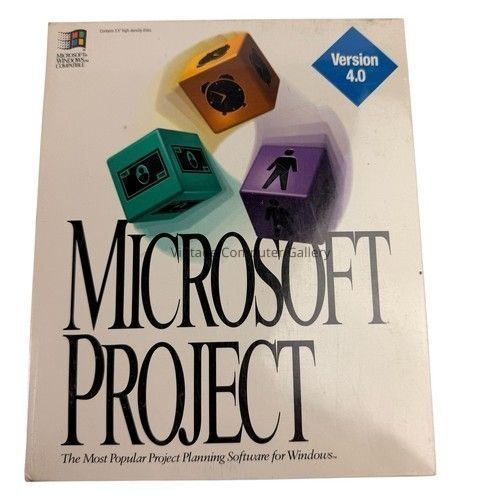
Release Date: October 1994, as a 16-bit Windows application.
Platforms: Primarily for Windows 3.1 and Windows NT 3.5/3.51; a Macintosh version was released concurrently in 1993–1994, supporting both 68k and early PowerPC processors, with Visual Basic for Applications (VBA) and integration with Microsoft Office 4.2 for Mac.
Editions: Available in Standard and Professional editions; the Mac version was the final one for that platform until later revivals.
Development Context: Following Project 3.0 (1992), which introduced macros and toolbars, version 4.0 addressed user feedback for better scalability. It was the last major 16-bit release before the full 32-bit shift in Project 98 (1998). A minor update, Project 4.1a (1995), added CD-ROM distribution, improved NT support, and was the last to open Project 3.0 files natively.
This version aligned with the Windows 95 launch, boosting its adoption as Microsoft pushed Office bundling.
Key Features
Project 4.0 built on its predecessors by focusing on usability and advanced planning, with a revamped interface for faster task handling:
Gantt and Network Views: Enhanced Gantt charts with drag-and-drop task linking, critical path highlighting, and network diagrams for dependency visualization.
Resource Management: Improved allocation with contoured availability, material resources, and workload analysis; introduced deadline dates and baseline clearing for better tracking.
Customization and Automation: Support for VBA macros, custom fields (with formulas and value lists), outline codes, and grouping; added planning wizards for quick setup.
Reporting and Output: Print preview, spell-checker, and export to formats like OLE DB for integration with Excel/Word; variable row heights and in-cell editing for easier data entry.
Collaboration Tools: Task calendars, estimated durations, and fiscal year settings in timescales; early support for AutoSave and templates for reusable project structures.
Mac-Specific Enhancements: PowerMac native code, seamless Office 4.2 linking, and the last Mac version to use MPX (Microsoft Project Exchange) files.
Significance and Legacy
Project 4.0 marked Microsoft's maturation in enterprise software, capturing ~40% market share in project management by the mid-1990s amid competition from Primavera and CA-SuperProject. Its VBA integration foreshadowed Office-wide scripting, while features like multiple baselines became standards in later versions (e.g., Project 2000's enterprise focus). The Mac edition's end in 4.0 reflected shifting priorities to Windows, but it influenced tools like Apple Motion. Critically, it supported the Y2K prep boom, helping teams manage millennial transitions.
As the last floppy-based and Acme-setup version, it symbolized the close of the 16-bit era. Project 4.0's modular design persists in modern Microsoft Planner and Project for the web, emphasizing timelines and resource agility.