Note
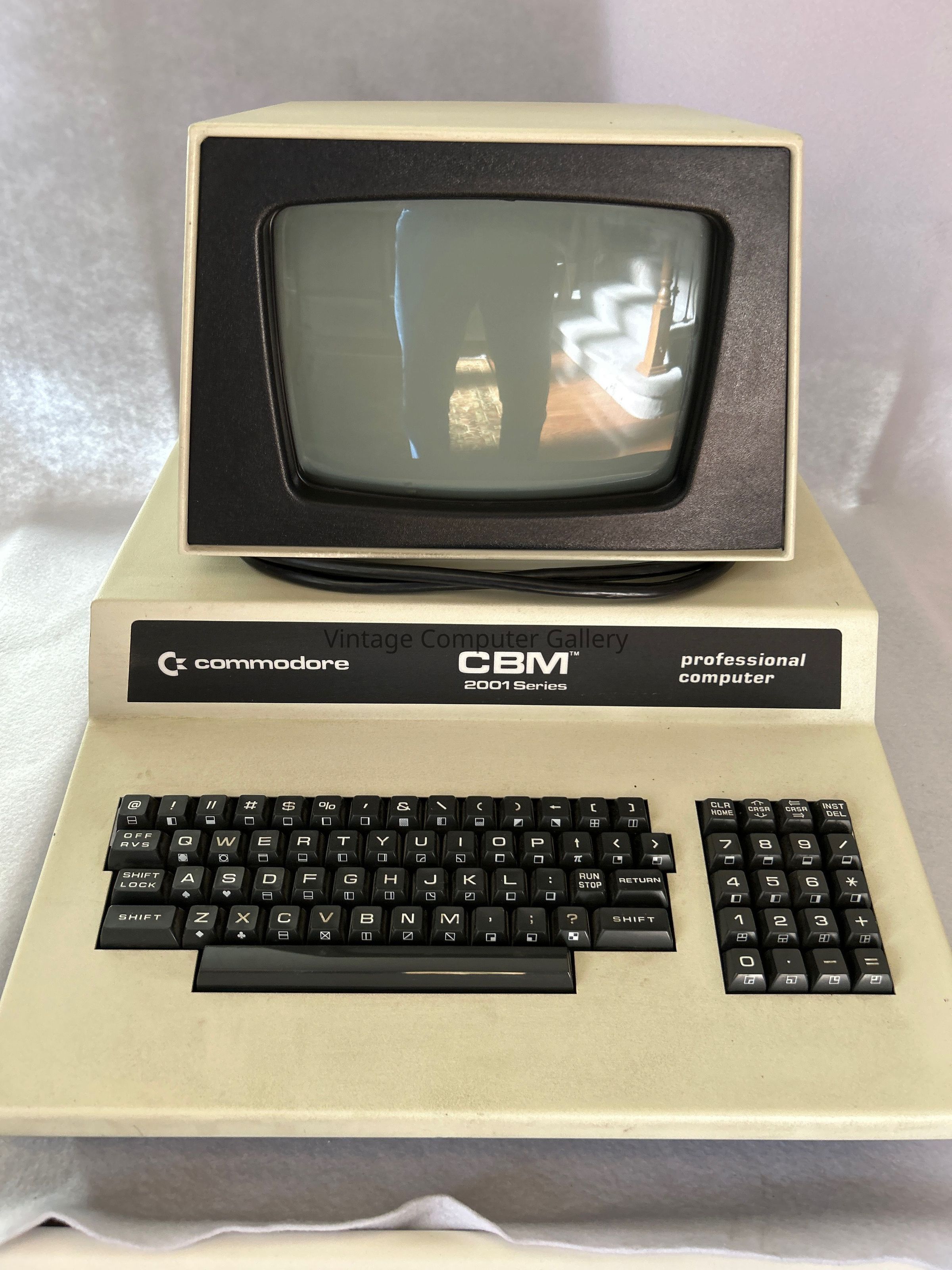
The Commodore PET (Personal Electronic Transactor) series was one of the pioneering personal computers, introduced by Commodore International in 1977 as part of the "1977 Trinity" alongside the Apple II and TRS-80. Development began in 1976, with the first prototype demonstrated at the January 1977 Consumer Electronics Show (CES). The PET was designed as an all-in-one machine, integrating a keyboard, monitor, and storage into a single unit to appeal to non-technical users in education, business, and home settings. It was powered by a MOS Technology 6502 microprocessor running at 1 MHz and came with Commodore BASIC in ROM, making it ready to use out of the box.
The original PET 2001 model shipped starting in October 1977 (initially to developers and media), with general availability by December. Early variants included the 2001-4 (4 KB RAM) and 2001-8 (8 KB RAM), priced around $495–$795. These featured a compact "chiclet" keyboard, a built-in cassette deck for data storage, and a 9-inch monochrome monitor with white phosphor. However, the chiclet keyboard drew criticism for its small size and poor ergonomics.
Key Specifications of the 2001-16N
CPU: MOS 6502 at 1 MHz.
RAM: 16 KB (expandable via ports).
ROM: 20 KB, including BASIC 2.0, KERNAL (for I/O and system functions), and character sets with PETSCII semigraphics.
Display: 9-inch monochrome monitor, 40×25 text resolution.
Storage: Supported external cassette tapes, 5.25-inch or 8-inch floppy disks, and hard drives via IEEE-488 bus.
Ports: IEEE-488 (for peripherals like printers and drives), parallel user port, memory expansion.
Sound: Basic beeper; optional external via user port.
Other: No high-resolution graphics or color; focused on text-based computing with semigraphic characters.
Significance and Legacy
The PET 2001 series, including the 2001-16N, sold around 219,000 units by 1982 and was hugely influential in education (especially in Canada and the UK) and business due to its rugged design, IEEE-488 networking for classroom sharing, and full-featured BASIC with floating-point math and lowercase support—features ahead of many competitors. It helped Commodore transition from calculators to computers and established vertical integration in the industry. However, limitations like max 32 KB RAM, lack of color/graphics, and no CP/M compatibility led to its decline against more advanced machines like the Apple II. The series was discontinued in 1982, succeeded by models like the VIC-20 and Commodore 64.