Note
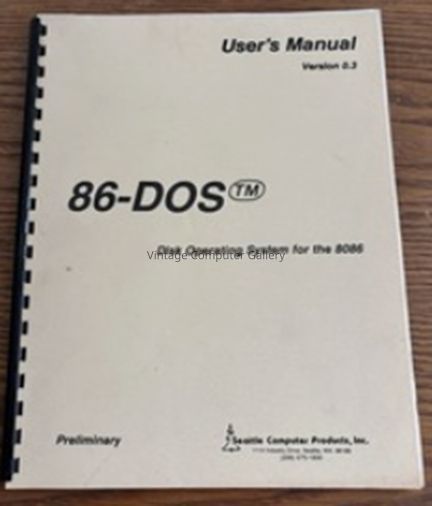
Seattle Computer Products was one of the first companies to build S‑100 bus systems using Intel’s new 8086 processor. They began shipping their 8086 CPU boards in November 1979, but sales stalled because no 16‑bit operating system existed to run software on them. Digital Research had promised CP/M‑86, but its release kept slipping, leaving SCP with hardware they couldn’t fully sell.
The only software SCP could bundle was Microsoft’s Standalone Disk BASIC‑86, which Microsoft had developed on SCP’s prototype hardware.
In April 1980, SCP assigned Tim Paterson to create a temporary substitute for CP/M‑86. Using a CP/M‑80 manual as a reference, Paterson wrote a CP/M‑like OS in 8086 assembly, finishing version 0.11 in August 1980. SCP began shipping it in September 1980.
Paterson designed it to be:
API‑compatible with CP/M, easing porting of existing 8‑bit software
Structured around familiar commands (DIR, COPY, etc.)
Adapted for the 8086’s 16‑bit architecture
Simple enough to implement quickly
This early version was called QDOS — “Quick and Dirty Operating System.” In December 1980, QDOS was renamed 86‑DOS to reflect its 8086 target platform.
Microsoft needed an operating system for IBM’s upcoming PC but didn’t have one. Recognizing 86‑DOS as a viable foundation, Microsoft:
Licensed 86‑DOS from SCP in December 1980 for $25,000
Purchased full rights on July 27, 1981 for $50,000
Granted SCP a perpetual royalty‑free license to sell 86‑DOS with its hardware
These moves occurred just weeks before IBM launched the IBM PC (August 12, 1981).
Microsoft then modified 86‑DOS and delivered it to IBM as PC‑DOS, while retaining rights to sell it independently as MS‑DOS.
Why 86‑DOS Mattered
1. It bridged the gap between CP/M and the IBM PC.
Its CP/M‑like API made porting software feasible during a critical transition.
2. It enabled the IBM PC launch.
Without 86‑DOS, Microsoft would not have had an OS ready for IBM’s deadline.
3. It became the foundation of MS‑DOS and PC‑DOS.
These systems dominated personal computing for more than a decade.
4. It standardized early PC software development.
Its command structure and file system conventions became industry norms.
🏛️ Historical Significance
From a preservation standpoint, 86‑DOS is important because it:
Represents the first practical 16‑bit OS for microcomputers
Shows how small companies shaped early PC history
Demonstrates how Microsoft’s rise was tied to opportunistic licensing
Serves as the direct ancestor of MS‑DOS, Windows, and the modern PC ecosystem
As one source puts it, 86‑DOS “quietly shaped the trajectory of modern computing.”