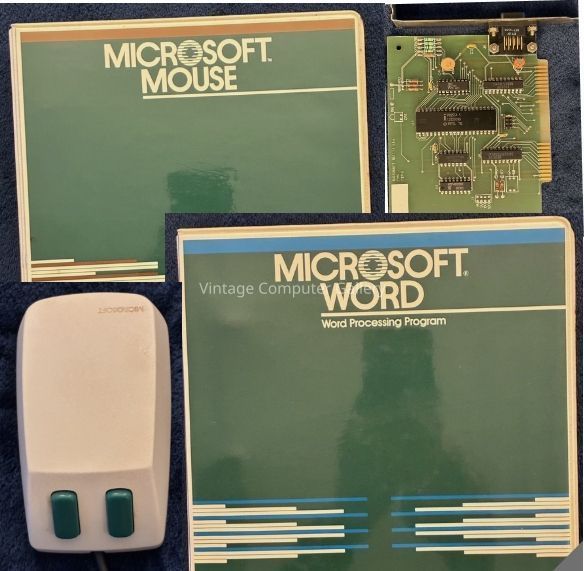
1983- Microsoft Word v1.0 + Green Eyed Mouse v1.0 Bundle (9/2026)
Tags
Microsoft
Description
When Microsoft released its first mouse in May 1983, the PC world wasn’t ready for it. Most IBM PC users lived entirely in text mode. DOS didn’t have a graphical shell. Windows didn’t exist yet. And almost no software supported mouse input. So Microsoft created a mouse before there was anything meaningful to use it with. This bundle was sold through computer stores and mail‑order catalogs. It was one of Microsoft’s earliest attempts at selling hardware and software together — a precursor to later “Microsoft Office + hardware ecosystem” thinking.
Acquisition
Acquisition Method
EBay
Date
Sep 14, 2026
General Notes
Note
Why the Bundle Is Historically Important
This bundle marks several firsts:
✔ Microsoft’s first consumer hardware product
The green‑eyed mouse was the first physical object Microsoft ever sold.
✔ Microsoft’s first attempt at GUI‑style interaction
Word 1.0 introduced menus, windows, and mouse selection before Windows existed.
✔ The birth of Microsoft’s application strategy
Word was the first pillar of what would later become Microsoft Office.
✔ A rare transitional moment in PC history
The bundle represents the shift from text‑only computing to graphical interaction.
Collectors consider this one of the holy grails of early Microsoft artifacts, because:
Most mice were separated from their software bundles so
Word 1.0 boxes are scarce. Early Microsoft hardware was produced in small quantities. Bundles were often broken up by resellers. Having the mouse and the software together is historically significant.
The Word + Mouse bundle lasted only about a year Because in 1984–1985:
More applications began supporting mice
Microsoft released newer mouse models
Windows 1.0 was approaching
Word began selling independently
OEMs started bundling mice with PCs
By 1985, the bundle was discontinued.
This makes surviving examples — especially complete ones — extremely rare.