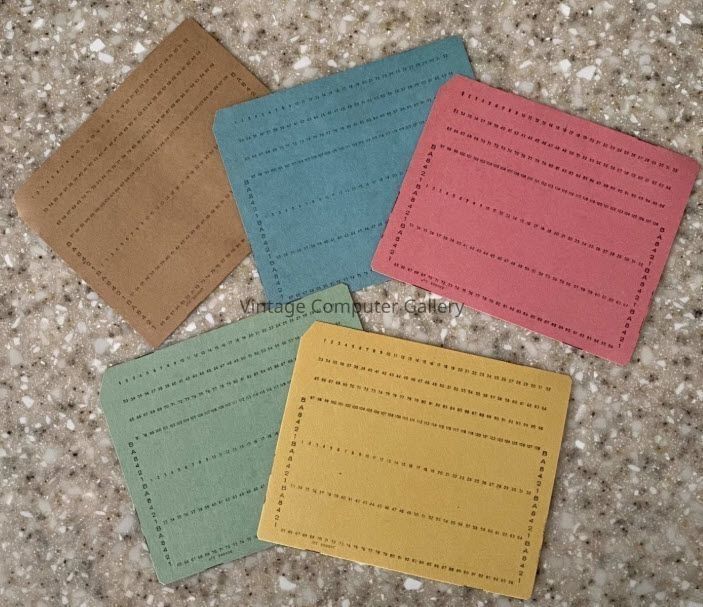
Note
1. Origins: The System/3 Family (1969–1985)
IBM introduced the System/3 in July 1969 as a new line of midrange business computers aimed at smaller companies that couldn’t afford or didn’t need full-scale mainframes like the IBM System/360.
The System/3 was designed to:
Be affordable and office-friendly (using low power and small physical footprint).
Handle accounting, inventory control, and small manufacturing data tasks.
Use a new, more efficient form of punched card storage.
To achieve this, IBM developed the 96-column punch card, which became one of its most distinct and influential innovations in data entry.
2. The 96-Column Card Design
Physical Characteristics
Dimensions: 3.25 inches × 7.375 inches — slightly smaller than the traditional 3.25 × 7.375 inch 80-column card, but with rounded corners and lighter cardstock.
Columns: 96 total, arranged in 12 rows × 8 columns per character (each character encoded in a column using smaller rectangular holes).
Card Material: Lighter stock, more flexible, and coated for use in high-speed optical or mechanical readers.
Orientation: Cards were fed end-on (short edge first) rather than lengthwise, allowing more compact reading/writing mechanisms.
3. Technology and Encoding
The 96-column card used EBCDIC (Extended Binary Coded Decimal Interchange Code) rather than the older Hollerith encoding scheme used in 80-column cards.
Each character was represented by 12 small rectangular holes, rather than the traditional circular holes. The reduced size of the holes and closer spacing allowed IBM to fit 96 columns into essentially the same card length.
This high-density encoding provided:
Up to 20% more data per card.
Compatibility with optical readers and System/3 keypunch devices.
Smoother feeding and fewer jams, thanks to the smaller form factor and improved cardstock.
4. Data Entry and Peripheral Devices
The System/3 series used the following key peripherals:
IBM 5496 Data Recorder – a combined keypunch and card reader for 96-column cards.
IBM 3741 and 3742 Data Stations – later devices that replaced card entry with diskette-based data input.
IBM 5424 Multifunction Card Unit – handled reading, punching, and stacking operations.
Operators could punch, verify, and process cards much like they had with the older 80-column system, but with faster throughput and more compact handling.
5. Software and Applications
The System/3 ran the System Support Program (SSP) operating system, supporting RPG II (Report Program Generator) as its main programming language.
RPG II was tightly integrated with the card format:
Programs often read card decks as primary data input.
Business applications (invoicing, payroll, inventory) were written to process 96-column cards directly.
This made the System/3 an efficient and powerful business computer for its time — bridging the gap between punched-card accounting machines and disk-based systems.
6. Legacy and Transition
By the mid-1970s, IBM’s System/32, System/34, and System/36 succeeded the System/3, gradually moving away from punched cards toward diskette and hard drive storage.
However:
96-column cards remained in use through the early 1980s, especially in small businesses.
Many System/3 and System/36 installations retained card readers for legacy data conversion.
The optical 96-column card became one of the last major punched card formats before the technology was fully phased out.