Note
Development
The H8's origins trace back to 1975, inspired by the groundbreaking MITS Altair 8800 featured in a Popular Electronics article, which sparked widespread interest in affordable microcomputers. Heath engineers Chas Gilmore and Lou Frenzel, passionate about microprocessors, proposed the project to the company's Executive Product Development Committee (XPDC). Initially met with skepticism over market potential, the idea gained approval under company president Dave Nurse, who mandated exclusive focus on the H8 until its success. Development emphasized rigorous testing to ensure the kit's assembly instructions were foolproof, aligning with Heathkit's reputation for educational, user-built products. The design drew from Heath's prior experience with DEC PDP-8/L systems in scientific instruments, adapting microcomputer tech for broader hobbyist use.
Release and Features
The H8 debuted in August 1977 at the inaugural PC Show in Atlantic City, priced at around $375-$379 in unassembled kit form—making it an accessible entry into computing. It was released alongside complementary products like the H-11 (a DEC PDP-11-based kit), H-10 paper tape reader/punch, a printer, terminal, and developing disk drives. Unlike competitors such as the Altair 8800 or S-100 bus systems, the H8 used a proprietary 50-pin "Benton Harbor" bus (named after Heath's headquarters location), which was more compact, robust, and better shielded but incompatible with standard expansions.
Key technical specifications included:
Processor: Intel 8080A at 2 MHz, with an optional upgrade to Z-80 via a separate card (HA-8-6).
Memory: Up to 64KB RAM, starting with options like 4KB and expandable via boards such as the WH-8-64 (32KB base, up to 64KB) or WH-8-16 (16KB).
Bus and I/O: Fully buffered bus with 7 plug-in slots; supported full I/O devices, including RS-232C serial ports via interfaces like WH-8-47.
Storage: Cassette tape (with Heath's Cassette Operating System) or disk drives; required additional peripherals like a terminal for usability.
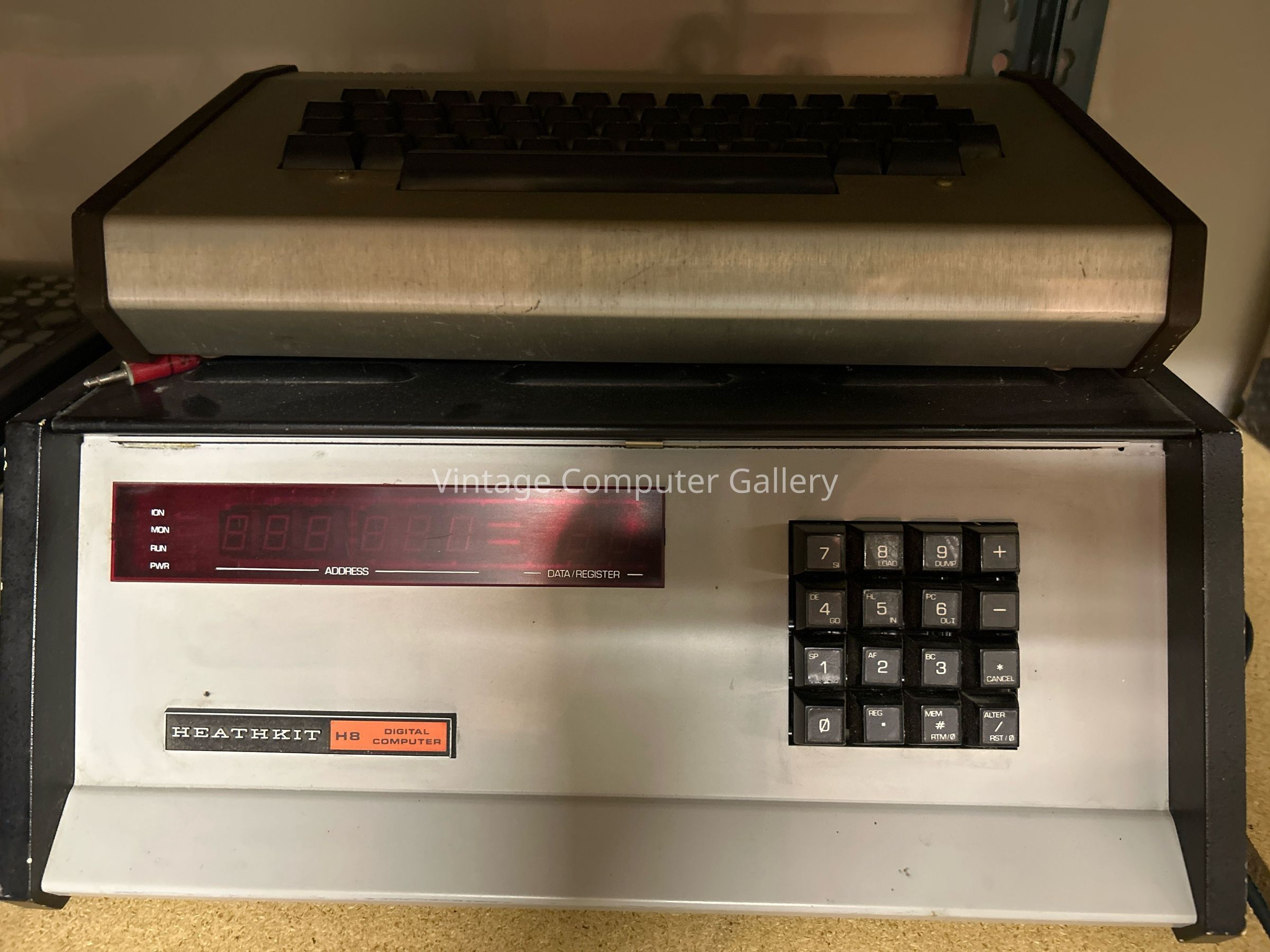
Display/Input: Front panel with LED digits for address/data/register display and a hexadecimal keypad; no built-in monitor or keyboard in base form.
Operating System: Compatible with CP/M, a popular OS for early micros.
Dimensions and Power: 6.5 x 16.1 x 17 inches, with a heavy-duty power supply; kit weighed about 30 pounds.
Market Impact and Legacy
Launched amid the "Golden Age" of personal computing (late 1970s to early 1980s), the H8 achieved rapid success, generating $7-8 million in sales from PC-related products between September and December 1977 alone—surpassing expectations and boosting Heath's overall revenue to $65-71 million that year. It appealed to the homebrew community, offering educational value through assembly and customization, though its proprietary bus limited third-party compatibility compared to S-100 systems. The H8 played a role in democratizing computing, much like its contemporaries, and paved the way for Heath's expansion into more computers, including the H-89 all-in-one system.
By the early 1980s, pricing had adjusted slightly (e.g., $350 for the kit in 1982 catalogs), but the rise of pre-assembled machines like the IBM PC contributed to Heathkit's eventual decline in the computer kit market. Today, the H8 is remembered as a pivotal artifact in computing history, preserved in museums and cherished by retro computing enthusiasts.