Note
1. Overview
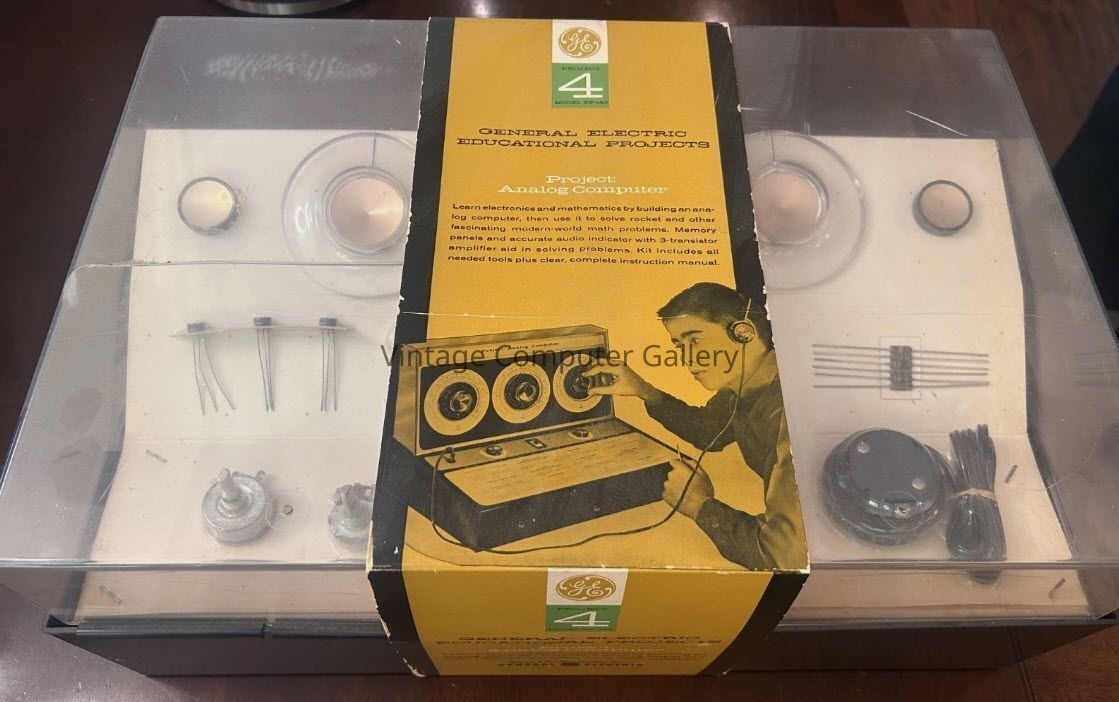
The GE EF-140 is a build-it-yourself educational analog computer kit marketed by General Electric in 1961, under the label “Project 4”. According to the kit’s own manual:
“The GE Project 4 Model No. EF-140 was General Electric’s ‘new concept in introducing transistor lectronics to America’s youth’.”
It sold for a modest price (estimated around US $29.29 in 1961) and required no soldering—powered by four “D”-cell batteries.
The kit allowed the user to build an analog computing device, learn how it works, and apply it to simple mathematical problems.
Bitsavers
2. Historical Context
In the late 1950s and early 1960s, electronic computing (both analog and digital) was rapidly becoming part of engineering, education and industry. GE, which had long been a major electrical and electronics supplier, participated in this trend by offering not only large-scale computing and control systems, but also educational kits for younger audiences or hobbyists.
The manual for the EF-140 explicitly explains the difference between digital computers (“counting… pulses of electricity”) and analog computers (“work by comparing physical quantities… numbers are multiplied by multiplying electric currents”).
Analog computing was still seen as relevant for tasks such as plotting trajectories, controlling systems in “real time,” and giving an intuitive grasp of continuous systems. (See broader literature on analog computers).
GE’s push into analog-computer educational kits suggests an intent to cultivate future engineers and familiarise youth with “transistor lectronics” and the concept of computing devices. The branding “Project 4” hints at an educational series from GE.
3. The Kit: Features & Assembly
According to the instruction manual for the EF-140:
The manual is divided into six parts: what you will do, unpacking the kit, how to assemble the computer, how it works, putting it to work, and further reading.
Tools required appear minimal (no soldering required). Components likely included a small chassis, transistors (reflecting the transition to transistor electronics), wiring harnesses, potentiometers, analog components (resistors, capacitors), connectors, and battery holders.
It uses four “D” size batteries as its power source.
GE positioned it as an analog computer, meaning that rather than solving problems by discrete logic (like a digital computer), it solved equations and simulated relationships by analog means (voltages, currents, potentiometers) to give approximate results with two-digit accuracy.
It was intended not for industrial computing but for education, as the manual states:
“…this one you are about to build gives approximate answers, accurate to two places… was not designed to give exact answers … but to introduce you to the principles of computers and … the design and use of computers.”
4. Significance & Impact
From a historical engineering-education viewpoint, the EF-140 kit is notable for several reasons:
Bridging students to computing: In an era when digital computers were large, expensive and largely out of reach for individuals, a small analog kit let students experiment with the concepts of computing and simulation.
Analog computing awareness: It reminds us of a time when analog methods still had educational and even practical relevance—for example simulating physical systems, controlling engineering tasks, etc.—even as digital computing was ascending.
Transistor electronics: The kit promotes transistor electronics (“transistor lectronics” in the manual) which reflects the replacement of vacuum tube electronics with transistorized systems, a key technology shift in the late-1950s/early-1960s.
Pedagogical value: For engineers (such as yourself) and hobbyists, the EF-140 provides insight into how analog computing was taught, and illustrates the thinking about computing and simulation before microprocessors and inexpensive digital electronics.
5. Limitations & Practical Use
While an educational tool, the EF-140 had some inherent constraints:
As the manual clearly states, the kit gives approximate answers (to two places of accuracy) and is not intended for high-precision or industrial calculations.
Being a kit meant for assembly, component tolerances, wiring quality and user-adjustment would limit accuracy and repeatability.
With the coming dominance of digital computing and microprocessors in the 1960s and 1970s, analog computing kits of this type became more niche and of historical interest rather than mainstream.