Note
Release History
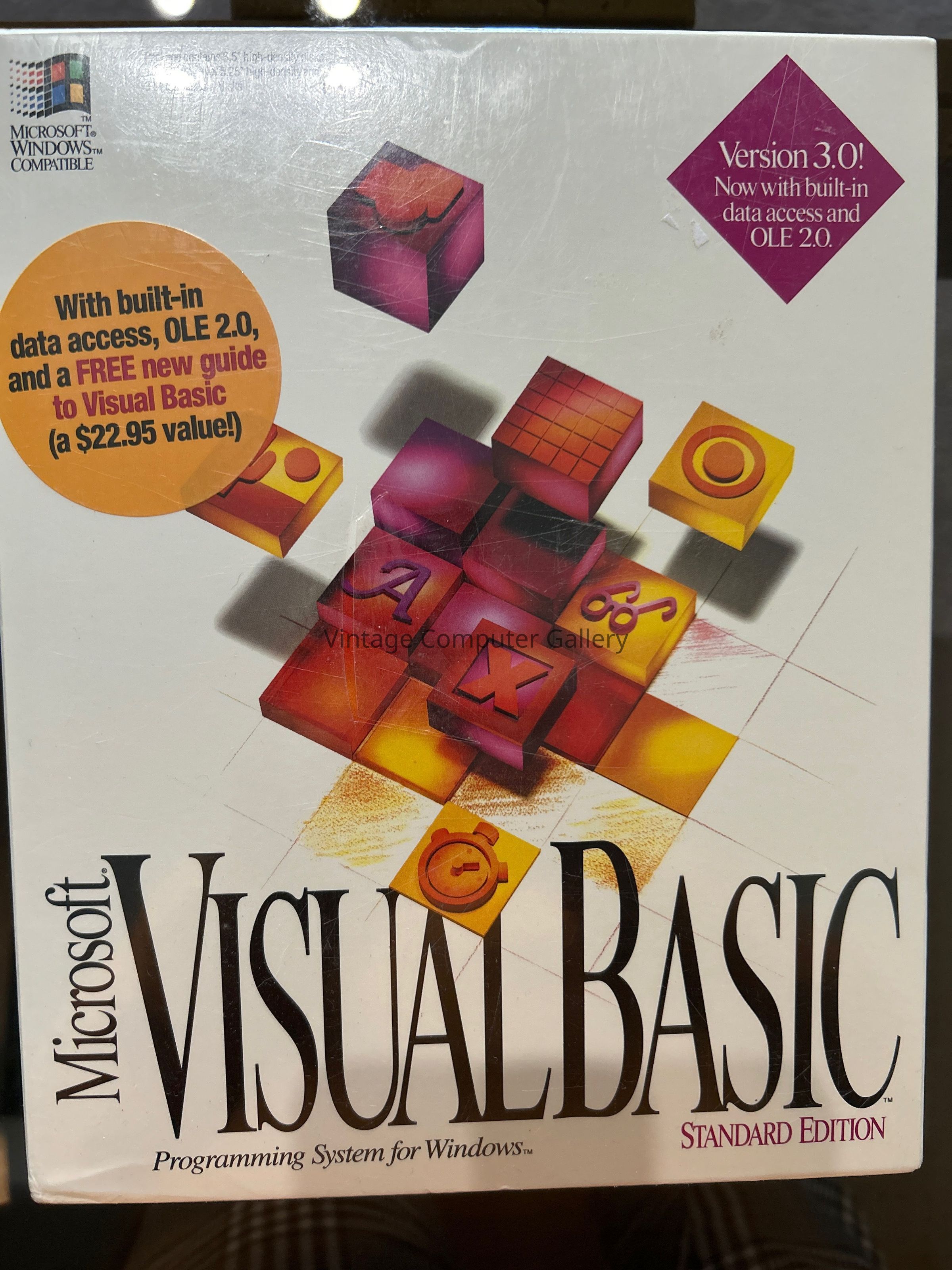
Release Date: Summer 1993, specifically around mid-1993 for Windows.
Platforms: Designed for Windows 3.0 and 3.1, with compatibility for Windows 3.1x environments.
Editions: Available in two editions:
Standard Edition: For general-purpose Windows application development.
Professional Edition: Included advanced features like database tools, additional controls, and Crystal Reports for report generation.
VB 3.0 was not part of the Microsoft Office suite but was often used alongside it for custom application development, particularly for integrating with Access databases.
Key Features
VB 3.0 introduced several features that made it a powerful and accessible development tool:
Database Integration:
Introduced the Jet Database Engine (shared with Microsoft Access), enabling robust database connectivity.
Support for ODBC (Open Database Connectivity) allowed connections to external databases like SQL Server.
The Data Control simplified binding forms to databases, letting developers create data-driven apps with minimal code.
Improved Form Designer: Enhanced drag-and-drop interface for building GUIs, with better control over form layouts and properties.
New Controls: Added controls like the Grid Control, Combo Box, and List Box, expanding UI possibilities.
Crystal Reports: Included in the Professional Edition, enabling sophisticated report generation from database data.
Code Enhancements:
Improved event-driven programming model, making it easier to handle user interactions.
Support for dynamic-link libraries (DLLs) and custom controls (VBXs), allowing developers to extend functionality.
Performance: Optimized for 16-bit Windows, with better memory management than VB 2.0.
Setup Wizard: Simplified application deployment by generating installation packages.
System Requirements
OS: Windows 3.0 or 3.1.
CPU: 286 or higher (386 recommended).
RAM: 2 MB minimum (4 MB recommended).
Storage: ~10-15 MB for installation, depending on edition.
Display: VGA or better for the graphical IDE.
Significance and Legacy
VB 3.0 was a game-changer for developers, particularly for small-to-medium businesses, as it democratized application development with its intuitive IDE and database capabilities. Its integration with the Jet engine and ODBC made it a go-to tool for creating data-centric applications, such as inventory systems or customer management tools. The ability to use VBXs fostered a vibrant third-party control ecosystem, enhancing its flexibility.
This version cemented Visual Basic’s reputation as a beginner-friendly yet powerful tool, bridging hobbyist and professional development. It was widely used until the mid-1990s when VB 4.0 (1995) introduced 32-bit support for Windows 95. VB 3.0’s influence persists in modern RAD tools, and its simplicity inspired later frameworks like VBA and VB.NET.