Name/Title
World War II Sons in Service FlagEntry/Object ID
40.11Description
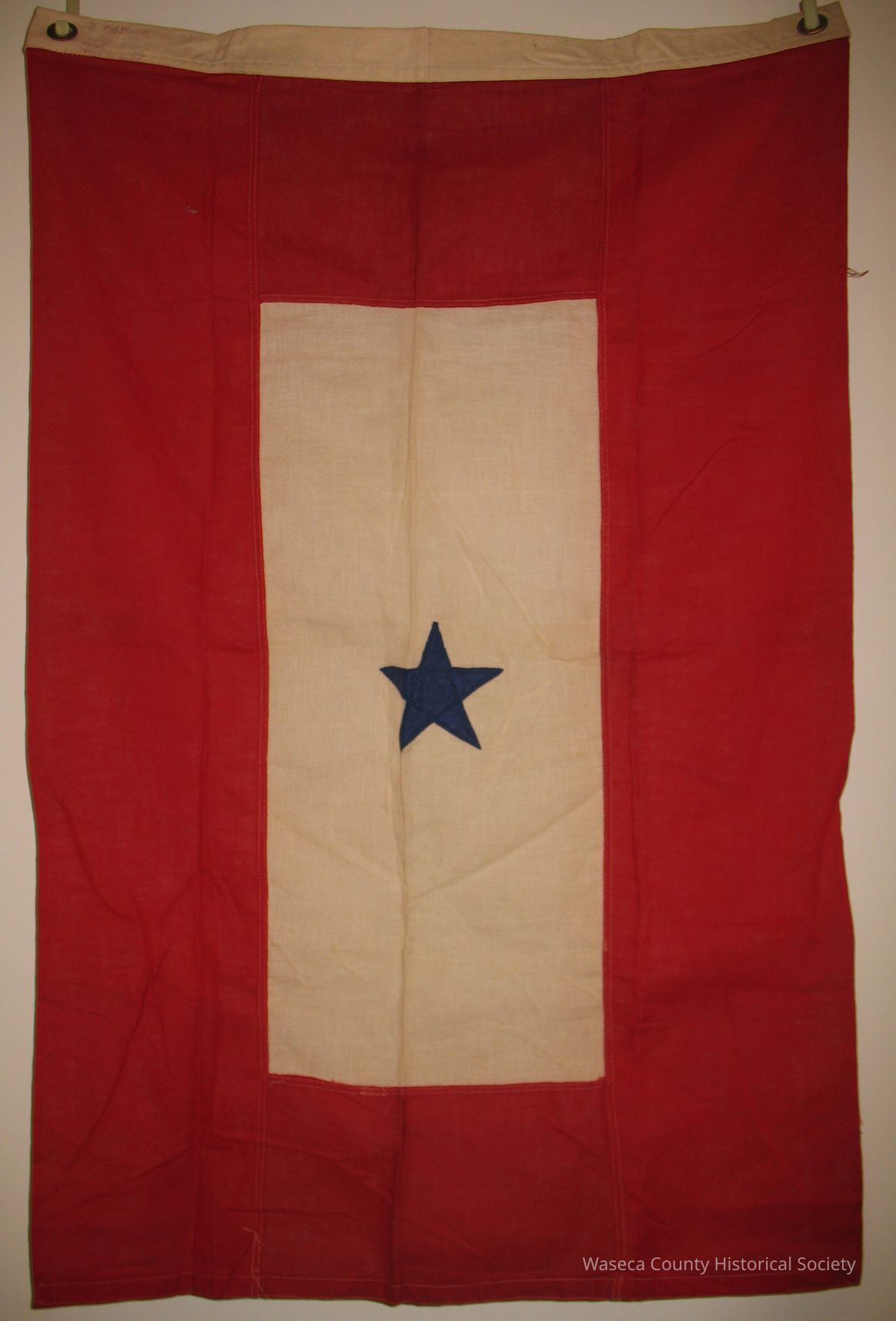
World War II Sons in Service Service Flag. Material: textile, metal. Size: 21 3/4" x 35". Description: red cotton; rectangular shaped flag; white cotton canvas center strip provide backing for one felt blue star; white edging holds two 7/8" W. metal rings for hanging in vertical position.Context
Flag found in Orlando & Jennie Didra house: 716 2nd Avenue NE, Waseca, MN. The house was built in 1924. The "Sons in Service" flag was used during World War I and World War II. Each family was entitled to hang a small Son In Service flag in their window, the blue star in the center of the red-bordered white rectangle signified a family member in active service. The star was replaced (or covered) with a gold star (in practice, yellow or dark yellow) if the family member died in action. (Hence the name of the organization "Gold Star Mothers" of women who had lost sons in the war.) There were other variations to the star for missing in action, injured, captured, etc, etc, but flags of that sort are rarely, if ever, seen.
Sons in Service flags made and used by families usually were no larger than about one foot long. They were always hung vertically, a stick being sewn into the top heading of the flag and a piece of string attached to both ends of the stick - the string suspended at its midpoint from a hook or some other feature of a front window of the home.
If a family had a husband and a son, or multiple family members in the service of their country, then additional blue stars were set into the white rectangle. Organizations and corporations extended this practice to fly flags incorporating stars for each of their members/employees who were off to war and, of course, would change/overlay the blue stars with gold ones when the news came back that one of theirs had died in action. These larger flags (I have one with some 50 stars in a circle, a quarter of them in gold, measuring about 8 feet long overall) were sometimes flown outside on a pole, but most often were suspended from the ceiling of the factory / meeting hall indoors.
It is not always easy to determine a date for these flags, though I believe that WW I era flags were more likely to be made of wool, and WW II flags usually were sewn of cotton bunting. However, they are definitely no older than 1917, the date of entry of the USA into WW I.Cataloged By
vanessaLexicon
Nomenclature 4.0
Nomenclature Primary Object Term
FlagNomenclature Sub-Class
Organizational ObjectsNomenclature Class
Ceremonial ObjectsNomenclature Category
Category 08: Communication ObjectsCreate Date
May 31, 2011Update Date
October 14, 2026