Scope and Content
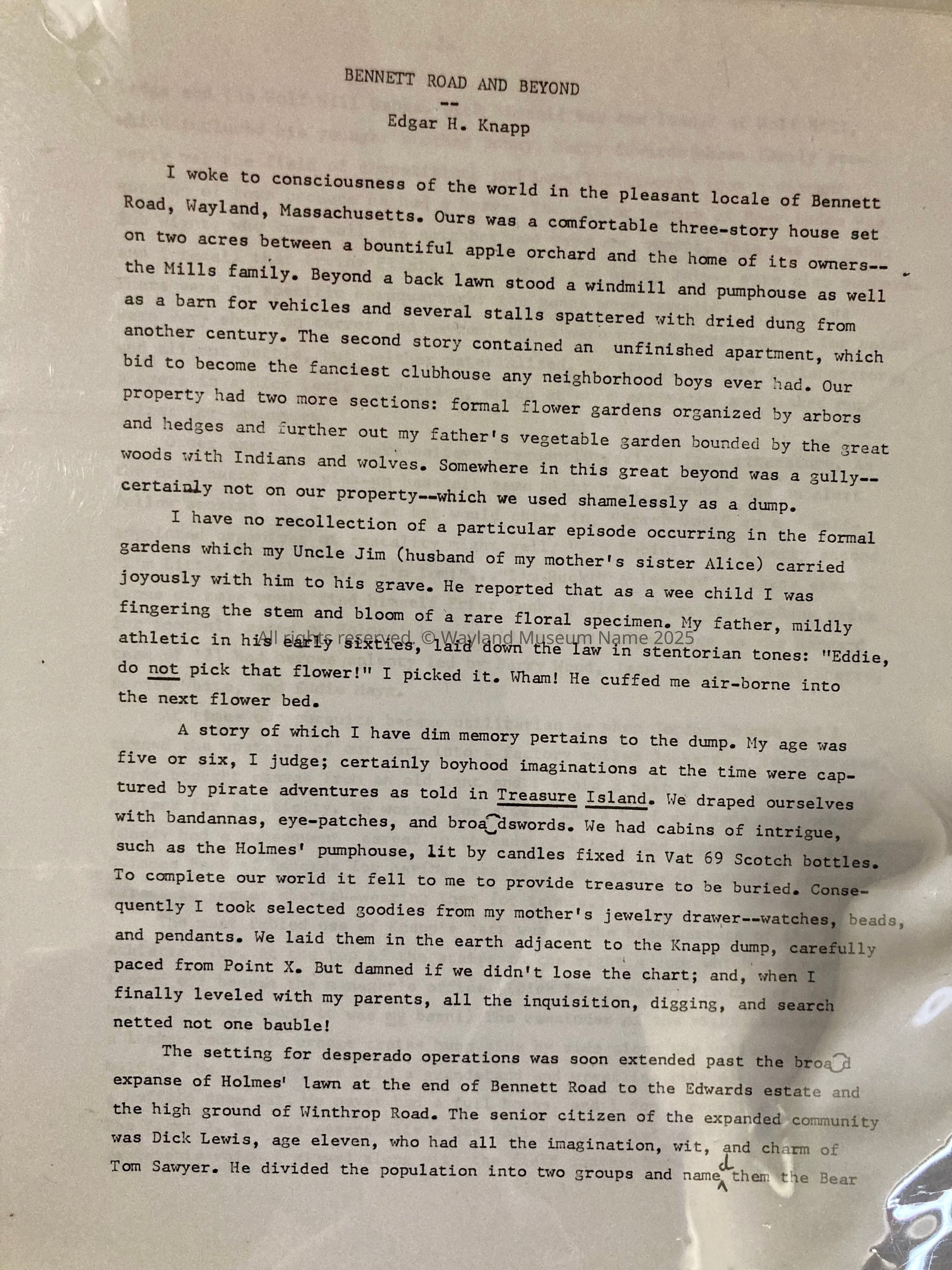
Typescript reminiscence (4+ pp.) of a Wayland boyhood on Bennett Road, c. 1930. Knapp recalls unstructured, child-organized outdoor play: a treasure hunt gone wrong at the neighborhood dump, pirate and Robin Hood make-believe drawn from books, neighborhood “gangs” (Bear Ledge and Wolf Hill), and homemade enterprises in the Knapp barn, including the “Tiger Athletic Club” (a boys’ baseball club with a manager’s office, orange-crate lockers, and a wrestling ring) and “Jockstrap, Incorporated.” Names local children (Dick and Sonny Lewis, Marty Edwards, Bob Wight, Gordy Holmes) and pickup-ballgame customs (“Scrub!”). Includes a tour of 1930s town-center landmarks along Routes 20 and 27: the Unitarian church, Tom Barr’s store, the post office, Collins Market, and the Wayland Free Public Library, with period detail on party-line telephone numbers, commuter trains from Boston, and a framed photograph of the town’s World War I veterans. Closes reflecting on how adult-organized activity gradually replaced self-invented play. A first-person written counterpart to the 1950s WHS History Project oral histories, documenting Wayland childhood, recreation, and daily life a generation earlier.
Here are the sport and play passages from the Knapp typescript, transcribed as written (his own typos preserved). Verify against the original before any public use.
**The pickup-baseball / kid-run teams beat (p. 3):**
> "None of the groups could field nine players without mothers and older brothers. Dick Lewis, where were you when we needed you, to allign two teams to play a best-of-seven series?"
with the two rival clubs named: "Gorilla" Wheeler's squad from the Sudbury River marshes and "Fireballing" Howard Harrington's club from the Mill Pond section.
**The pickup-game call-out custom (p. 2):**
> "As the originator of a pick-up baseball game might cry, 'Scrub!' and an alert fellow seeking the second at bat would chime in, 'Scrub One!'"
**Football on Holmes' lawn (p. 2):**
> "The pecking order for football games on Holmes' lawn could be less competitive as the Harvard team of '31 had heroes aplenty led by Barry Wood, Jack Crickard, Jack Sherry, Bernie White, and Eddie Mays."
**The Tiger Athletic Club, the boys' barn "club" (p. 2):**
> "The most fabled use of Knapp's barn was as the headquarters of the Tiger Athletic Club. At the top of the stairs to the right, a room which was partitioned off became the manager's office... The remainder of the right side became a locker room with orange crates hung side by side along the walls. The other half of the second floor held a grandstand and wrestling ring with ropes and a buffalo robe mat. We never had a full house, and I don't recall any wrestling. The Tiger A. C. was essentially a baseball club."
**"Jockstrap, Incorporated" and the tennis close (p. 2):**
> "Of course, I ended my career in jockey shorts, wearing them for tennis."
**The bicycle-to-swimming line (p. 3), the one that ties two wheels → town beach → the fields:**
> "A second triumph of technology that widened my world was the bicycle! During ensuing summers, with baseball glove and swimming trunks adangle, I pedalled further west and north, making new friends and discovering new places, principally the school athletic fields and Baldwin's Pond, the murky depths of which we'd heroically plumb."
**The thesis close (p. 4), play giving way to adult-arranged sport:**
> "Our doings were, of course, play-centered, and the design of the fabrications was our own. During the second decade of our lives we were coaxed over hurdles and through hoops arranged by adults. We became accustomed to being audience rather than doers."
Two flags carried over: the "Guinness Book of Records" zipper line about Gordy Holmes is memoir
embellishment, don't harden it; and "Bob Wight" / "Robert Wight" is a Bennett Road neighbor.