Name/Title
CalashEntry/Object ID
C430Description
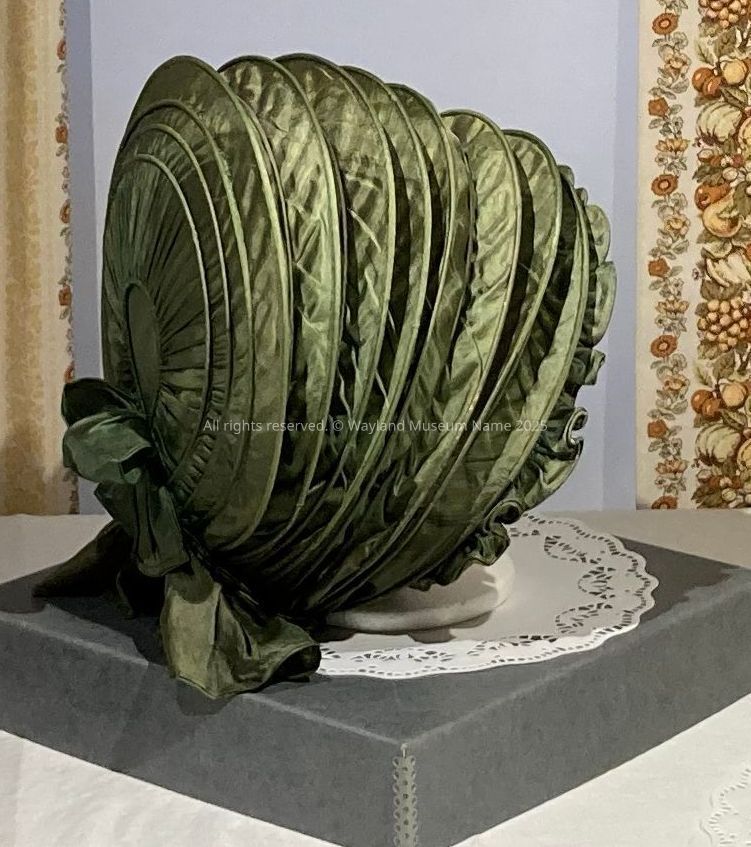
Green, 8 rings of reed, white lawn lining, 12" height, 4" flounce in back with matching bow, cream colored with pink splashes ties not original to hat. Hand made with silk thread.
Condition: Faded, very worn.
____
Lydia Maria Child's Calash
The Wayland Museum & Historical Society holds a green silk calash bonnet that once belonged to Lydia Maria Child. Dating to around 1820, it may have been part of her wedding trousseau when she married David Lee Child in 1828. With its eight rings of reed, twelve-inch height, and cream-colored ties with pink splashes, it is now faded and worn—but it has been carefully refurbished and remains a prized possession of the collection.
A calash was a practical item: collapsible, designed to protect elaborate hairstyles from weather while meeting expectations of modesty. But for Child, the hat became something more. As she aged, she refused to replace it. When friends questioned her preference for dowdy headgear, she reportedly said she would buy a new bonnet when the war was over—and then, after the war ended, when all the freedmen had homes and spelling books. What she wore should not matter, she insisted. What mattered was the person wearing the hat.
Child moved to Wayland in 1853 to care for her ailing father and stayed until her death in 1880. By then she had already sacrificed a best-selling writing career for abolition, publishing Appeal in Favor of that Class of Americans Called Africans in 1833—a book calling for immediate emancipation, an end to racial prejudice, and respect for African culture. Her former admirers abandoned her. Her income vanished. She pressed on.
She became the first woman to edit a newspaper dedicated to public policy, the National Anti-Slavery Standard. Her "Letters from New York" attacked urban poverty, unjust prisons, capital punishment, the oppression of women, and ethnic and religious persecution. She corresponded with John Brown after his raid on Harpers Ferry, offering to care for him in prison. In 1865, she published The Freedmen's Book to support newly emancipated people in building lives and literacy.
She is honored at the National Women's Hall of Fame, the National Abolition Hall of Fame, and the Smithsonian National Museum of African American History and Culture, one of the few white people, and the only woman, featured there for contributions to the abolitionist movement.
As America marks 250 years, Child's calash invites us to ask: What does it mean to live by one's principles? Whose liberty has required others to sacrifice comfort, income, respectability? And what work remains unfinished?Context
Belonged to Lydia Maria Child (1802 - 1880)Collection
Costume CollectionAcquisition
Source (if not Accessioned)
Damon, MabelNotes
Given to Damon family by Lydia Maria Child. May have been part of Mrs. Child's wedding trousseau.Clothing/Dress/Costume Details
Article of Clothing/Dress/Costume
HatClothing Sex
FemaleRelationships
Related Person or Organization
Person or Organization
Child, Lydia Maria (Francis)Provenance
Notes
Given to Damon family by Lydia Maria Child. May have been part of Mrs. Child's wedding trousseau.Exhibition
Red, White, and “I do”